Fuel crisis: Govt policies insulated consumers
When the Strait of Hormuz shut to commercial shipping in late February, global oil markets did what they always do: panic first, adjust later. Brent crude surged from the low $80s to well above $115 per barrel in a matter of days, briefly spiking higher as traders priced in the possible disruption of nearly a fifth of global supply. Freight costs jumped, insurance premiums surged, and LNG prices followed suit. In much of the world, that volatility travelled quickly and visibly to the consumer.
In the United States, gasoline prices rose within weeks, with several regions seeing double-digit percentage increases at the pump. Across Europe, where energy costs were already structurally elevated, the shock was sharper. Governments scrambled for the second time in barely six years after COVID to cushion households with subsidies, tax cuts, and fiscal transfers. This has become a familiar cycle in advanced economies: allow prices to spike, then compensate after the fact, at high fiscal cost and political discomfort.
India did not follow that script. And it is worth stating plainly, the Ministry of Petroleum and Natural Gas managed this crisis with a level of control and effectiveness that deserves far more recognition than it has received.
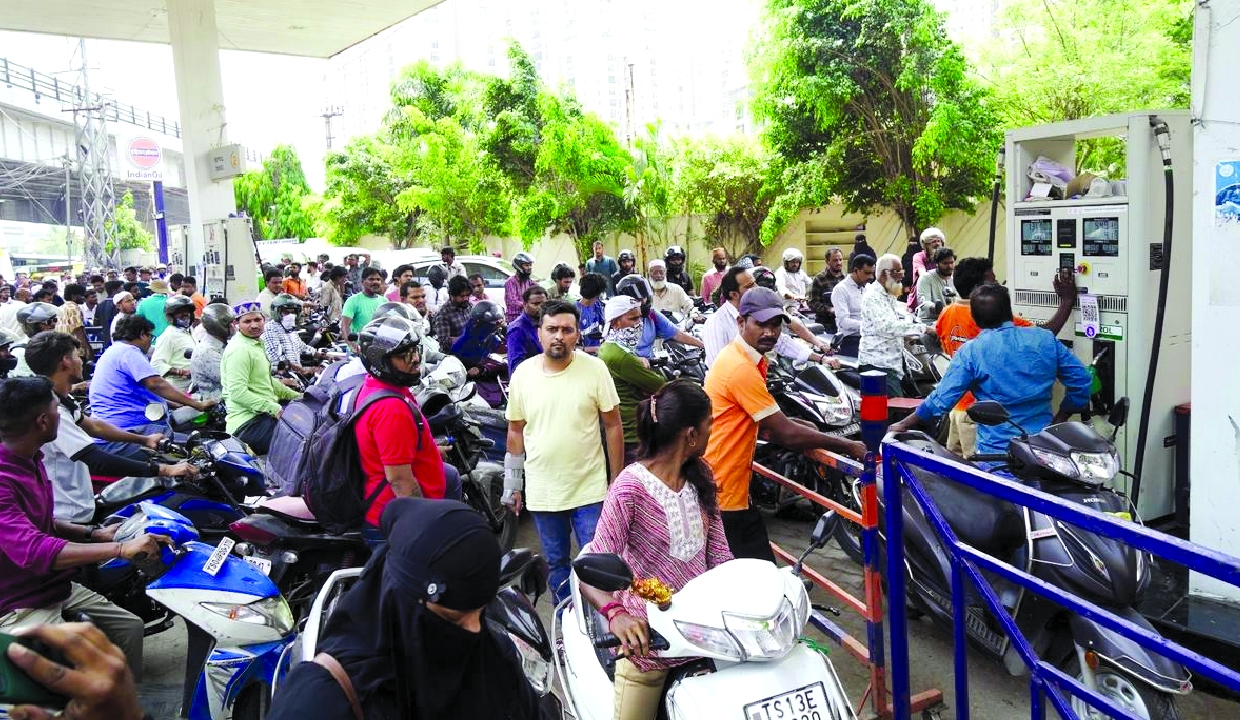
While global crude prices surged, Indian consumers saw remarkable stability. Petrol and diesel prices did not mirror international volatility. LPG remained accessible at subsidised rates. There were no widespread shortages, no visible panic buying, no breakdown in distribution. In a crisis defined globally by price shocks, India delivered continuity. This was not luck. It was policy.
The government made an explicit choice to shield consumers and then implemented it through coordinated intervention. Excise duties were adjusted. Oil marketing companies were required to absorb under-recoveries. Supply chains were actively managed. The state, in effect, stepped in as a shock absorber between global markets and domestic consumers.
The cost of that decision was substantial. OMC losses during the disruption are estimated at `35,000-`40,000 crore, as fuel continued to be sold below import parity. LPG subsidies alone added another `20,000-`25,000 crore in burden over three months, with Ujjwala beneficiaries paying `642 for cylinders that would otherwise have cost upwards of `1,600. Add to this the revenue foregone on fuel taxes, and the total fiscal impact comfortably crosses `1 lakh crore.
Critics will point to these numbers and ask whether such intervention is sustainable. That is a legitimate question. But it is also, in this context, the wrong first question.
The first question should be — did the system work? On every observable metric, it did. Fuel was available. Pumps did not run dry in any sustained way. LPG cylinders reached households without prolonged disruption. There was no cascading panic, no hoarding-driven shortages, no visible breakdown of distribution networks. The system absorbed a global shock and delivered domestic stability over a 100-day disruption in one of the world’s most critical energy corridors.
That outcome stands in stark contrast to much of the developed world, where consumers were often deliberately exposed to price volatility as part of market adjustment. In India, that volatility was contained.
It is fashionable in some circles to dismiss such outcomes as inevitable or to attribute them to favourable circumstances. That reading does not withstand scrutiny.
India entered the crisis with roughly 60 days of crude reserves and about 45 days of LPG reserves. These were not symbolic figures; they were operational buffers that allowed time for rerouting and adjustment. Domestic LPG production was ramped up from around 35 TMT per day to approximately 54 TMT per day, with refineries reconfigured to maximise output. Supply chains are adapted in real time, drawing on a diversified supplier base that now spans over 40 countries.
None of this was improvised in February. It was the result of decisions taken over a decade, expanding import infrastructure, diversifying sourcing, and building redundancy into the system. When the stress came, that system behaved exactly as it was designed to. And yet, much of the commentary in India chose to look elsewhere. The early weeks of the crisis were marked by familiar alarmism. Estimates of exposure were inflated. Worst-case scenarios were presented as baseline outcomes. Images of petrol queues from decades past resurfaced. What was largely absent was the most basic journalistic exercise: verification.
A reporter visiting petrol pumps or speaking to LPG distributors would have found a far less dramatic reality. Prices were holding. Supplies were arriving. Inventories were fluctuating but not collapsing. The story, in other words, was not of failure narrowly avoided, but of a system functioning under stress.
That distinction matters. It shapes public behaviour. Panic narratives create the very shortages they predict; accurate reporting prevents them.
Instead, much of the coverage remained trapped in speculation about what might happen, what could go wrong and what failure would look like. Meanwhile, what was actually happening on the ground went underreported.
This is not merely a media critique. It obscures something more important: the nature of State capacity. Crisis management is not about dramatic announcements or visible heroics. It is about preventing disruption from becoming visible in the first place. It is about ensuring that a global supply shock does not translate into a household crisis. By that standard, the Ministry of Petroleum and Natural Gas delivered.
It did so without resorting to the most visible tool available to other major economies: large-scale strategic reserve drawdowns. The United States released nearly 80 million barrels from its reserves. European countries coordinated similar, if smaller, actions. India relied instead on a combination of diversification, fiscal intervention, and operational control. This approach is not without trade-offs. The fiscal burden is real. OMC balance sheets will need repair. There is a broader question about whether suppressing price signals delays necessary market adjustments.
But those are second-order debates. The first-order fact is simpler: in the middle of a severe global disruption, Indian consumers were insulated from both price shock and supply failure.
That did not happen by accident. It happened because the government chose to prioritise stability, and had the administrative capacity to enforce that choice across a complex energy system.
In the end, what matters is not the volatility of Brent crude or the anxiety of early commentary, but the lived experience of consumers. Over those 100 days, that experience was one of continuity. Transport functioned. Kitchens ran on gas. Daily life did not reorganise itself around fuel scarcity or price spikes.
In most countries, that would have been considered a significant policy success. In India, it barely registered as such. It should have. Because when a system absorbs a global shock of this magnitude without transmitting it to its citizens, that is not the absence of crisis. It is the presence of competence.