Free Seats or not? MoCA’s Gambit
“There is no such thing as a free lunch,” a top airline executive told me yesterday, when we chatted about the DGCA’s new diktat about ‘60% free seating on board’. It’s the first time in a long time that I found myself agreeing with the DGCA and MoCA, whom I have otherwise been critical of.
The airline body, the Federation of Indian Airlines, has written to the Government on behalf of all airlines to protest this, however, they are strangely absent and silent when it comes to passenger complaints against Airlines or abuse of dominance or high passenger fares.
There is no doubt that the FIA have some deep pain points, against the Government, like rampant taxation, varying ATF, lease costs, etc., and they need to resolve it with the Government; but to flay passengers for it, is not the way forward. The Indigo crisis and its aftermath have shown that passengers have had enough. The reason why consumers have not supported Airlines against the Government, is that they feel hard done by the Airlines at every step.
Black swan & profits
“Why are you supporting this?” he asked me, and my mind rushed back to Covid in 2020 & 2021, Diwali of 2024, Russia-Ukraine war, 737 Max grounding, P & W groundings, Revenge travel surge pricing, the AI-171 tragedy and the Indigo crisis of 2025, the current Iran war, and other Black Swan events during the last 8 years. Sadly, the airline Industry, of which I am a part, has not covered itself in glory, often swooping down to flay the poor passenger, reaping windfalls in last-minute fare hikes and surcharges over the past 7 years. In some rare cases, fares going up to as high as 10x during the Indigo crisis and 4x during the AI-171 tragedy. Talking about Covid lockdown airfares, is too long and too painful for far too many people.
However, as if to counterbalance the blow on FIA and its members, the DGCA also issued an order on March 20 lifting the fare-caps which were earlier imposed at the peak of the Indigo crisis. The irony would not be lost on Indian travelers, that caps introduced during a domestic crisis are being lifted at the peak of the Iran war, a global oil crisis the likes of which we have never seen since the 1970s rationing of oil, when some readers were not born.
Questions will be asked-whether this was the correct time to lift the fare caps? Or even whether the DGCA could have waited until the war ended? Moreover, was this the appropriate time to direct the “60% free seat selections” when airlines face an existential crisis?
Cold dark summer
The world is facing a grave threat, as if to add, Airlines are facing the prospects of a bleak summer of international travel, a cutback in operations, a reduction in routes, burgeoning ATF fuel hikes and even possible layoffs. The Air India CEO has gone on record stating that they are operating 30% of the normal Middle East capacity. In our estimates, the aviation market will take a hit of at least 3-5% points on growth in the next two quarters, and operational costs are expected to rise at least 12%-16% more on average with fuel, routes, layovers and landings. The Customer confidence has been dented and unless this war ends now, it will be a dry summer, and we will have to wait until Diwali before the green shoots of traffic recovery appear.
Supreme Court pil
Many missed the Public Interest litigation filed by S Laxminaryanan before the Supreme Court, seeking regulatory guidelines against sharp fare hikes and ancillary charges by Airlines, though it was detailed in the media. On 23/2/26, the bench granted the Centre four weeks’ time to complete its deliberations and inform the Supreme Court. The PIL sought judicial intervention, because of the state's inaction in protecting the consumer. The MoCA & DGCA’s actions were as a consequence of the Supreme Court's decision, thus the FIA’s plea of a HC order on lack of jurisdiction over ancillary charges, in my view, does not hold much water anymore. I would be surprised if any airlines had even impleaded themselves in that PIL, (though they may have lawyers observing), it would perhaps be worth the FIAs' while to intervene in the matter.
Global practices
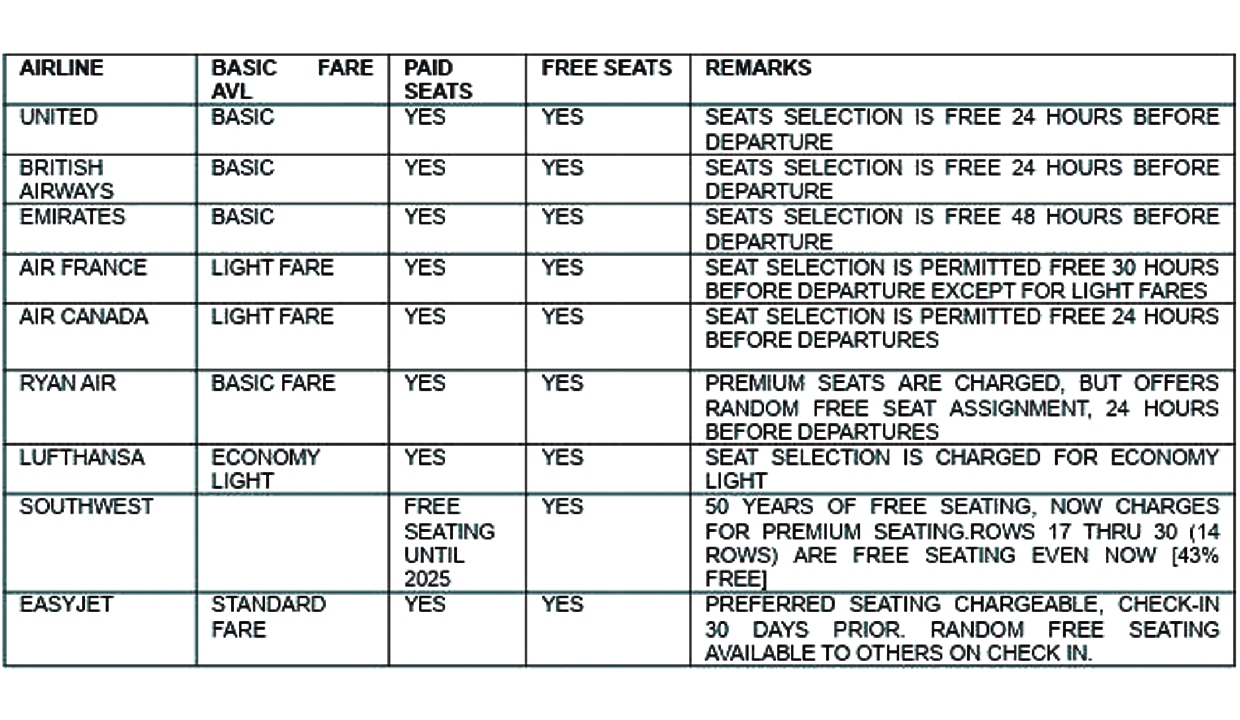
In order to gauge global practices, we surveyed many world airlines, FSC & LCCs and were surprised to find that many of them permitted free seat selection 24 hours prior. (See Table) Even Southwest the big daddy of global Low-Cost Carriers, did not charge for seat selection for 50 years until 2025, and was still hugely profitable. In 2025, they brought in paid seating, but still maintained 14 rows of seats as free seats for passengers on their aircraft.
The US Congressional committee completed an investigation in 2024/2025 on how the US aviation market had been overtaken by “Junk Fees” in American air travel, and how it was affecting the markets.
The committee investigated the Big 5 over two years, and made some findings that (1) the Big 5 are making more money from seat fees than ever before ($12.4 Billion between 2018-2023) [This is despite allowing free seat selection 24 hours in advance] (2) The price of ancillary fees is not tied to each airline’s cost of providing a service (3) The five airlines increasingly rely on algorithms to set the price of ancillary fees and they harvest customer data to determine their prices.
The recommendations of the Congressional Committee were (a) Congress should require airlines to provide more granular fee data to the DOT (b) strengthen fee disclosure requirements (c) The Department of Transportation should investigate potential abuses in the use of incentive-based collection of ancillary fees, (d) DOT should prohibit unfair and deceptive practices, and assess civil penalties if appropriate (e ) The Department of the Treasury should examine whether current airline ancillary fee practices comply with rules about applying the transportation tax Airfare deregulation in India began in 1994 and since then airfares have risen time and time again, every Oil / ATF price hike have made a new benchmark platform for fares. The unbundling of air fares began in 2007, with the advent of the LCCs in India, the DGCA allowed the gradual unbundling of fares and ancillary services.
The preferred seating modules entered Indian aviation as a norm by 2011/12, and DGCA’s first guidelines on Seat selection came about in 2015, and then expanded into the drip pricing framework, where everything else was part of revenue generation.
Circular no 3/2015 set out the framework for ancillary seat revenue allocation, with an “opt-in “model and “regulatory oversight”.
The DGCA did not cap seat selection prices, and therein perhaps lies the source of angst on all sides, passenger, government, and airlines. The DGCA, in its wisdom, retained the power to step in in case the charges were non-transparent, discriminatory and unfair, as they have appeared to have become in recent times. There are cases where the seat selection costs vary from Rs 350 to Rs 2000 on a Rs 6000 fare, almost 20% of the basic fare, which is absurd. The new norm of 60% free seats, is just the DGCA reverting its earlier permission, partially, that too on a suggestion of the apex court.
Price cap or seat cap?
Has the time has come for the capping of seat selection? or is an overall fare cap required?
In our opinion, airlines must be free to charge their own fares, in the pursuit of profit, given the tough markets they operate within, however there has to be a bandwidth within which this freedom operates. Airlines & FIA have failed to self-regulate themselves, there needs to be a monitor or an Aviation Ombudsman, who will protect both the airline and passenger. India is a nation where the air passenger charter is not worth the paper it is written on, when compared to the EU - 261/2004 or the UK-261 rules, and there has been no Passenger body who has taken up cudgels on behalf of the passengers in the country, before the Government or the courts, most of them are self-serving groups. Passengers have to fight their own battles or rely on lone-wolf PILs. The time has come to restructure the passenger charter and the reframe the DGCA as an independent CAA-style regulator.
The way forward
The way forward to resolve the “Free Seat” deadlock, is to possibly reach a middle ground of 50% of seats for free and the balance to be charged, subject to 24 hours before the flight, where it must be open to all passengers to choose their seats.
There should be a cap on the percentage of basic fare that can be charged as a “seat selection fare,” which should not exceed 10% of the fare. The threat of fare hikes by the FIA will be counterproductive, since it could result in a three-way face-off with the Government, the Judiciary and the Regulator.
The consumer is the goose that lays the golden eggs, and the Airlines and Government must realise it and handle them with care. No corporate is running an airline for charity, yet airline operators bear the biggest burden to not only act responsibly, but seen to be acting transparently and fairly. It is, after all, the ultimate customer-facing hospitality industry.
Sanjay Lazar is CEO Avialaz consultants & an Aviation expert; Views presented are personal.