Flavours in a season of stillness
On most festivals, devotion gathers around abundance. Platters expand, kitchens grow fragrant with spice and ghee, and hospitality is expressed through generosity. Devshayani Ekadashi asks for something different. It turns the act of eating inward. The ingredients become fewer and the appetite more disciplined, yet the culinary imagination remains remarkably alive. In homes across India, ordinary grain is set aside and humble ingredients such as barnyard millet, amaranth, tapioca, peanuts, sweet potato, water chestnut, milk and fruit are transformed into dishes that nourish without overwhelming. The cuisine of this Ekadashi, therefore does not contradict fasting. It reveals how restraint itself can acquire flavour, texture, regional identity and spiritual meaning.
Observed on the eleventh day of the bright fortnight of the Hindu month of Ashadha, Devshayani Ekadashi marks the moment when Lord Vishnu, the preserver and sustainer of the universe, is believed to enter yoganidra upon Shesha in the Ksheer Sagar. This divine sleep is not understood as ordinary rest, but as a state of cosmic meditation in which Vishnu continues to uphold creation while withdrawing from outward activity. The observance is therefore a reminder that stillness does not mean absence, and that spiritual strength is often renewed through contemplation. Known variously as Shayani Ekadashi, Hari Shayani Ekadashi, Padma Ekadashi and Ashadhi Ekadashi, the day holds particular importance for Vaishnav devotees, who worship Vishnu and his forms, including Vitthal, with fasting, prayer, bhajans, temple visits and the recitation of sacred texts.
The festival is celebrated to seek Vishnu’s grace, cleanse the mind of excess and begin a period of greater spiritual discipline. The Ekadashi fast is not merely an avoidance of certain ingredients. It is intended to regulate the senses, reduce attachment and redirect the time and energy usually devoted to consumption towards devotion, charity and self-examination. Devshayani Ekadashi also inaugurates Chaturmas, the four sacred months extending until Prabodhini Ekadashi in Kartika, when Vishnu is believed to awaken. During this period, many devotees undertake personal vows, simplify their diets, avoid unnecessary indulgence, study scripture and intensify acts of service. Major Hindu ceremonies such as weddings are traditionally limited in many communities, allowing the season to become one of inward renewal. As the monsoon transforms the landscape outside, the devotee is similarly encouraged to cultivate humility, patience and moral clarity within.
The vrat katha traditionally linked with the observance tells of the righteous King Mandhata, whose kingdom suffered a devastating drought. Seeking relief for his people, the king was guided towards the disciplined observance of Ashadha Shukla Ekadashi. The fast was undertaken with faith, after which rain returned and the land recovered. The narrative connects zappetite with responsibility. The ruler does not respond to scarcity with personal excess, but accepts restraint on behalf of his people. This is especially meaningful in Ashadha, when the monsoon determines sowing, water security and the agricultural future of communities.
Nowhere does the day acquire a more visible public life than in Maharashtra. Here, Devshayani Ekadashi is inseparable from the Pandharpur Wari and the worship of Vitthal and Rukmini. Warkaris travel on foot in organised dindis, singing abhangas, carrying saffron flags and accompanying the palkhis that bear the padukas of saints such as Dnyaneshwar and Tukaram. The routes from Alandi and Dehu gather people from different regions and social backgrounds into a moving fellowship of devotion, eventually reaching Pandharpur on the banks of the Chandrabhaga.
The journey carries forward the Warkari emphasis on humility, collective discipline, remembrance of the divine name and equality before Vitthal.
Food along this spiritual landscape must sustain pilgrims during an arduous monsoon journey while respecting the control demanded by Ekadashi. Some devotees observe nirjala vrat without water, some consume only fruit and milk, while others eat one carefully regulated meal. Customs differ by family, region and sampradaya, but grains, cereals and pulses are widely avoided. Ordinary salt may be replaced by sendha namak, and onions, garlic and heavily stimulating spices are usually excluded. There is therefore no single compulsory Devshayani Ekadashi menu, but a family of regional fasting cuisines expressing the same principle: the body may be supported, but desire should not command the day.
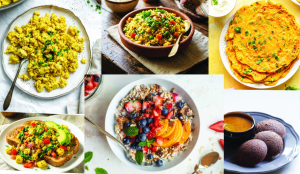
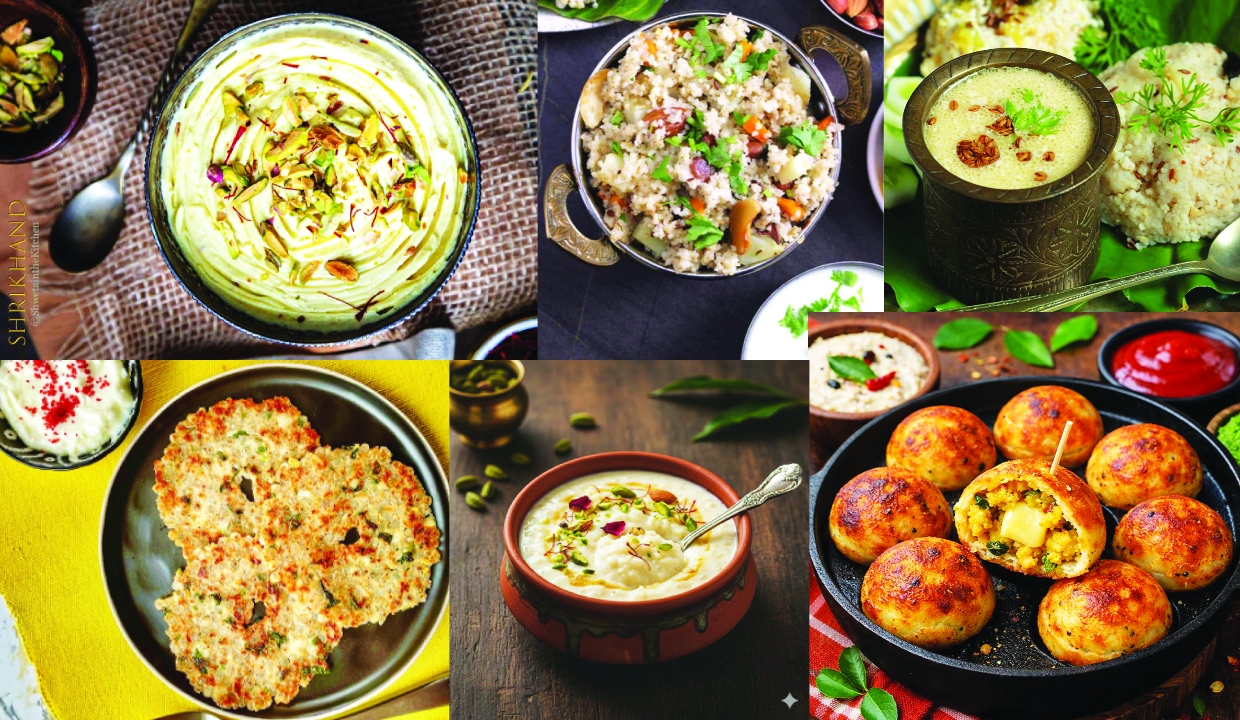
In Maharashtra, the most meaningful place to begin is Varyacha Bhat, also called Bhagar. Despite its rice-like appearance, it is prepared from barnyard millet, known by several regional names including vari, samo and moraiyo. The tiny seeds are washed and lightly roasted or cooked in ghee with cumin before being simmered until tender. Some households keep it plain, while others add peanuts, green chilli or coconut within their vrat practice. Its gentle flavour makes it an ideal base for Danyachi Amti, a fasting curry made from roasted ground peanuts. The peanut powder is loosened with water and simmered with cumin, chilli, a little jaggery or sugar and sourness from lemon or kokum, depending on household custom. Together, bhagar and danyachi amti form a complete meal that is earthy, warming and unmistakably Maharashtrian.
The familiar sabudana pearl also takes on a more distinctive form in Sabudana Thalipeeth. Soaked tapioca is mixed with mashed potato, coarsely crushed roasted peanuts, cumin, green chilli, coriander and vrat salt. Instead of being stirred in a pan, the mixture is patted into a flat round, usually on a damp cloth or sheet, then transferred carefully to a hot griddle. A work small hole pressed into the centre allows ghee to spread as the thalipeeth cooks. The surface becomes crisp while the inside remains soft and pleasantly chewy. Served with plain curd or a cucumber and peanut koshimbir, it offers more character than the ubiquitous sabudana khichdi and remains closely associated with Maharashtrian fasting kitchens.
Another preparation suited to the damp Ashadha season is Ratalyacha Kees. Sweet potato is peeled and coarsely grated, then cooked gently in ghee with cumin, green chilli and roasted peanut powder. Fresh coconut may be folded through at the end, while lemon brightens its natural sweetness. It occupies the appealing middle ground of fasting cuisine, with sweetness from the tuber, heat from chilli and crunch from peanuts. Sweet potato also helps produce Upvasache Ghavan, a thin savoury pancake made by combining rajgira or another permitted fasting flour with water, cumin and chilli. Poured onto a hot pan like a delicate crepe, it cooks quickly and is eaten with curd, coconut chutney adapted for the vrat or a spoonful of danyachi amti.
A thicker griddle bread appears as Rajgira Thalipeeth. Amaranth flour is bound with boiled potato or grated sweet potato because it contains no gluten, then seasoned with cumin, chilli and coriander. The dough is pressed directly by hand rather than rolled, and ghee gives the edges a nutty crispness. Amaranth moves easily between savoury and sweet forms, allowing one pantry staple to serve several ritual needs.
As the observance extends beyond Maharashtra, the vocabulary changes but the discipline remains recognisable. In Gujarat, Farali Pattice brings refinement to the fasting plate. Mashed potato forms the outer covering, while the centre holds a sweet, sour and mildly hot mixture of grated coconut, crushed nuts, raisins, green chilli and lemon. The stuffed patties are shallow-fried or fried until golden and served with vrat-friendly coriander or coconut chutney. Their contrasting textures make them festive without grain or pulses. A lighter Gujarati companion is Farali Chevdo, in which thin potato strips, peanuts, cashews, coconut chips and sometimes makhana are fried or roasted separately and tossed with rock salt, chilli and a touch of sugar. It stores well and travels easily, making it useful during fasting.
In northern and western Vaishnav households, Singhare ki Kadhi provides the comforting sharpness of a traditional kadhi without gram flour. Water chestnut flour is whisked into curd until smooth, diluted and simmered gently with sendha namak and restrained seasoning. A tempering of ghee, cumin and chilli adds aroma without disturbing the simplicity of the dish. Some families add small singhara-flour dumplings. The kadhi can accompany rajgira flatbread or sama, adapting a familiar dish to Ekadashi restrictions.
Sweet dishes are not included merely as rewards after austerity. Many are made from the same ingredients that sustain the savoury meal, reinforcing the economy and coherence of the vrat kitchen. Varyachi Kheer transforms barnyard millet into a creamy dessert by slowly cooking it in milk until the seeds soften and the liquid thickens. Cardamom, saffron and a modest quantity of sugar or jaggery provide fragrance, while nuts add texture. Sabudana Kheer works differently. The translucent pearls swell in milk and create a softer, silkier consistency, often finished with cardamom and raisins. Both are gentle enough for the restrained meal yet festive enough for naivedya.
The dry sweets are especially useful when food must be prepared in advance. Rajgira Laddoo is made by binding popped amaranth with warm jaggery syrup, producing light, crisp spheres with a deep caramel note. Shengdana Laddoo uses roasted ground peanuts combined with jaggery or powdered sugar and ghee. Its richness makes a small portion satisfying. Coarsely crushed peanuts may be left visible to preserve a rustic bite. Sweet potato returns in Ratalyacha Sheera, where it is boiled or grated, then cooked with ghee, milk and sugar or jaggery until it becomes soft and glossy. Cardamom and nuts give it the fragrance of a celebratory sheera without requiring semolina. North Indian fasting traditions contribute Singhade ka Halwa, prepared by patiently roasting water chestnut flour in ghee before adding hot water or milk and sweetener. The flour develops a warm, nutty aroma, and the final halwa is dense, smooth and best served in a small portion.
Milk-based sweets further soften the day’s menu. Makhana Kheer begins with fox nuts roasted in ghee, lightly crushed and simmered in milk until they absorb its sweetness while retaining some texture. In Maharashtra, Kelyache Shikran offers an almost effortless alternative: ripe banana is sliced or mashed into milk, sweetened lightly and scented with cardamom. Across coastal Karnataka, a related preparation called Balehannina Rasayana combines banana with jaggery and fresh coconut or coconut milk. It may be served as a pudding, fruit preparation or simple offering, showing how ripe fruit, dairy and coconut create sweetness without elaborate cooking. Beverages remain equally mindful. For those not observing nirjala vrat, coconut water and diluted lemon water offer light refreshment. Milk may be warmed with saffron or cardamom according to household custom. Thin buttermilk, seasoned only with cumin and sendha namak, is preferred by some families, although others avoid it depending on their vrat rules. Kokum sharbat is particularly suited to western India during the humid monsoon, while fresh fruit drinks may be taken without packaged additives. Panchamrit, made from milk, curd, ghee, honey and sugar, belongs primarily to worship and is received in a small sacred portion rather than consumed as an ordinary beverage.
The fast is broken on Dwadashi through parana at the time prescribed by the devotee’s tradition. The purpose is not to compensate with excess, but to receive nourishment with gratitude. That principle gives Devshayani Ekadashi cuisine its quiet power. Every substitution has meaning. Barnyard millet stands where rice would normally stand. Peanut becomes the body of a curry when pulses are absent. Amaranth replaces wheat, sweet potato replaces semolina, and fruit becomes both offering and dessert. Culinary skill does not disappear when the pantry is restricted. It becomes more attentive.
To preserve this heritage, we must do more than circulate lists of “foods allowed during fasting.” We must learn which dishes belong to which regions, record the names used by grandparents, understand why one household eats bhagar while another takes only fruit, and recognise that the strictest fast and the carefully prepared farali meal can both arise from sincere devotion. Children should be invited into the kitchen to pat sabudana thalipeeth, stir danyachi amti, shape rajgira laddoos and hear the story of Vishnu’s yoganidra while the food is being prepared. Families and cultural organisations can document local variations before convenience foods erase them.
Devshayani Ekadashi teaches that civilisation is not sustained only through grand feasts. It is also sustained through the meals people willingly simplify, the ingredients they set aside, the discipline they accept and the recipes through which restraint is made nourishing. When future generations understand not only what was cooked but why it was cooked, the observance will remain more than a date on the calendar. It will continue as a living conversation between devotion, season, memory and the Indian kitchen.
The writer is Secretary, Cuisine India Society; Views presented are personal.