Fighter strength falling, Tejas delays a challenge, says IAF Chief
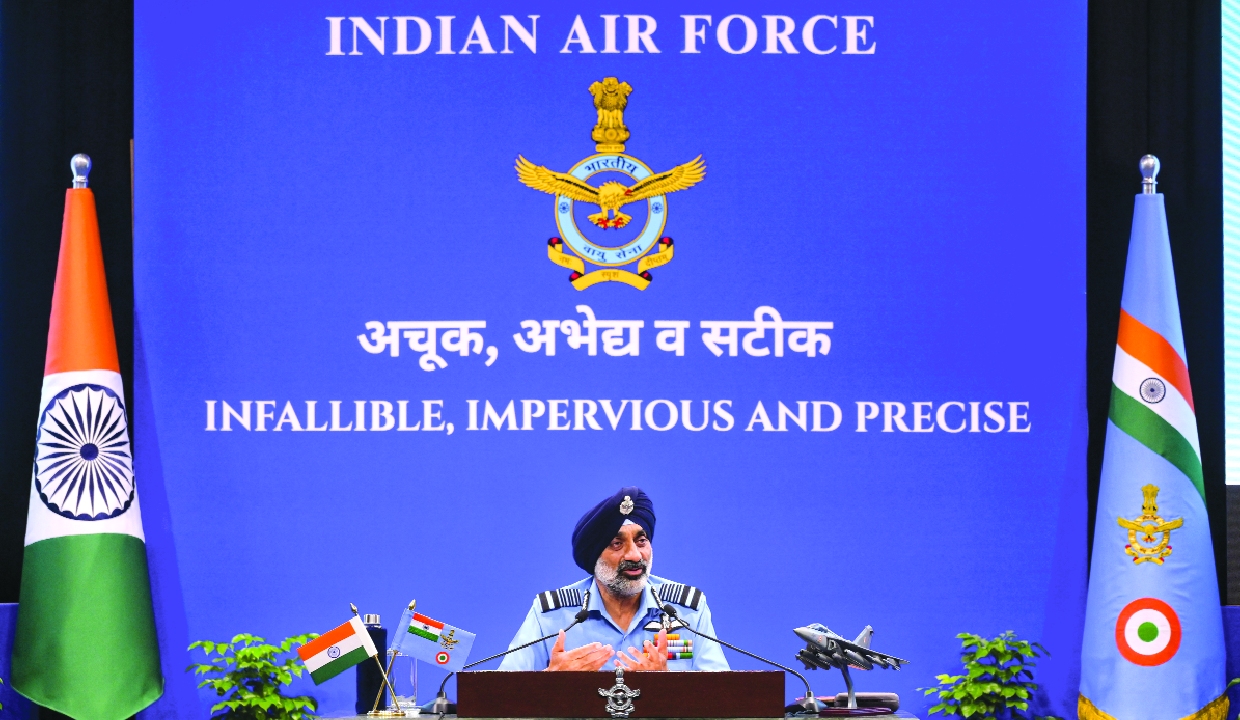
Flagging the depleting strength of the fighter jet squadrons, IAF Chief AP Singh on Saturday said the inordinate delays in the induction of indigenously built Tejas Light Combat Aircraft (LCA) are hurting the force. He also said these factors are a challenge as air power becomes increasingly crucial in addressing security challenges.
Making these assertions during the annual press conference ahead of the 94th Air Force Day on October 8, the IAF Chief said the force requires 36-40 fighter jets annually for the next few years and hoped that the situation will improve with the induction of indigenously built Tejas Mark-1A aircraft as well as Rafale combat jets to be procured under the Multi-Role Fighter Aircraft (MRFA) programme.
At present, the fighter jet squadron strength of the IAF is 30 against the sanctioned strength of 42. One squadron includes 18-20 planes.
The delay in inducting new fighter jets is hurting the Indian Air Force, and the country needs to produce up to 40 aircraft a year to plug capability gaps and build long-term combat strength, Air Chief Marshal Singh said.
He said the IAF is counting on the timely induction of the LCA Mk-1A, new MRFA and additional Sukhoi-30MKIs to shore up its fighter fleet and keep the number of its combat squadrons from falling below 30, while underscoring the need to deploy fifth-generation aircraft too.
“There is some extra delay this time, and there is no doubt that it is going to hurt us,” the IAF Chief said. “We need to induct two fighter squadrons every year. That means we should produce and induct between 36 and 40 aircraft to stop the decline from the current 30 fighter squadrons and start moving toward the target of 42. Actually, we need even more than that.”
He said the IAF could finalise the MRFA contract by the end of the financial year. It refers to the proposed purchase of 114 Rafale fighter jets from France to sharpen the IAF’s combat edge at a cost of roughly `3.25 lakh crore.
“Hindustan Aeronautics Limited (HAL) is talking about producing 20 LCA Mk-1As every year. If the MRFA deal goes through, we will get about 12 aircraft per year from that contract. That makes the number around 32. We also have a contract for 12 Su-30 aircraft.
Let’s say six come in one year and six come in another year, so that we will be in the region of 35-40 aircraft per year. We are hoping that these things will happen and then we will be able to achieve the pace of growth that we have set for ourselves,” the IAF chief said.
Under the proposed MRFA model, French plane maker Dassault Aviation and a local partner will make the Rafales in India. France is expected to supply 20 Rafale jets in fly-away condition while the remaining will be made in India under the Government-to-Government deal.
The LCA Mk-1A is finally nearing induction after missing several deadlines. Both the IAF and HAL are confident that induction will start by year-end. It will replace the IAF’s workhorse MiG-21s, which retired last year after more than six decades of service.
The IAF has placed two orders for 180 Mk-1A fighter jets worth a combined `1.1 lakh crore. The IAF signed the first contract for 83 aircraft in February 2021, followed by a second for 97 jets in September 2025. The deliveries, likely to begin in December, are under the first contract.
The first Mk-1A aircraft, ordered in 2021, was due for delivery in March 2024. That deadline was missed due to a combination of factors, including US firm GE Aerospace’s inability to supply the F404-IN20 engines on time and delays in securing key certifications.
The Air Chief said the IAF is looking forward to getting the Tejas Mark-1A jets, aircraft under the MRFA programme, Tejas Mark 2s and the combat planes under the Advanced Medium Combat Aircraft (AMCA) programme.
At the same time, he said the IAF may have to consider procuring another platform if the AMCA programme faces delays. Russia has offered Su-57 jets, but he said no decision has been made.
Responding to a question on the proposed theaterisation plan, Air Chief Marshal Singh said the proposed structure is being reviewed with a fresh perspective following Operation Sindoor.
The Government announced the theaterisation plan in 2019 to ensure greater synergy among the three services. However, little visible progress has followed.
Under the theaterisation model, the Government seeks to integrate the capabilities of the Army, Air Force and Navy and optimally utilise their resources for wars and operations.
According to the theaterisation plan, each of the theatre commands will have units of the Army, the Navy and the Air Force, and all of them will work as a single entity looking after security challenges in a specified geographical territory. At present, the Army, Navy and the Air Force have separate commands.
The Air Chief also emphasised the growing importance of air power in the current geopolitical context, saying India needs to further ramp up its air power.
On modernising the IAF, he said the force must be augmented through artificial intelligence, but added that humans will continue to make critical decisions. The Chief of Air Staff also underlined the need for India to produce a fighter jet engine in the country.
IAF Chief lauds Captain Smit Machhhar
IAF Chief AP Singh lauded Captain Smit Machhhar for displaying exceptional bravery in saving a flyDubai flight this week. “Every Indian is proud of him. What he did was exceptionally brave. He showed great physical and mental resolve,” the Air Chief said