EU Deal—A New Page in Modi’s Trade Doctrine
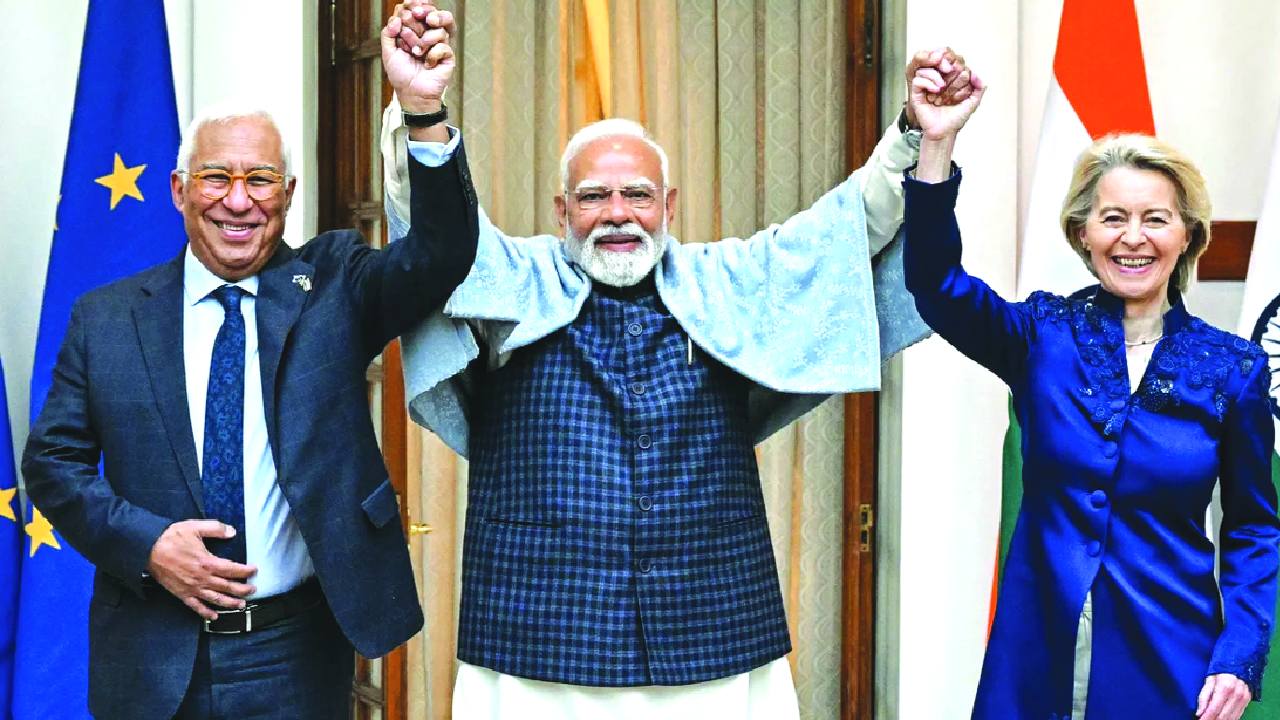
The conclusion of the free trade agreement between India and the European Union comes at a moment when the global trading system itself is undergoing profound stress. The post — Cold War economic order — built on assumptions of open markets, multilateral dispute resolution, and gradual tariff reduction — is no longer intact. In its place has emerged a fractured landscape marked by tariff wars, unilateralism, and deep uncertainty.
It is against this unsettled backdrop that the India-EU agreement must be read — not merely as a bilateral trade pact, but as a strategic statement about how nations choose to engage the world when rules fray and predictability erodes. When the President of the European Commission described the agreement as the “mother of all deals”, she was acknowledging not just its size, but its timing. Europe was signalling something larger: a preference for stability over shock, for negotiated order over coercive disruption.
The collapse of the old trade order
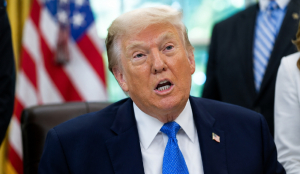
For decades, global trade functioned within a broadly accepted framework. Even disputes unfolded within institutional guardrails. That consensus has steadily weakened, but the decisive rupture came with the re-emergence of tariffs as primary instruments of state power. Under President Donald Trump, the United States unapologetically weaponised tariffs — not only against strategic competitors but also against long-standing allies.
Trade, in this approach, became transactional and confrontational. Tariffs were imposed to force rapid concessions, to demonstrate strength, and to reorder supply chains through pressure rather than persuasion. The result was immediate impact — and enduring volatility. Retaliatory tariffs followed, uncertainty seeped into global markets, and businesses found themselves navigating policy unpredictability rather than commercial logic.
This style of leadership produced disruption by design. It commanded attention, but it also eroded trust. In such an environment, middle powers and economic blocs began searching for alternatives — partners who could offer predictability rather than shock therapy.
Two leadership styles, two trade philosophies
The contrast with Prime Minister Narendra Modi’s approach to global trade could not be sharper. Where the Trump model relies on abrupt leverage, Modi’s trade doctrine has been built on patience, sequencing, and calibrated reciprocity. Where tariffs are used as instruments of coercion in one model, trade agreements are deployed as instruments of stabilisation in the other.
India under Modi has not rushed into agreements for symbolic victories. The EU negotiations themselves stretched nearly eighteen years. Yet closure came not through dilution of domestic priorities, but through alignment — opening markets where India is competitive and holding firm where livelihoods and political economy demanded protection.
This difference in leadership style matters. In an era when economic nationalism is often confused with economic strength, Modi’s approach has quietly reasserted an older but increasingly rare principle: that durable influence comes not from disruption alone, but from reliability.
Europe’s choice, India’s moment
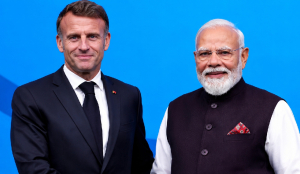
Europe’s embrace of the India agreement must be seen in this light. The EU is among the world’s most regulated markets, deeply invested in standards, predictability, and long-term partnerships. That it chose to conclude its most ambitious trade agreement in years with India — rather than rely solely on traditional transatlantic anchors — is itself revealing.
European leaders have been explicit that the deal is not merely commercial. It is strategic. It reinforces a rules-based economic order at a time when such rules are under strain. It creates a large, stable corridor of trade at a moment when tariff uncertainty continues to emanate from Washington.
In choosing India, Europe was not simply diversifying markets; it was diversifying risk. It was aligning with a partner whose leadership style privileges negotiation over shock and stability over spectacle.
The architecture of Modi’s trade doctrine
The India-EU agreement is not an isolated achievement. It fits into a broader pattern that has emerged with trade agreements with the United Kingdom, Australia, the UAE, and EFTA countries. Together, these deals reveal the contours of a coherent trade doctrine.
First, diversification. India is consciously reducing over-dependence on any single market or bloc.
This is not ideological non-alignment; it is economic prudence in a fragmented world.
Second, reciprocity. Market access is no longer assumed or conceded asymmetrically. India opens where it gains, and negotiates where it must.
Third, protection of domestic stability. Sensitive sectors such as agriculture and dairy have been kept outside the EU agreement. This is not retreat, but restraint — recognition that trade liberalisation must coexist with social and political realities. Finally, patience. The Modi Government has shown a willingness to wait rather than settle prematurely. The EU deal was concluded not when deadlines loomed, but when interests aligned.This doctrine contrasts sharply with tariff-first strategies that seek immediate leverage at the cost of long-term trust. One disrupts to dominate; the other stabilises to endure.
India as a stabilising force
As global trade norms weaken, India’s role has quietly expanded. It is emerging as a stabilising force — a country capable of engaging both advanced and emerging economies without ideological rigidity or coercive tactics. This is not accidental. It flows directly from leadership choices.
While tariff shocks have generated uncertainty, India’s trade agreements have generated corridors of predictability. While unilateralism has narrowed options, India’s calibrated engagement has widened them — for itself and for its partners. The EU agreement, in this sense, is not just about exports or tariffs. It is about signalling that amid fragmentation, stability is still possible — and desirable.
Confidence without hubris
None of this implies that the road ahead will be smooth. Implementation challenges remain. Regulatory alignment, capacity building, and competitiveness will determine whether Indian industry fully capitalises on new access. Trade agreements create opportunity; they do not guarantee outcomes.
But the larger signal is unmistakable. India today negotiates the global economy with confidence — not the brittle confidence of disruption, but the grounded confidence of design. It knows what it will open, what it will protect, and when it will wait.
This is why the comparison between Trump and Modi is not merely political; it is structural. One style thrives on immediacy and shock. The other builds influence through endurance and trust. In a world increasingly fatigued by volatility, the latter is finding greater resonance.
A new page, not just a deal
When Europe calls the India-EU agreement the “mother of all deals”, it is acknowledging more than size. It is acknowledging a partner whose leadership style aligns with a world seeking anchors rather than accelerants of chaos. The old trade order may be fraying. Tariffs may once again dominate headlines. But India’s response has not been retreat or reaction. It has been recalibration.In that sense, the EU deal is not merely the culmination of eighteen years of negotiation. It is a marker of something larger — a new page in Modi’s trade doctrine, and perhaps a glimpse of how stability can still be negotiated in an unsettled world.
The author is a Retired IAS officer; views are personal