El Nino effect: As Monsoon falters, farmers face an uncertain season
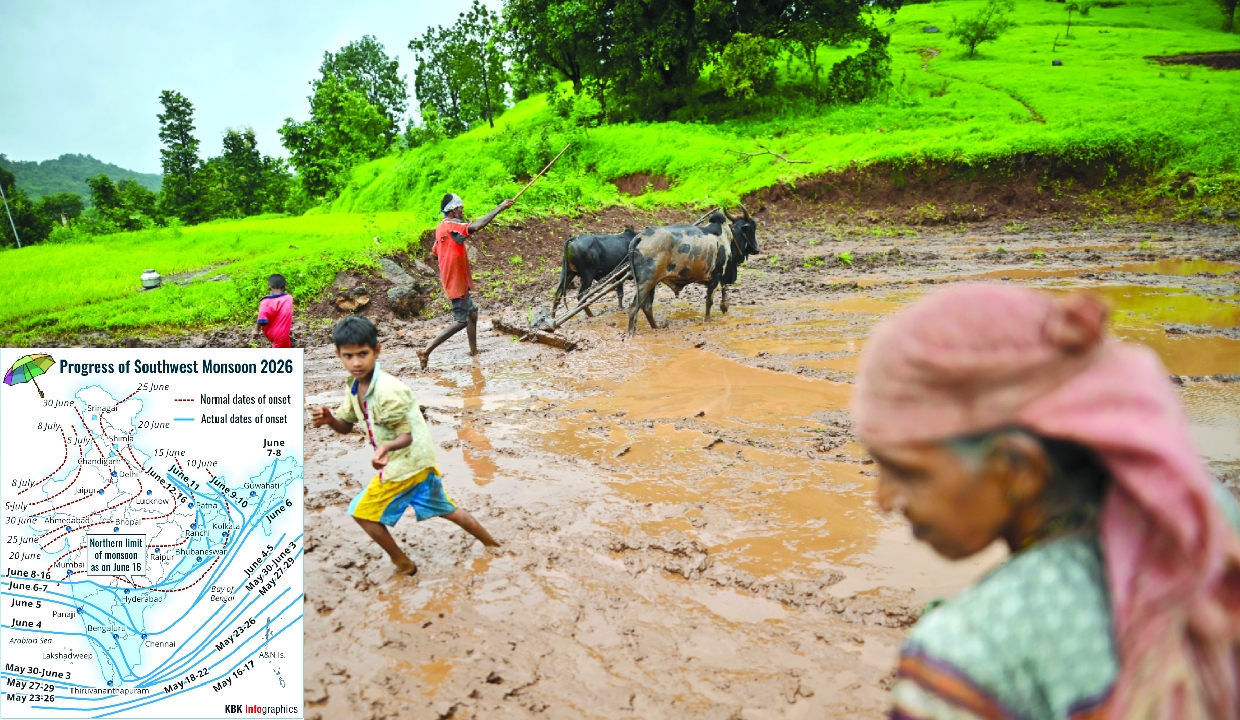
Acknowledging that the monsoon is likely to be “relatively severe” due to El Nino in 12 States, including Uttar Pradesh and Tamil Nadu, Agriculture Minister Chouhan on Tuesday directed officials to be ready with advanced contingency plans.
“In 9-10 States where the impact of El Nino may be relatively higher, coordinated meetings should be organised with District Magistrates, Agriculture Departments, Krishi Vigyan Kendras (KVKs) and other extension systems of the identified districts,” Agriculture Minister Shivraj Singh Chouhan, who chaired the weekly review meeting on Kharif 2026 preparations, said.
Data from the India Meteorological Department (IMD) shows the country received just 19.2 mm of rainfall between June 4 and June 15 against a normal of 53.7 mm, resulting in a nationwide rainfall deficit of 66 percent. Central India has been hit hardest, recording a 55 per cent deficit so far, while East and Northeast India are down around 40 per cent. The southern peninsula is marginally below normal at a 4 per cent deficit, but Northwest India stands out as the only region with surplus rainfall (13 per cent above normal). The rainfall departure map indicates deficient to large deficient rainfall across vast stretches of central, southern and eastern India, raising concerns after the monsoon had advanced into several parts of the country earlier this month. The slowdown comes despite the monsoon making further advances into parts of Karnataka, Telangana, Andhra Pradesh, Maharashtra and central India in recent days.
The other States likely to adversely impacted include Andhra Pradesh, Telangana, Karnataka, Odisha, Gujarat, Rajasthan, Bihar, Madhya Pradesh, Jharkhand and Maharashtra. Chouhan also stressed the need for advance contingency planning in rain-deficient districts, while also pushing for increased acreage under cotton and pulses.
Fresh data from the Nino 3.4 region, a key area of the central Pacific used to monitor El Nino conditions, show that sea-surface temperatures (SSTs) have set a new daily record high for the 16th consecutive day. El Nino is a climate phenomenon historically linked to weaker monsoons and heightened rainfall uncertainties — a concern that looms large this year.
As per the IMD, El Nino conditions are currently present over the equatorial Pacific Ocean and are expected to strengthen further during the southwest monsoon season (June-September).
The weather department has forecast the southwest monsoon at around 90 per cent of the long-period average, signalling a below-normal season.
On June 11, the United States’ National Oceanic and Atmospheric Administration declared that El Nino had formed and issued an advisory, putting a 63 per cent chance of it turning very strong by winter. India’s own weather office is more cautious, still calling the Pacific neutral but “transitioning toward El Nino”, a gap in thresholds, not direction.
Chouhan gave clear directions that full preparations should be made in advance in those districts where there is a possibility of low rainfall or uneven rainfall.
He said that such districts should be clearly identified and crop-wise contingency plans should be prepared in coordination with state Governments so that in any weather challenge situation, farmers can be provided immediate alternatives, advice and support.
The Agriculture Minister said the Government is working closely with states to expand cultivation of pigeon pea, black gram, and green gram through crop rotation, area expansion, improved seed availability, and technical guidance, with the aim of reducing import dependence. The review covered fertiliser availability, market prices, reservoir levels, and water storage status across states.
Chouhan assured that fertiliser supply is adequate at the national level and will be further streamlined to states and districts as the monsoon progresses. He directed officials to ensure advance supply in areas facing potential micro-level shortages.
Chouhan stressed the need for tighter coordination among agricultural universities, ICAR institutes, KVKs, and state agriculture departments, noting that technical knowledge is “meaningful only when it reaches the fields in a timely manner.