Delhi court acquits Sajjan Kumar in 1984 Janakpuri, Vikaspuri violence
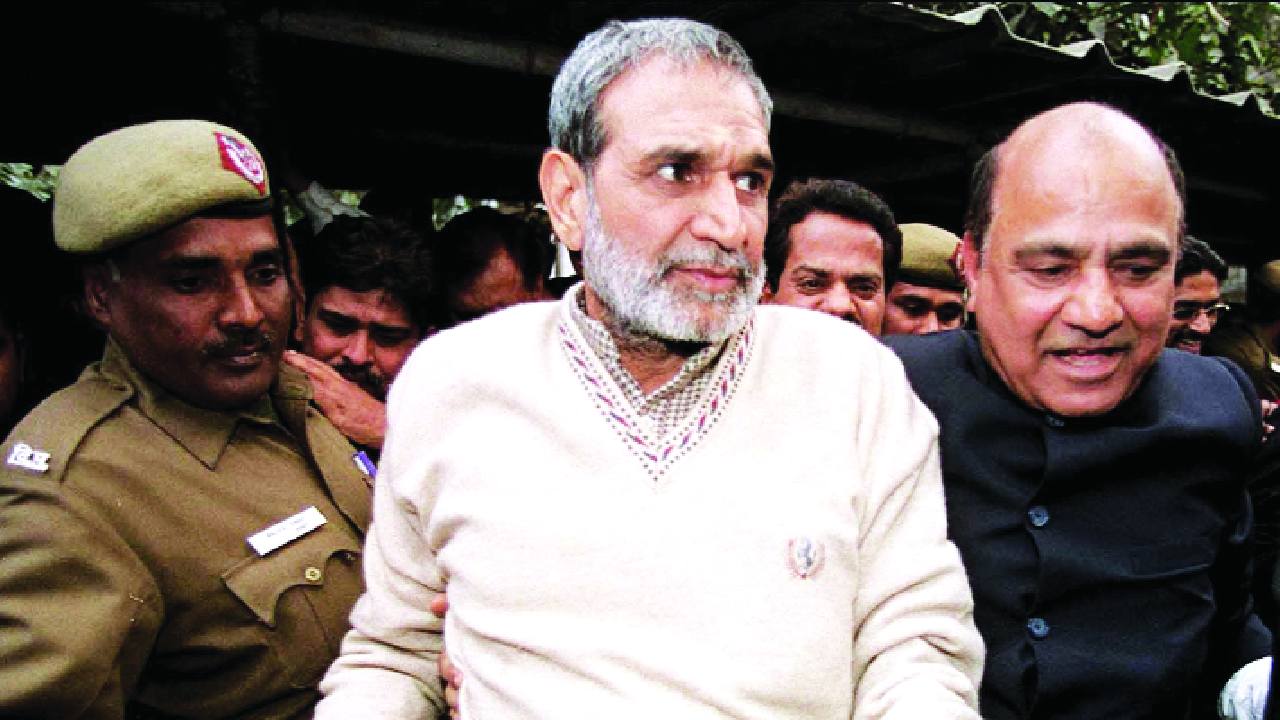
A special court for MPLs and MLAs cases on Thursday acquitted former Congress MP Sajjan Kumar in a case related to inciting violence in Janakpuri and Vikaspuri in Delhi during the 1984 anti-Sikh riots, saying there is “no evidence of instigating any such mob”, and “of conspiracy”. The court noted that though the court understood the trauma suffered by the victims and their families, but that trauma cannot come in the way of this court’s decision, which has to be sans emotions. Meanwhile, the Delhi Sikh Gurdwara Management Committee (DSGMC) has decided to challenge the verdict in the Delhi High Court.
“Sum and substance is that the prosecution has not met its burden of proof against the accused beyond a reasonable doubt, which is essential for conviction in a criminal trial,” Special judge Dig Vinay Singh of Roue Avenue court wrote in his 60-page judgment.
“Resultantly, because of a lack of credible evidence as to the presence of the accused in the crime in question or a part of the unlawful assembly or his involvement in any manner, either through instigation, conspiracy, or abetment of any other nature, he is acquitted of the charges,” judge Singh added in the judgment.
The Court said that relying on the identification of Kumar by such persons would be risky and may lead to a travesty. “Thus, there is no reliable evidence in the present matter that the accused was present at the crime scene for which he has been charged on 01.11.1984, or that he was seen there by anyone. There is no evidence of instigating any such mob. There is no evidence of conspiracy so far as the incident in question is concerned, and this Court has no hesitation in holding that the prosecution has not met the standard of proof required in a criminal trial to prove the guilt beyond a reasonable doubt,” the judge said.
“The finding of guilt of the accused in this case must be solely judged based on the evidence led in the present matter. Unfortunately, most of the witnesses examined by the prosecution in this case are hearsay, and/or those witnesses who failed to name the accused for three long decades,” the judge said.
Rejecting the argument that Kumar had been found guilty of similar offences, the court said a person could be convicted of 100 crimes, but to be held guilty of the 101st crime, proof beyond a reasonable doubt was required.
“One cannot be found guilty merely because in the past he was involved in similar offences. Past criminal background or the commission of other offences are separate and can have some value in sentencing a person, but they cannot be considered by a court of law in holding a person guilty of another crime,” the court said.
It said conviction in a criminal matter could only be founded when there was no doubt that the accused had committed the crime, and there was no place for mere suspicion.
“Merely because the accused is an ex-member of parliament or that he was involved in similar instances at other locations, this court cannot lower the standard of proof required in this case to hold him guilty. The law remains the same for all criminals, whether they are ordinary men or influential people,” it said.
The court noted the prosecution’s argument that while appreciating evidence in the present case, appropriate weightage must be given to the circumstances, including the victims being severely beaten and injured; two people being killed; their homes and properties damaged and destroyed; and police officers not providing immediate help. “Accepted. But then, even if that allowance is given in favour of the witnesses, still, there is no satisfactory justification for not naming the accused for three long decades.
“While appreciating evidence of this case, this court did consider all those factors, yet this court finds it unconvincing that the injuries, loss of life, and loss of properties weighed with the witnesses for so long that they were not even able to name the perpetrator of the crime,” the court said.
It said any witness who lost a family member at the hands of a criminal would not spare such an individual and would try to name him/her at the earliest opportunity. “Therefore, even if the fear of the influence of the accused got reduced in a few years, there is no reason why the members of the families who suffered human loss and who were also eyewitnesses would fail to name the accused for so long,” the court said.
It said merely because there was no prior enmity between the victim and the accused, it could not be said conclusively that there was a lack of motive for false implication. “It is well-nigh possible that, given the accused’s alleged involvement in various similar riots against a particular community during the relevant period, the accused has been named in this case as well,” the court said.
In February 2015, a special investigation team re-investigated two FIRs that had been registered against Kumar in the Janakpuri and Vikaspuri police stations for various offences during the 1984 riots. The Delhi Police had filed closure reports in both the FIRs.
Based on fresh statements, the SIT filed the chargesheet against the accused, asserting that the evidence gathered showed that Kumar, who was then an MP from Outer Delhi constituency, conspired to commit offences, including spreading disharmony, rioting, arson, murder, and destruction of Sikh property, along with setting a gurudwara on fire. The SIT concluded that the accused, along with 100-125 unidentified people, formed an unlawful assembly for these common objects.
A common chargesheet was filed in both cases as the alleged incidents were held to be continuous parts of the same incident committed by the same unlawful assembly under the conspiracy orchestrated by Kumar, and because both cases originated from the affidavit of an alleged victim, Harvinder Singh.