CIABC questions Karnataka’s AIB tax model, counters BAI revenue claims
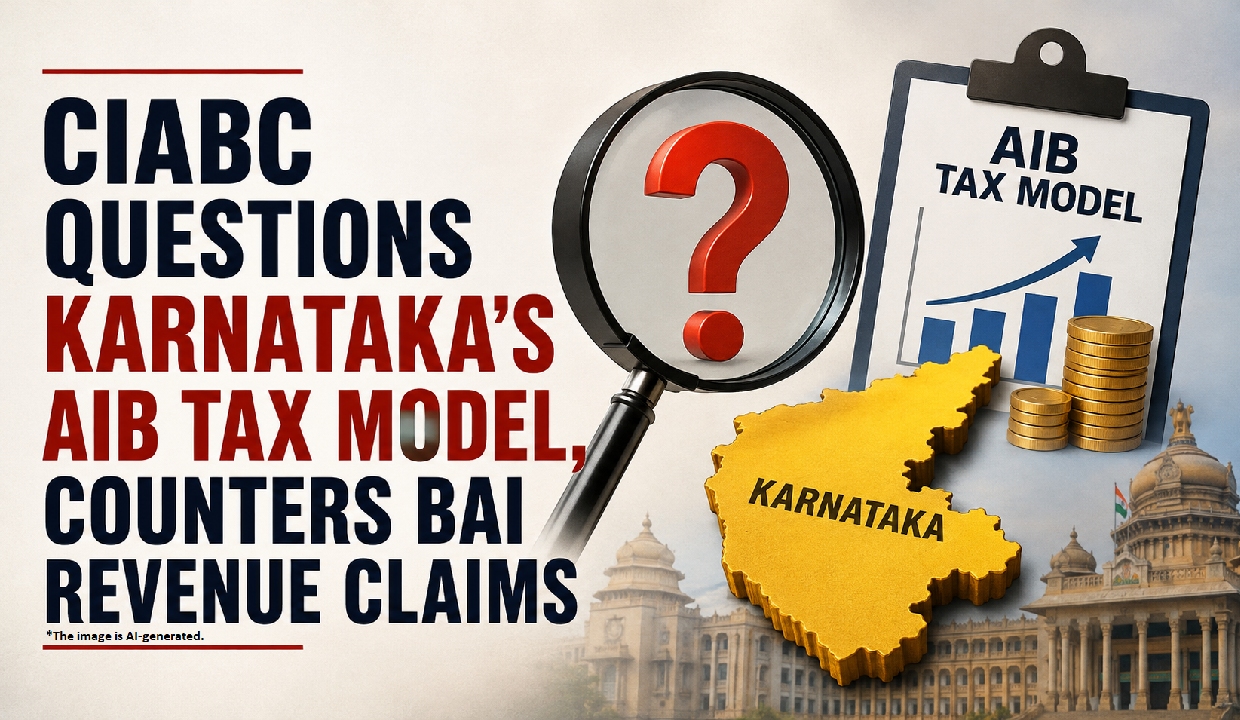
CIABC, the industry association representing domestic Indian-made liquor companies, on Thursday questioned the effectiveness of Karnataka’s Alcohol-in-Beverage (AIB) taxation regime and the preferential treatment given to the ‘beer’ category.
The Confederation of Indian Alcoholic Beverage Companies (CIABC) countered claims made by the Brewers Association of India (BAI) that the new tax structure has boosted state revenues and encouraged consumption of milder alcoholic beverages.
Citing state Government data for July-September 2026, CIABC said there is a “clear divergence” between volume growth and revenue contribution across Indian-made liquor (IML) and beer.
IML sales rose marginally to 171.69 lakh cases (9 litres each) from 169.12 lakh cases a year ago, a volume growth of 1.52 per cent. Despite this near-flat volume performance, IMFL revenue rose 13.36 per cent, or Rs 1,064.52 crore, to Rs 9,033.21 crore from Rs 7,968.69 crore.
Beer sales jumped 49.69 per cent to 126.68 lakh cases from 84.63 lakh cases. Beer revenue rose Rs 228.57 crore, or 18.52 per cent, to Rs 1,463.07 crore from Rs 1,234.50 crore. “The contrast becomes even clearer when the incremental revenue is examined,” said CIABC as Karnataka revenue growth continues to be driven by IML.
Though beer volumes surged sharply after the implementation of the AIB framework, the bulk of incremental excise revenue continued to come from IFL, the association said, raising concerns over the efficiency and long-term sustainability of the new tax regime.
“Total excise revenue during Q2 increased by Rs 1,291.94 crore. Of this increase, approximately Rs 1,064.52 crore or 82 per cent came from IMFL, despite IMFL volumes growing by only 1.52 per cent. On the other hand, Beer, despite recording nearly 50 per cent volume growth, contributed only about Rs 228.57 crore, or 18 per cent, of the incremental revenue,” said CIABC.
Karnataka introduced an AIB taxation framework from May 11, 2026, replacing the earlier structure with a system that levies excise duty based on actual alcohol content of a product. The regime is strongly backed by the beer industry and aims to align taxation with alcohol strength, while an Additional Excise Duty (AED) linked to product value continues to apply through a simplified slab structure.
CIABC remarks come days after BAI in a statement hailed Karnataka’s AIB taxation reforms, stating that total tax collections in the state rose 13.4 per cent to Rs 22,191 crore during April-September 2026 and that beer sales grew 41.3 per cent during the period, while tax collections from beer increased 19 per cent.
BAI had argued that the alcohol-content-based taxation system, introduced by Karnataka from May 11, 2026, was in line with global best practices and encouraged consumers to shift towards milder alcoholic beverages such as beer and wine.
However, CIABC also disputed that interpretation, saying the state’s own data painted a different picture.
“The state Government data clearly suggests that the strong growth in Karnataka’s excise revenue during the period has not been driven by the category that witnessed the sharpest increase in consumption volumes. Instead, the bulk of additional revenue has continued to come from IML,” CIABC said.
The body further argued that a tax structure that facilitates strong growth in beer sales while generating relatively limited incremental revenue may not represent an efficient excise model.
It also contended that higher revenue from IML was being driven largely by increased tax realisation rather than volume growth, potentially placing a greater burden on mass-market consumers.
BAI Director General Vinod Giri had said the data showed “people are drinking milder and better forms of alcohol”, which he called “a much-desired public policy outcome of reducing harmful effects of alcohol”.
Rejecting that premise, CIABC said “alcohol is alcohol” and “there is no more harmful or less harmful alcohol. What matters is how much alcohol is consumed and the consumer’s drinking pattern, not the type of alcohol consumed”, it said, adding that equal servings of beer, wine and spirits can contain the same quantity of pure alcohol.
It also said liquor consumption in pure alcohol litres “has gone up rather than going down”.
CIABC also challenged BAI’s assertion that higher beer and wine consumption represents a better public policy outcome.
“The state Governments need to implement a more balanced, equitable and sustainable excise framework with the objective to support healthy growth across categories, ensure long-term revenue sustainability, and avoid disproportionate taxation of a particular category,” said CIABC.