Canadian PM to recast ties, no schedule for Punjab visit
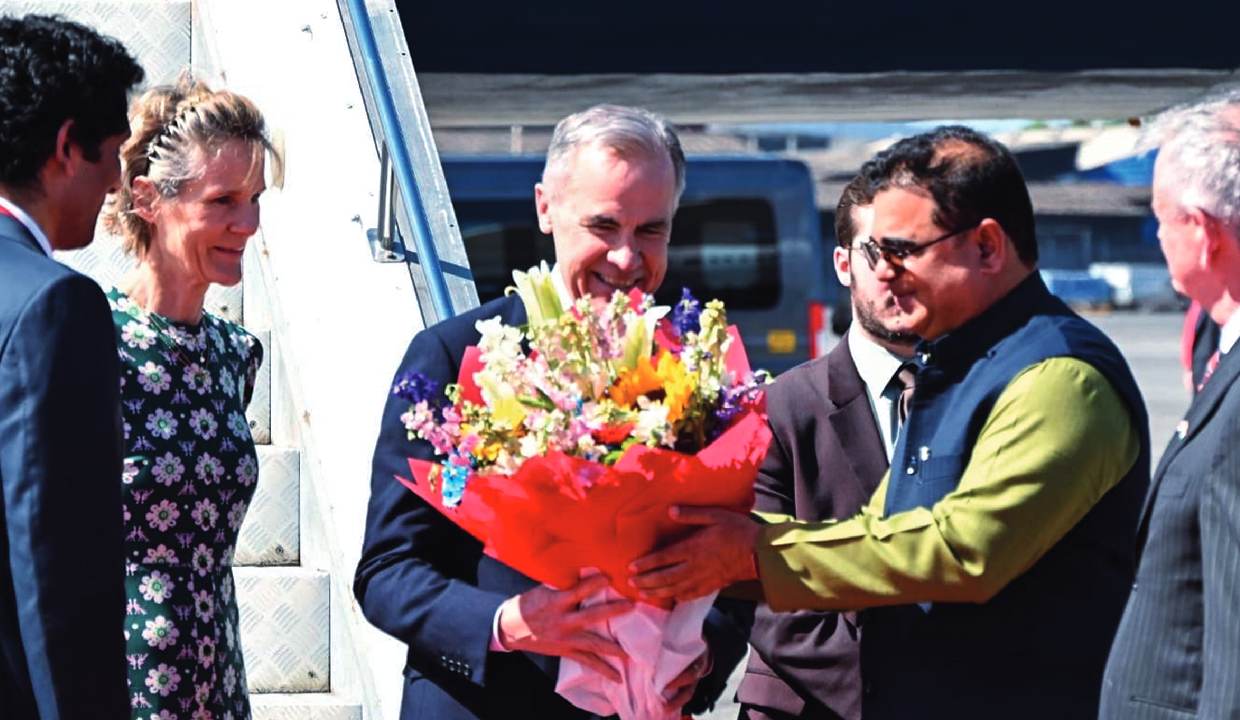
India’s financial power house, Mumbai, rolled out the red carpet for Canadian Prime Minister Mark Carney on Friday, marking the opening act of a high-stakes, economy-driven India tour designed to inject fresh momentum into a relationship that only recently emerged from deep diplomatic frost.
Carney’s arrival signals more than ceremonial optics. It underscores Ottawa’s urgent push to diversify trade and investment corridors at a time when Canada is recalibrating its economic dependence on the United States. With global supply chains under strain and geopolitical fault lines widening, New Delhi has emerged as a pivotal partner in Canada’s search for resilient markets and strategic leverage.
Over the next two days in Mumbai, Carney will engage in a packed schedule of boardroom diplomacy - meeting Indian and Canadian CEOs, financial heavyweights, pension fund managers, innovators and policy architects.
The focus is clear: unlock investment flows, expand financial-sector collaboration, and forge durable strategic economic partnerships capable of withstanding global turbulence. The Canadian leaders will then travel to New Delhi on March 1 for formal talks with Prime Minister Narendra Modi at Hyderabad House.
Delegation-level discussions are expected to span trade, critical minerals, energy security, agriculture, education, research, innovation and people-to-people ties — sectors increasingly viewed as pillars of a recalibrated bilateral architecture. Both leaders will also attend the India–Canada CEOs Forum on March 2, where business chiefs are expected to press for accelerated negotiations on a long-pending Comprehensive Economic Partnership Agreement (CEPA).
The agreement, stalled amid political tensions, is now being framed as a litmus test of mutual resolve. Carney’s visit carries unmistakable political undertones.
Relations between New Delhi and Ottawa spiralled into a bruising standoff in 2023 after former Prime Minister Justin Trudeau alleged Indian Government involvement in the killing of Hardeep Singh Nijjar, a Khalistani separatist, in Surrey. India categorically rejected the accusation and countered that Canada had become a “haven” for extremists and organised crime. The fallout triggered diplomatic expulsions, frozen trade talks and a sharp erosion of trust.
Since assuming office in early 2025, Carney has moved decisively to steady the relationship. A symbolic breakthrough came when he invited Modi to the G7 summit in Kananaskis last June — a gesture widely interpreted as an olive branch.
Subsequent meetings on the margins of the G20 Summit in Johannesburg further thawed tensions, paving the way for the restoration of high commissioners and a revival of trade negotiations.
Notably absent from Carney’s itinerary is a visit to Punjab — a departure from precedent that has stirred unease among some Sikh groups in Canada. Both Trudeau and former Prime Minister Stephen Harper made high-profile visits to Punjab during their India trips.
Harper visited the Golden Temple in Amritsar in 2009 and again in 2012, while Trudeau’s 2018 visit to the shrine — accompanied by his family — drew global attention and, at times, online ridicule over sartorial choices. Earlier, former Prime Minister Jean Chrétien paid respects at the Golden Temple in 2003. Carney’s decision to bypass Punjab appears deliberate — a signal that this visit is anchored firmly in economic recalibration rather than symbolic outreach.
By keeping the spotlight on commerce and strategic cooperation, Ottawa seems intent on insulating the reset from politically combustible optics. For Canada, the India outreach is driven by hard-headed pragmatism. As protectionist currents swirl globally and economic reliance on Washington becomes increasingly uncomfortable, Ottawa is aggressively scouting alternative growth engines. India — one of the world’s fastest-growing major economies — represents both opportunity and geopolitical ballast. For India, the calculus is equally strategic. Deepening ties with a resource-rich G7 nation offers access to critical minerals, advanced technologies, pension capital and education linkages — all central to New Delhi’s long-term economic ambitions.
As Carney and Modi prepare to sit across the table in Delhi, the stakes are unmistakably high. The visit is not merely about repairing bruised egos; it is about constructing a sturdier economic bridge resilient enough to outlast political tempests.
Whether this reset translates into lasting structural cooperation will depend on how swiftly both sides can convert diplomatic warmth into binding economic commitments. For now, Mumbai has set the stage — and the tone — for what both Capitals hope will be a defining chapter in India–Canada relations.