Blasé Capital WEALTH IS HEALTH

India has entered its most powerful wealth-creation phase, as the equity markets added an unprecedented Rs 148 trillion in value over the last five years. The economy is poised for a multi-trillion-dollar expansion over the next two decades, according to the latest annual wealth creation study by Motilal Oswal Financial Services. It tracks wealth creation across Indian equities since 1996, and states that the 2020-25 period marked the strongest phase in its history, helped by a sharp post-pandemic rebound in the stock markets, financialisation, and better and improved corporate earnings and profitability.
The report shows that the top 100 wealth-creating firms added INR148 trillion in market capitalisation between March 2020 and March 2025, the highest recorded by the study. Wealth creation during this period grew at a compound annual growth rate of 38 per cent, outperforming the BSE Sensex, which delivered a 21 per cent growth. Motilal Oswal measures wealth creation as the change in market capitalisation over five years, adjusted for corporate actions such as mergers, demergers, dividends, buybacks, and capital issuance.
Bharti Airtel emerged as the biggest wealth creator during the period, adding INR 7.9 trillion in market value, followed by ICICI Bank, and State Bank of India. Strong operating performance and sustained re-rating lifted large financial and telecom stocks. An equal investment of INR 10 million in the top 10 fastest wealth creators grew to INR 240 million over the five years, and translated into 88 per cent compounded growth, far ahead of the 24 per cent by the Nifty total returns index. Hindustan Aeronautics was the most consistent wealth creator. It outperformed the Nifty total returns index in the five years, and delivered a 75 per cent compounded return.
Among the sectors, financials continued to dominate wealth creation, supported by robust credit growth, stronger balance sheets, and rising profitability. Industrials, capital markets, technology, and utilities followed. Apart from the private players, state-owned firms extended their revival, particularly in areas such as defence, energy, and utilities. State-owned firms such as Hindustan Aeronautics, Bharat Electronics, and NTPC featured prominently among the wealth creators due to improvement in execution and perception.
Beyond the five-year rankings, the study’s theme section argues that India is entering a long compounding cycle that may transform the scale of financial wealth over the next two decades. India’s equity market capitalisation has compounded at 17 per cent over the past two decades, and now stands at around 1.3 times GDP. Thus, India is the fourth-largest equity market globally. The study notes that financial wealth has no absolute upper limit, and can grow much faster than the GDP as equity participation deepens.
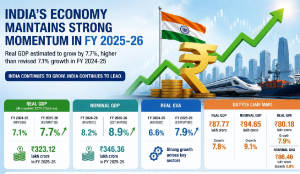
India’s GDP quadrupled to $4 trillion over the past 17 years. The report projects another quadrupling to $16 trillion over the next 17 years to create what it calls a “Multi-Trillion-Dollar (MTD) opportunity” across the sectors. With national growth will come the growth in corporate earnings. One needs to remember that in the almost four decades since the Sensex was launched, the annual returns have kept pace with the yearly nominal GDP growth rate. Thus, the economy mirrors the stock markets, or vice versa. There is surely a correlation that investors need to be aware of.
A key driver is the accelerating “wealth effect.” Rising household equity ownership is beginning to lift consumption, and create a virtuous cycle between asset prices, spending, and growth. Even a modest five per cent wealth effect on incremental market cap can materially boost GDP growth. Financialisation, SIP inflows, demat accounts, and deeper retail participation reinforce this cycle. Formalisation and corporate governance support earnings visibility. In effect, the ecosystem has changed, and continues to do so. What has happened over the past 17 years will accelerate in the next 17.
According to the study, financials including capital market businesses, and consumer discretionary sectors are best placed to benefit from this multi-trillion-dollar phase. These sectors are approaching key scale and penetration inflection points, which could drive sustained compounding. Large-cap stocks are likely to outperform in the medium term, supported by the stronger balance sheets, higher institutional ownership, and better access to capital. Midcaps and lower caps will witness sharper, short-term upswings, and a few may graduate to the next caps over years.
Raamdeo Agrawal, chairman, Motilal Oswal Financial Services, feels that the country is at the start of a long compounding journey. He thinks that “long-term wealth will be created by high-quality businesses that can compound for decades,” but cautioned the investors to “avoid the temptation to time the market.” No one, not even the best, can do this, at least not consecutively. Some do due to luck, pluck, and due diligence. But even they get it wrong. The average investor needs to ride the momentum, and hope for decent returns. It does not matter if she joins the upward ride midway.
As India embarks on the next growth phase, the study suggests that patience, quality, and disciplined capital allocation will matter more than the short-term market spikes, downs, and cycles. Most experts give this advice, which is a constant for the past 100-200 years. However, as experience shows, it is not easy to implement; most investors are swayed by the present. In the long term, as an economist rightly said, we are dead, and it does not matter.