Blasé Capital READ, PLEASE
Reading is a private affair. Libraries are memories in the mind. It is a book that decides when to be read, rather than the reader who decides when to read it. Despite this closed-door, and closed-mind trait of reading, the issue exploded publicly in the past few weeks. First, an Indian author in a British newspaper questioned the reading habits of Indians, despite the successes of literary festivals, which now numbered 100 a year, and attracted millions of visitors. India-hands, including foreign writers on Indian issues, reprimanded the column. An Indian magazine took up the cudgels on behalf of the Indian readers to prove that the reading habit was alive and kicking in the country. Some pointed to average print runs of a book, which average 3,000, with 10,000 copies sold labeled as a best-seller. Others countered with books sold across languages, with some titles selling in millions. The beauty lies in the eyes of the beholder; reading in the hands of a buyer.
According to the British newspaper, Indian literary festivals are like carnivals, circus-like events. In India, they are “only partly about books. They are a ‘spectacle’ offering music, dance, handicraft sales, and food. Even the T-Rex of them (lit fests) all, the Jaipur Literature Festival (which attracted 4,00,000 visitors in January 2026), would almost certainly attract fewer people without these extras,” stated the column. Although literacy rates are higher, there is a gap between the ability to read, and the habit of reading for pleasure. According to one maybe-bizarre and weird journalist, “I do not read unless I am paid to do so.” Publishers lament about the lack of reading habits, which lead to low print-runs, and some comment about the lack of a transition to a “literate book-reading class.” Some talk about a dumbing down, a phrase that was applied to print, TV, and online media some years ago.
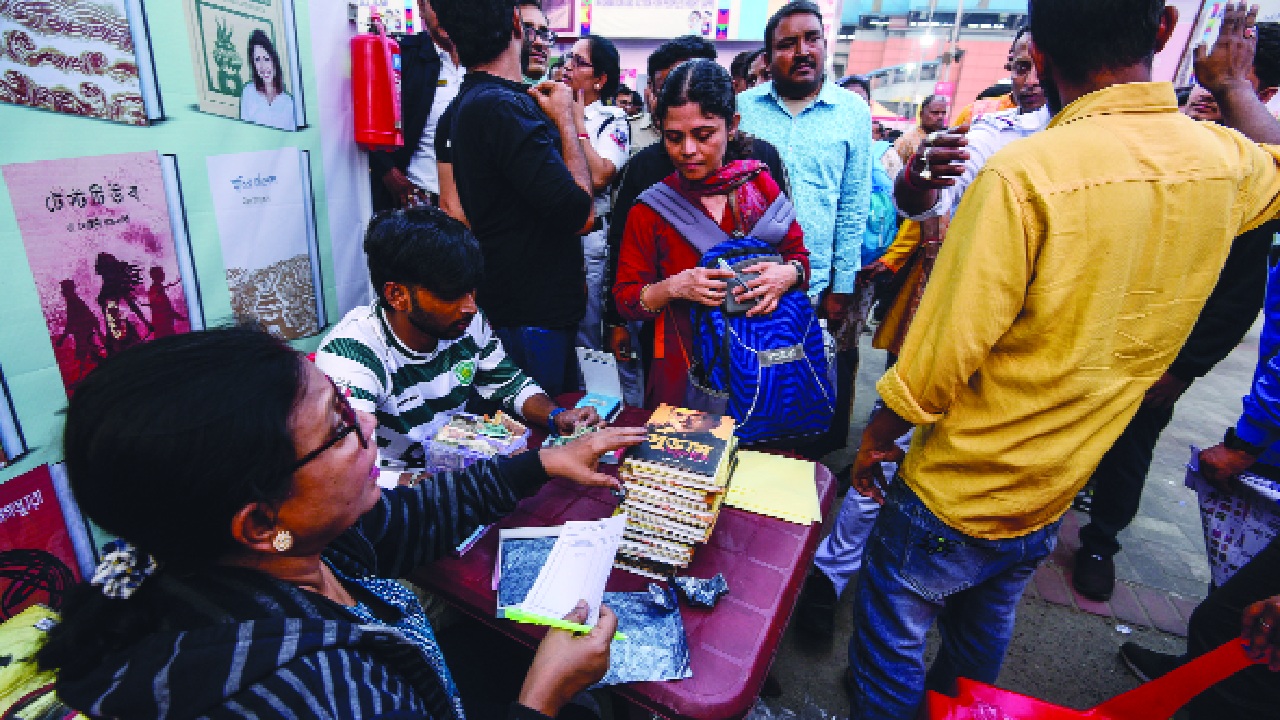
As a counter, an Indian magazine presented data and figures. Let us forget about English books. There is a thriving and growing set of readers across languages. If one discounts the western metrics of reading, “India’s print world is multilingual, informal, scattered, and under-measured,” according to a seemingly-neutral online column. The magazine predicts that by the time the Kolkata Book Fair closes in two weeks, “it will have drawn close to three million visitors, and recorded sales of over INR 26 crore.” It adds, “India is today one of the world’s largest producers of books. According to data from the Federation of Indian Publishers and UNESCO, the country publishes close to 90,000 new titles annually, placing it among the top ten publishing nations globally. These books appear in more than two dozen languages, many of them with long and fiercely defended literary traditions.” In fact, a British newspaper has no right to question how India reads.
Now, like it or not, both the British newspaper and Indian magazine contradict their claims. It is ironic that while a reader can recognise them, the writers and authors do not. Let us take the main issue. Do Indians read for pleasure, asks the British newspaper? Indians read a lot, but not necessarily for pleasure, answers the Indian magazine. The latter quotes figures, which conclusively proves this argument. “The Indian book market itself is estimated at over $6 billion, making it one of the fastest-growing globally. Educational publishing accounts for nearly 70 per cent of this market. Textbooks, exam guides, and reference works dominate sales. For millions of families, books are not cultural accessories but instruments of aspirations,” states the Indian magazine. It proves the British viewpoint. Of course, exam guides are not read for pleasure, and the same is true for textbooks. Most of it is forced reading, thanks to the country’s rigid education system.
As for the British newspaper, it harps on the spectacle-like lit fests. But the fact is that when it comes to culture and sports, the western nations, including Britain, have long adopted the need to ride on the commercial aspects to gain popularity, and spur sales. Take Hollywood, for example, which hypes, exaggerates, and converts every event (and non-event) into a jamboree, either in physical or virtual sense. British tourism is like a circus, with various commercial add-ons to woo tourists every year. British newspapers, well, the less said about them the better. After all, we still have not witnessed the most-read newspaper being accused and punished for breach of privacy, hacking phones, and using emotions to sell its products. We do use sensationalism, even extortion and blackmail, but we are still far from hacking. The truth being that using commercial and marketing events to sell an event, especially a cultural one, like a lit fest or concert, is the norm.
Hence, let us not make reading into a public spectacle. Let us retreat behind the privacy of reading, to the bedrooms under table lamps, and dark and quiet corners of libraries, or even the public loudness of places like a lawn. Let us not be drawn out to shout and scream about who reads what, for what purpose, when, and how much. What can be an issue is possibly what kind of books do we publish, and what sells. But then that will be a whimper too. Porn sells, pulp sells, exam guides too.