BioGas India Policy Framework: What more can be done?
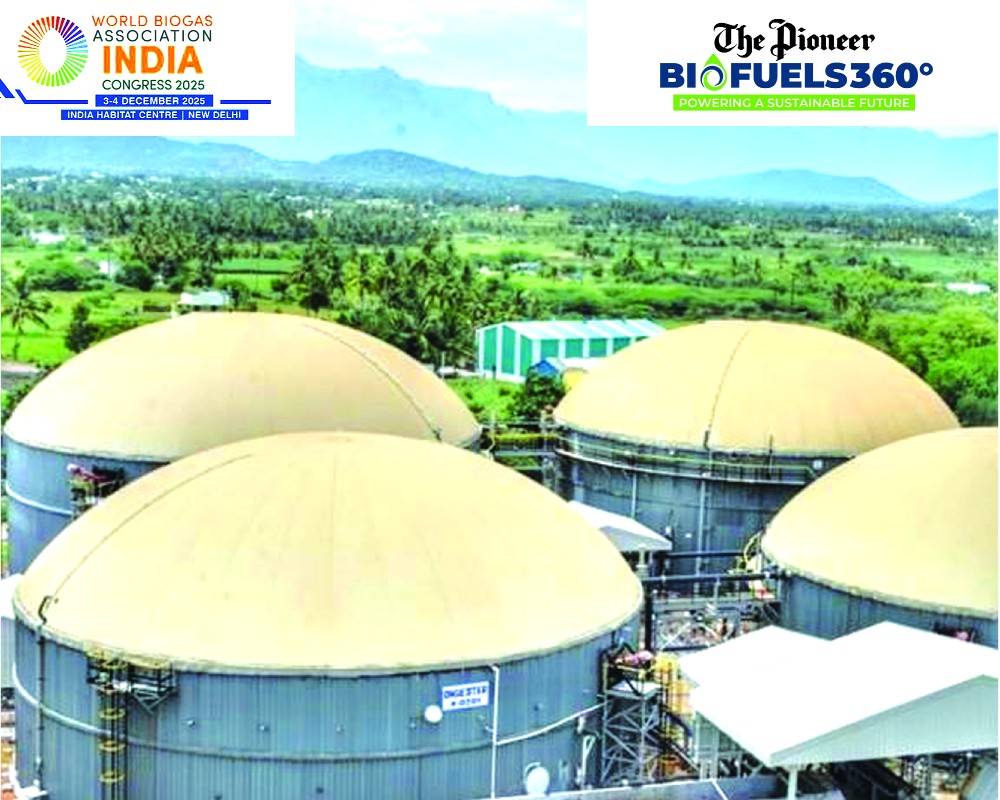
CBG Growth Pathway: Opportunities and Implementation Challenges : Compressed Biogas (CBG) has emerged as a strategic national opportunity, delivering a “triple dividend” of stronger energy security, reduced stubble burning and urban waste and the production of valuable organic manure (FOM/LFOM) that improves soil health. The Sugar Industry is central to this transition, offering a steady and high-quality feedstock supply mainly press mud and spent wash, that supports reliable, year-round CBG production. This integrated model helps de-risk operations and positions sugar mills as natural anchor investors. Under the SATAT scheme, more than 1,200 plants have received LOIs, though only about 160 are operational so far. Addressing the implementation challenges through calibrated policy support will be important for scaling the supply chain to its full potential.
Translating LOIs into operational CBG plants remains challenging due to three factors: steady feedstock availability, reliable offtake for gas and the commercial viability of FOM. Feedstock from agricultural residue is often costly to aggregate, seasonal and difficult to transport over long distances. Industrial feedstocks such as press mud also face recovery losses when stored improperly.9
For many plants located in the hinterland, moving CBG to the City Gas Distribution (CGD) network adds further logistical complexity. In addition, uncertainty in FOM offtake affects both revenue streams of a CBG project. The Department of Fertilisers (DoF) mandate for FOM procurement is still evolving, resulting in periodic unsold inventories for producers.
Policy Framework 2.0: Strategic Interventions for Decisive Scaling :
To enable large-scale CBG deployment, Policy Framework 2.0 can focus on ensuring assured markets for gas and FOM, easing financial processes, and improving infrastructure support. Industry feedback suggests the following measures can further strengthen this effort :
1. Assured offtake of CBG : To overcome the financial impact of plant underutilisation and revenue loss from gas flaring, certainty in CBG offtake is paramount. This requires expedited implementation of the Scheme for Development of Pipeline Infrastructure (DPI) to swiftly connect all new CBG plants to the City Gas Distribution (CGD) network.
Crucially, in the interim period until grid connectivity is achieved, the Government may consider ensuring producers receive payment at ex-factory price or are reimbursed for transportation costs. This dual approach helps ensure continuous offtake and maximizes utilisation.
2. Assured offtake of FOM To fundamentally de-risk the CBG project balance sheet, the existing DoF mandate for fertilizer companies to offtake FOM and Liquid FOM (LFOM) could be implemented with renewed emphasis.
3. Enhance MDA Support of FOM : The current MDA support of Rs1,500 per tonne does not adequately cover production economics. This support should be enhanced, with higher levels of assistance specifically for enriched and value-added products, such as Phosphorous Rich Organic Manure (PROM) and enriched FOM/LFOM.
4. Market Expansion for MDA Eligibility (FOM and LFOM): To widen adoption and reduce unsold inventory, sales of FOM and LFOM across all states, whether in bulk or packaged form and through all dealer/retailer networks, should be fully eligible for MDA support.
5. Recognise Storage and Handling Costs of FOM and LFOM: Producers incur significant, unrecognised costs for storage, handling, drying and distribution against seasonal demand of FOM/LFOM.
These unavoidable logistical costs should be formally recognised either through incentives or within the MDA framework to ensure financial viability.
6. Streamline MDA Disbursal (FOM and LFOM) : The MDA process could be simplified. It should be linked directly with CBG production and released monthly.
A mechanism where a substantial majority share (75-80 per cent) is released upfront upon proof of CBG production, with the balance released subsequently, would provide the necessary predictability for financial stability.
7. Enhancing CFA and Streamlining Fiscal Incentives: The process for releasing CFA could be simplified, and the government can consider increasing the CFA grant limits to better de-risk project financials. The enhanced CFA should be strategically directed, utilizing the higher grants available for Solid Waste Management projects, toward capital-intensive core plant machinery and technology upgrades.
Conclusion and call to action
A collaborative effort between Government, industry and the fertiliser ecosystem can rapidly unlock the next wave of CBG growth. Clear offtake pathways, predictable incentives and timely infrastructure interventions will allow CBG plants to operate at full potential and deliver long-term benefits across energy security, waste management and soil health.
Author is a Executive Director and CEO of DCM Shriram’s Sugar and Ethanol Business; views are personal