Before building temples, build community values
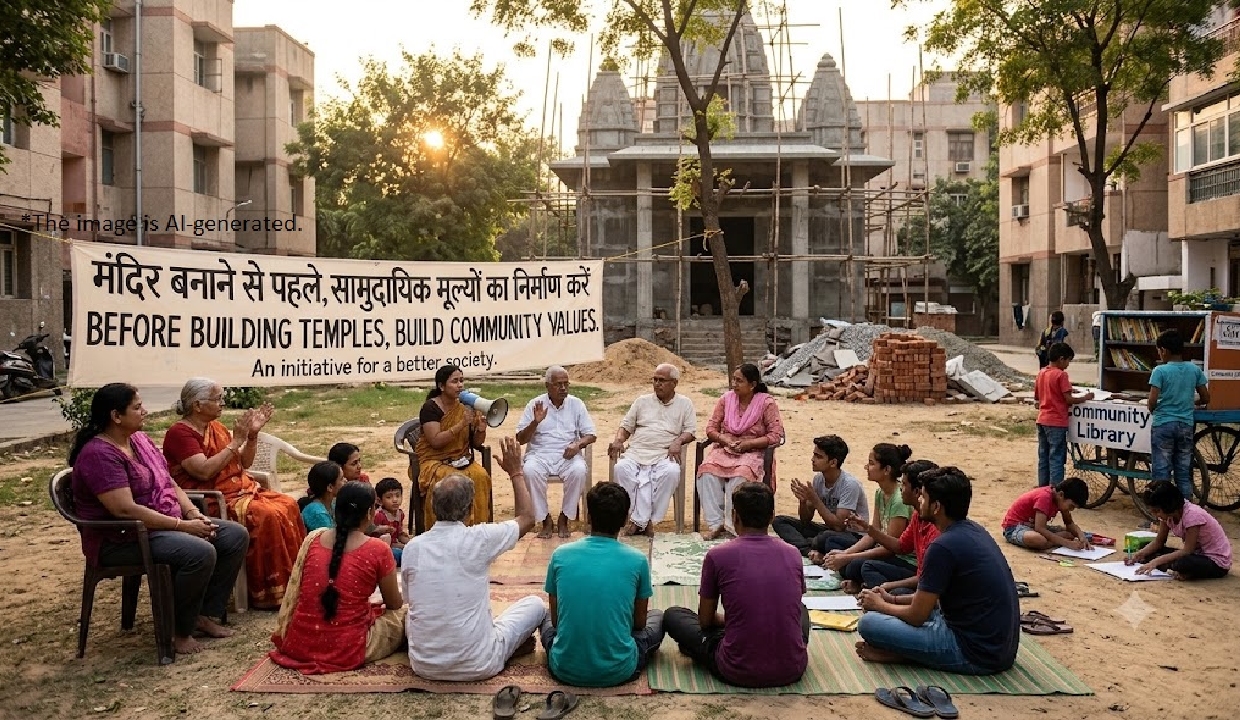
We are preparing to vote in our society elections, and the mudslinging and slugfest have descended to levels that many of us have come to associate with elections at much larger political levels. Among the issues dominating the campaign is the proposal to construct a religious structure within the complex, a subject that has generated debate over the limited common space.
The argument advanced by some contestants is that such a structure would create an enabling environment for senior citizens and help inculcate values in the younger generation. It is an attractive proposition because it appeals simultaneously to tradition, culture and community identity. Yet a few conversations over the past few days made me wonder whether we sometimes confuse symbols with substance.
We are, in fact, a household of three senior citizens - my father, my wife and I. My wife observed that many of those advocating such facilities in the name of senior citizens have not yet entered that phase of life themselves. Those of us who have, she remarked, do not necessarily feel the need for such elaborate handholding. The comment contained a larger truth. People often speak for others without understanding what they may actually need.
Another conversation was revealing. A young resident recounted how one of the leading contestants, whose manifesto featured the proposal, had spent considerable time explaining its importance. When the youngster attempted to present an alternative perspective, however, he found himself brushed aside. What struck him was the unwillingness to listen.
His response stayed with me. He pointed out that his parents live with him and that he cares for them every day. What greater lesson in values, he asked, could he impart to his own children than the example of looking after ageing parents within the family? His comment reminded me that values are absorbed through example. Children watch what we do long before they understand what we say.
Religious spaces have their place in community life, just as parks, libraries, playgrounds and cultural centres do. They can provide comfort, belonging and opportunities for engagement. But values are rarely transmitted through buildings alone. They are learned through observation and experience. Children absorb them when they see respect for differing opinions, courtesy in disagreement, honesty in public life, concern for neighbours and care for elderly family members.
Perhaps the larger question is not what serves us today, but what kind of community we leave for those who come after us. Every society, whether a residential complex or a nation, ultimately depends on citizens who are willing to think beyond immediate preferences and short-term gains. The challenge is not merely to choose what serves us today, but to consider what will enrich the lives of those who will inherit these spaces long after we are gone.
In that sense, every citizen must aspire to be something of a statesman. A politician thinks of the next election; a statesman thinks of the next generation. Our choices about common spaces and values are rarely confined to the present. They shape the culture that future residents and children will inherit.
If a community wishes to leave a lasting legacy for its younger generation, it may need to focus less on what is constructed in concrete and more on what is demonstrated in everyday life. After all, values are not taught merely through places of worship. They are taught through the quiet acts of responsibility, respect, compassion and thoughtful stewardship that children witness every day.
The writer is a founder of Kala - Krazy About Literature And Arts, is an author, speaker, coach, and strategy consultant; Views presented are personal.
Leave a Comment
Comments (1)
The issue of Temple in the Manifasto of an Aspirant and the brushing aside of the differing views ( from a youngster), have been analyzed and articulated in a very subtle and clear way. Great Perspective nicely summed up. I totally agree with your observations,perspective and solution. 👏🏻👏🏻👏🏻👏🏻👏🏻