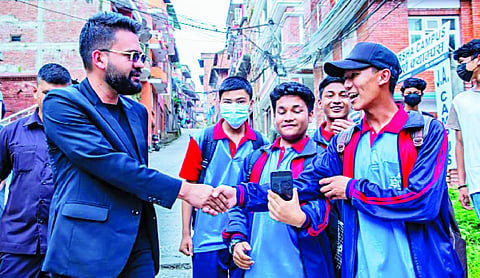

The euphoria that swept Balen Shah into office is gradually giving way to the harder realities of governance. With his first 100 days now behind him, the next phase will be crucial in shaping the future of Nepal’s democratic experiment
The new British Prime Minister Andy Burnham has two things in common with Nepalese Prime Minister Balen Shah: both have risen from Mayor to PM; and both want a new political and economic model. While Burnham has an experienced and capable team to do so, Shah has neither. Still, Balen has completed his honeymoon period of 100 days with a mixed record, even as his Adidas keds have begun to pinch. While the Balen craze seems to be on the decline, it is not clear who is calling the shots: Party Chairman Rabi Lamichhane, Shah or the PMO. By some reports, it is the PMO led by Balen’s political adviser, Kumar Ben, and his team.
Lamichhane is no Nitin Nabin, BJP’s titular head of the party. Lamichhane is a former deputy prime minister and home minister but carries the baggage of unresolved court cases, which do not allow him to hold any Cabinet office. Though he has the numbers in the party and government, it was the Balen craze that swept the elections. Obviously, there is an unspoken conflict between two young and ambitious politicians, which has spurred internal party strife, registering a decline in the Rashtriya Swatantra Party’s popularity. The sound of the bell (party symbol and rallying call) is getting muffled.
Yet, according to one confidential source, Balen consults Rabi frequently and their successful spouses, Sabina and Nikita, are good friends, though Sabina Kafle naturally captures the
limelight. Balen realises Rabi has stolen a march due to the tumultuous party convention in Chitwan last month and the red-carpet welcome in India. Balen’s focus on domestic affairs and decision not to travel abroad on any foreign visit have lost him mileage, which prompted his confidant Ben to meet NSA Ajit Doval, PM Modi’s principal adviser on the neighbourhood, especially Nepal, and discuss a possible Balen visit before he travels to the UNGA in New York in September.
A standing invitation to India for Balen was given by Modi soon after his triumphant victory, but scheduling in September may be a problem due to the BRICS summit fixed for September, unless he is a special invitee. Rabi is due to go to China, where he has sought a meeting with Communist Party Chairman Xi Jinping. At present, Rabi is the unquestioned leader who has managed differences with Balen.
Cracks within other political formations are natural after the Gen Z upheaval last year. GoP Nepali Congress was the first to introspect: after all, it had won a two-thirds majority in 1959, registering Nepal’s first short-lived tryst with multi-party democracy. King Mahendra dismissed the first elected Prime Minister, BP Koirala, which upset India even as its Army Chief, Gen KS Thimayya, was on a tiger shoot at Chitwan, Nepal, at that very time.
NC has never been fully united - parties within a party, at least three factions - and has split earlier and is on the verge of another split under the same patronage of five-time PM Sher Bahadur Deuba, who is abroad but will return shortly to face charges of corruption. The original NC, led by stalwarts Purna Bahadur Khadka and Shekhar Koirala, has challenged, through a review petition, the decision of the Election Commission and Supreme Court to award the flag and party symbol to rebel youth leader Gagan Thapa, who held a special party convention to be elected as NC party president. From the single-largest party with 87 seats in the last election, it has crumbled to its lowest-ever tally of 38 seats, still the second-largest party thanks to the mixed electoral system. Thapa has decided to break with Left parties in the Provincial Councils, where RSP has no representation.
Surprisingly, four-time PM KP Oli, who was the trigger of the Gen Z revolt last year, is still leader of CPN-UML, his health holding despite multiple kidney transplants, proving power is the biggest aphrodisiac. China, which is again recreating political space, is attempting to bring together all Left parties, including four-time PM Prachanda and former President Bidya Bhandari, spouse of legendary Left leader Madan Bhandari, into a grand Left alliance. It may end up in a surfeit of former PMs with few stormtroopers. Prachanda and Oli have allied to form governments in five of seven provinces.
Once kingmakers, the Terai-based parties and monarchists have been decimated by the RSP tsunami, but former Raja Gyanendra still hopes the monarchy, which is on the rise on social media, will return. Home Minister Sudan Gurung has announced a review of the 2000 Palace Massacre enquiry, when present President Ramchandra Poudel was Home Minister and Prince Gyanendra was in Pokhara. Former Indian ambassador KV Rajan and Atul K Thakur’s book, Kathmandu Chronicles, has covered the horrendous event in stark detail.
India enjoyed a fleeting sweet spot in Nepal with back-to-back visits by Lamichhane and Foreign Minister Shishir Khanal, who said his visit to India could be termed ‘special’, probably referring to India’s claim of “special and unique bilateral relations”. For 250 years now, Nepal has followed ‘balanced diplomatic relations’ between India and China in pursuit of the dictum enunciated by the founder of modern Nepal, King Prithvi Narayan Shah. In reality, this balance was always tilted towards India due to strategic geography and religious and cultural factors.
Advantage India has been diminished by the entry of a third power, the US, which two decades ago said it would follow India’s lead in South Asia. That is no longer the case. US Assistant Secretary of State for South and Central Asia, Samir Paul Kapoor, made a stand-alone visit to Nepal in April 2026, notably not meeting Balen Shah. He warned against Chinese ‘debt-trap diplomacy’ and asserted that no single power should dominate South Asia — a clear setback for India.
Nepal is India’s crown jewel in South Asia, located at the head of Bharat Mata. The blood bonding with Nepal through Gorkha recruitment is likely to be reviewed following a big rally commencing on July 29, from the Gorkha heartland in Lamjung. This strategic nirvana of bilateral relations.
The writer, a retired Major General, served as Commander, IPKF (South), Sri Lanka, and was a founder member of the Defence Planning Staff, now the Integrated Defence Staff; Views presented are personal.