Bangladesh’s first woman PM passes away at 80
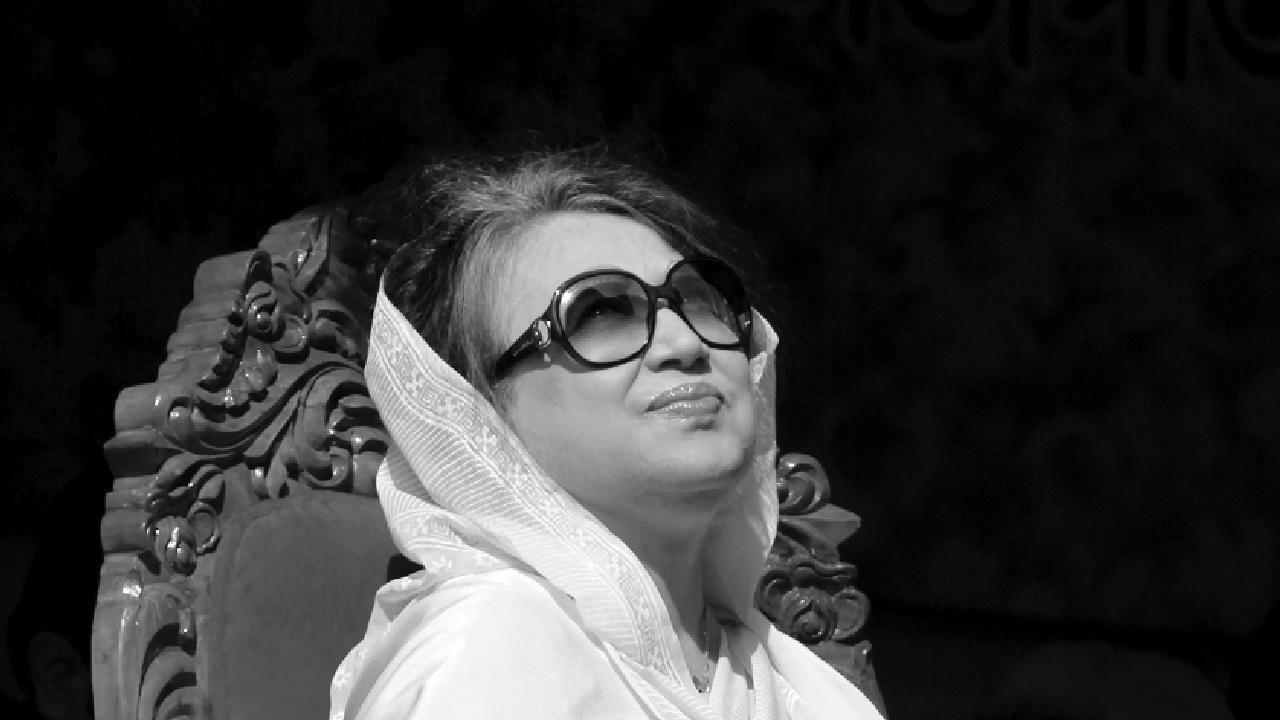
Khaleda Zia, Bangladesh’s first woman Prime Minister and a towering figure in the country’s turbulent political history, passed away on December 30 after a prolonged battle with illness, the Bangladesh Nationalist Party (BNP) announced. She was 80.
Zia had been undergoing treatment at Evercare Hospital in Dhaka since November 23. Her health deteriorated steadily over the past few weeks, and she was placed on ventilator support on December 11. Doctors treating her said she was suffering from multiple age-related ailments, including advanced liver cirrhosis, diabetes, arthritis, and severe cardiac and respiratory complications. Her personal physician had described her condition as extremely critical in recent days.
According to BNP sources, her condition worsened sharply late Monday night. A special aircraft had been kept on standby to fly her to London for advanced medical care, but a medical board declined clearance, citing the risks involved in moving her from the hospital to the airport.
Zia’s death comes at a crucial political juncture for Bangladesh, which is heading towards parliamentary elections scheduled for February. Only a day earlier, nomination papers were filed on her behalf for the Bogura-7 constituency. Her son and BNP’s acting chairman, Tarique Rahman, returned to Dhaka last week after nearly 17 years in exile and is widely viewed as a leading contender in the upcoming polls.
Rahman is expected to contest from Dhaka-17 and Bogura-6 constituencies. He had visited his ailing mother on Sunday and spent over two hours with her.
Prime Minister Narendra Modi expressed condolences over Zia’s demise, recalling her role in Bangladesh’s political evolution and her engagement with India. In a social media post, Modi said he was deeply saddened by her passing and extended sympathies to her family and the people of Bangladesh. He noted that as the country’s first woman Prime Minister, her contributions to Bangladesh’s development and India-Bangladesh relations would be remembered, and recalled his meeting with her in Dhaka in 2015.
Born into prominence after marrying liberation war hero Ziaur Rahman, Khaleda Zia entered politics following his assassination in a military coup in 1981. She took charge of the BNP in 1984 and emerged as a key leader of the movement against military ruler H.M. Ershad, enduring repeated detentions during his nearly nine-year rule. The mass uprising that forced Ershad to resign in 1990 paved the way for democratic elections the following year, which Zia won, making history as Bangladesh’s first woman Prime Minister.
She served two terms in office, from 1991 to 1996 and again from 2001 to 2006. Her governments focused on expanding access to education, particularly for girls, through free and compulsory primary schooling, stipends for female students, and food-for-education schemes. Her administration also raised the upper age limit for entry into Government service, a move aimed at widening employment opportunities.
Zia’s political life, however, was also defined by her intense rivalry with Awami League leader Sheikh Hasina, a five-time Prime Minister whose Government was overthrown in August 2024 amid violent protests. The two leaders differed sharply in their political outlook and foreign policy priorities, particularly in relation to India. While Hasina was widely seen as pro-India, Zia maintained a more cautious and nationalist stance, emphasising Bangladesh’s sovereignty.
As Prime Minister and later as Leader of the Opposition, Zia opposed granting India overland transit facilities to its northeastern States, arguing that such arrangements compromised Bangladesh’s security interests. She also resisted the renewal of the 1972 Indo-Bangladesh Friendship Treaty, contending that it constrained her country’s strategic autonomy. At various points, she framed her policies as safeguards against what she described as Indian domination, while also insisting that cooperation should be linked to tangible benefits for Bangladesh, including progress on the Teesta water-sharing agreement.
Though she remained out of power after 2006 and spent years in prison or under house arrest on corruption charges, Zia continued to command strong popular support. She was allowed to travel abroad for medical treatment earlier this year after Bangladesh’s interim government relaxed restrictions imposed during Sheikh Hasina’s tenure.
Her death marks the close of a defining era in Bangladeshi politics. With the BNP widely seen as the frontrunner in the forthcoming elections and Tarique Rahman emerging as a central figure, the political legacy of Khaleda Zia is set to continue shaping Bangladesh’s future.
Jaishankar to attend funeral
New Delhi: External Affairs Minister S Jaishankar will represent India at the funeral of former Bangladesh Prime Minister Khaleda Zia, underscoring New Delhi’s diplomatic engagement at a delicate moment in Bangladesh’s political transition. India’s decision to send its external affairs minister to Dhaka highlights the importance New Delhi places on continuity and stability in its relationship with Bangladesh amid ongoing political uncertainty.
Deeply concerned to learn about the health of Begum Khaleda Zia, who has contributed to Bangladesh’s public life for many years. Our sincere prayers and best wishes for her speedy recovery. India stands ready to extend all possible support, in whatever way we can. — Narendra Modi, Prime Minister