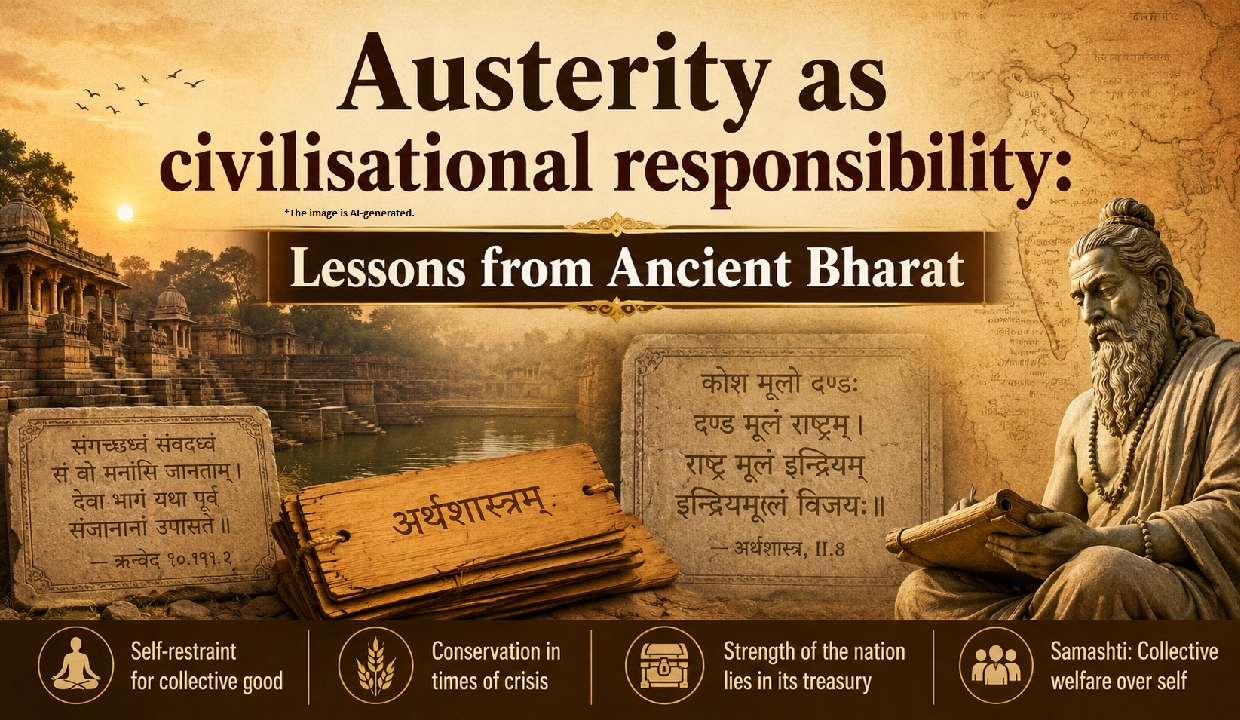
Austerity as civilisational responsibility: Lessons from Ancient Bharat
The Prime Minister’s clarion call for austerity measures is a sincere and honest effort for the future prosperity of the nation and the welfare of all Indians
The Prime Minister of India made a patriotic call for austerity measures for the citizens amid heightened global uncertainty. It is now the citizens' duty in the national interest to follow this for the larger and greater good of the nation.
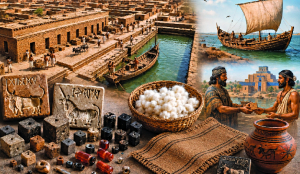
In ancient Bharat, too, there were austerity measures suggested by the state: not as impositions of hardship, but as expressions of Dharmic responsibility, collective wisdom and civilisational maturity. The idea that the citizens must voluntarily restrain consumption during calamity or adversity is, in fact, among the oldest crisis management mechanisms of Indian statecraft.
The Kautilyan Framework: State and Austerity
The most systematic articulation of state-directed austerity in ancient Bharat is found in Kautilya's Arthashastra. Kautilya underscored that the prosperity of the state (Rajya) rested on its treasury (Kosha) and that the treasury, in turn, depended on the disciplined conduct of both the leader and the populace. In times of calamity (Apad) - drought, flood, invasion, epidemic, economic distress etc. - he instructed specific conservation measures.
In the Arthashastra's Adhikarana (Book)-II, Kautilya explicitly advises the state to curtail expenditure on luxury and non-essential items during periods of fiscal strain and to lead by personal example. He enjoins the state to demonstrate Mitavyayita, i.e., frugality or economy in expenditure, as a model for the politico-economic realm. The masses, he argued, tend to follow the conduct of their sovereign; when the head of the state himself practises restraint, the compatriots naturally incline toward the same. The Prime Minister is leading the austerity measures by example.
The Concept of Apatkala
Ancient Indian Dharma Shastra literature, including texts like the Manusmriti and Yajnavalkya Smriti, identified a category called Apatkala (time of calamity or adversity) as distinct from Sushama (time of normalcy). During Apatkala, both rulers and laypeople were accorded different standards of conduct precisely because survival and collective welfare took precedence over ordinary routine. The very recognition of such a category in jurisprudential and ethical literature signals that ancient Bharat institutionalised the idea that crisis demands voluntary adaptation.
The Manusmriti (10.114) states that in difficult times, even ordinarily impermissible actions may be undertaken for sustenance, thereby reflecting that austerity and adaptive conservation are not punishments but pragmatic and Dharmic responses to extraordinary circumstances.
Grains, Gold and the Sacred Duty of Conservation
The hoarding of grain and gold during public crises was expressly condemned in the ancient Indian textual universe. The Arthashastra (Adhikarana IV, Chapter 2) articulates punishment for those who withheld essential commodities during scarcity, while simultaneously encouraging the populace to contribute voluntarily to public granaries.
Gold (Suvarna) in ancient Bharat held an irreplaceable economic role, much as foreign exchange does today. Royal edicts and treatises alike warned against the unproductive accumulation of gold during emergencies. Resources that could sustain the war-chest, feed armies or support public works were not to be locked away in personal coffers when the realm faced external threat.
The Powerful Voice of the Texts
The philosophical underpinning of austerity in ancient Bharat is most powerfully captured in this verse from the Manusmriti (11.234), which underlines the virtue of austerity (Tapa) as the foundation of strength and Dharma:
"Austerity is the root of all happiness, both divine and human. Everything is purified by austerity, and through austerity one attains all fruits."
The concept of Tapa (austerity or disciplined self-restraint) here is not limited to the ascetic in the forest; it is presented as a civic and social virtue that is accessible to and expected of every person. Voluntary restraint of the body and its appetites, in the service of a higher ethical goal, is precisely the spirit behind the clarion call.
The second verse comes from the Arthashastra about Kautilya's foundational maxim on the relationship between treasury and national power (Adhikarana II, Chapter 8):
"Treasury is the backbone of administration."
This profound aphorism conveys that all state power - military strength, administrative capability and the capacity to protect citizens - flows from a healthy national treasury. A nation that conserves its resources safeguards its sovereignty. Citizenry who execute the call to reduce fuel consumption, avoid unnecessary imports and forgo non-essential luxuries are, in Kautilya's scheme, directly sustaining the foundations of national power.
The Ideal of Samashti: Collective Welfare over Individual Desire
Ultimately, the ancient Indian worldview did not regard austerity as deprivation but as the highest expression of Samashti consciousness, i.e., the awareness that the individual is embedded in and responsible to the collective.
The Rig Veda speaks of Samgachchadhvam ("let us move together") as the foundational principle of civilised community life. From that vantage point, voluntary restraint during crisis was never seen as a sacrifice alone, but as a Yajna: an offering to the nation's fire.
From Kautilya's precise codes of conduct to the Gita's exhortation of Tapa as civic virtue, ancient Bharat bequeathed to its civilisational inheritors a rich and nuanced perspective of state-guided, Dharma-rooted austerity. The Prime Minister's call today stands in direct continuity with ancient Indian wisdom. It is not a novel inconvenience but an ancient duty, reawakened. For a civilisation that has always understood that true strength lies not in what one consumes but in what one is willing to conserve, the path forward is clear: Mitavyayita, i.e., measured and purposeful restraint. It is because of this that we are today the world's fastest-growing economy.
As good citizens, we must ensure and follow the Prime Minister's appeal, just as we voluntarily followed the lockdown and COVID protocols, united in spirit and solidarity towards the well-being and protection of one and all. The Prime Minister's clarion call is, hence, a sincere and honest effort for the future prosperity of the nation and the welfare of all Indians.
R K Pachnanda, Former Chairman, Haryana Public Service Commission; Former Chairman, Haryana Electricity Regulatory Commission; Former DG-ITBP; Former DG-NDRF; Commissioner of Police. Kolkata; Director, Bharat ki Soch; Views presented are personal.