AI takes the ‘I’ from you
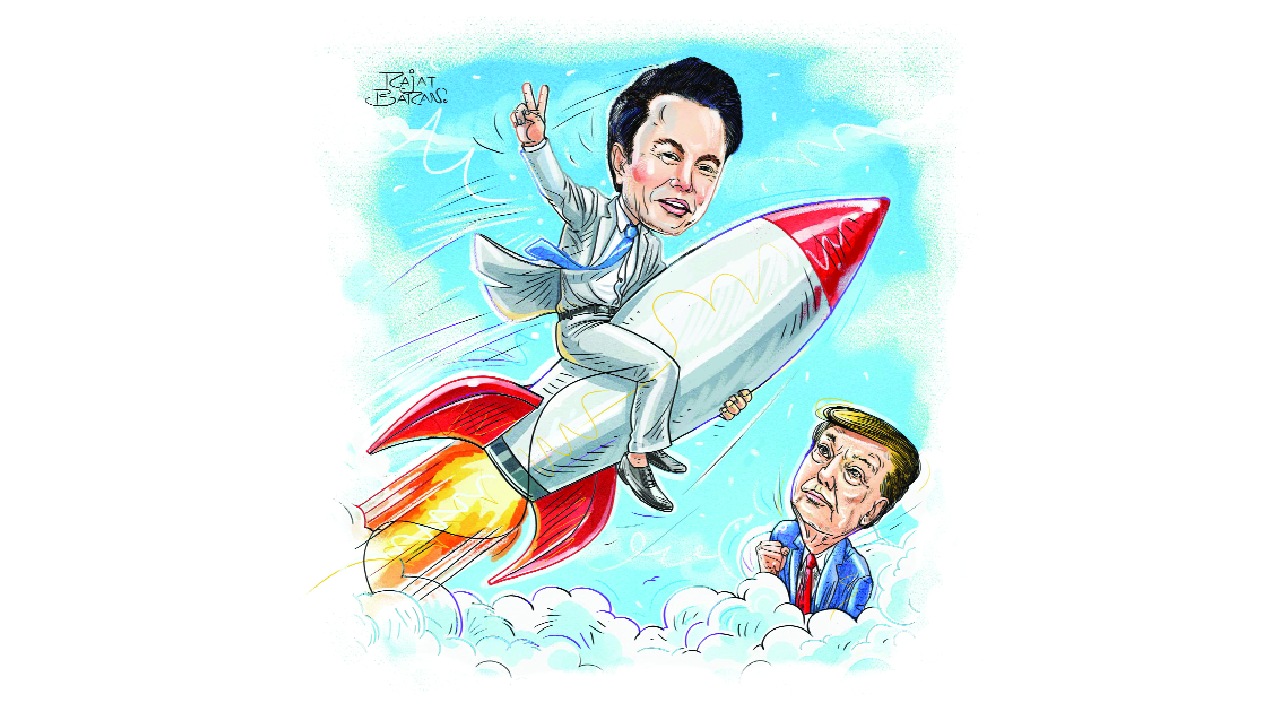
The world of Artificial Intelligence (AI) continued to expand and spread in 2025. Personalities, firms, economies, and societies were judged by the adoption of new-age tech. People's wealth zoomed due to higher and crazy valuations ascribed to tech stocks. Elon Musk was a prime example, as were start-ups in America, China, and elsewhere. The top 10 US founders of the world’s largest tech firms added more than half-a-trillion dollars to their wealth. Musk’s net worth was up 50 per cent, or more (if one takes the latest figures). Jensen Huang, the CEO of the largest chipmaker, Nvidia, sold a billion-dollar worth of shares to cash on the zooming stock price, even as the firm became the world’s first $5 trillion company in October 2025. Nvidia’s worth is now larger than the GDP of Japan, or India.
Firms and nations wrestle with AI, hoping for productivity gains. CEOs are excited about the power of these tools, which can transform the way firms think, and act. The US and China are at loggerheads over who will finally dominate AI. Each one hopes to spend trillions of dollars to achieve this objective. The European Union hopes to latch on to the tails of the possible winner, or hitch their bandwagon to both. However, employees and workers are worried about job losses, and finding themselves short of future skills. Indeed, there is a paradox within firms. While senior management pushes for AI, the mid-level one wishes to derail the process. Some studies indicate that AI moves falter since the mid-level shuns it after a while.
Nations like India, which have little hope of joining the AI sprint, or even becoming a part of the finals, wish to become the backroom boys. Like in software, they feel that they can get an edge over the outsourcing process, and nudge the big players to give a part of the work to Indian firms. In addition, the Indian policy-makers want to reduce the dependence of global giants by developing their own local AI tools, and algorithms. While the intentions are good, the success rates are minimal. One may learn from China, which first successfully took on the western social media dominance, and then ran shoulder-to-shoulder with the US in AI. But this requires a long-term (10-20 years) vision, and national, political, and business consensus across different sets of players with differing ambitions.
As this newspaper has highlighted in several past columns, AI is not merely a business tool. It influences personal, emotional, intellectual, and spiritual aspects of a human being. More people rely on ChatGPT as a friend, companion, counsellor, mentor, and advisor. AI tools influence lifestyles, livelihoods, and basic living. Humans are slowly outsourcing their lives and thinking to tech, which creates images of a future world, when machines and humans may tussle for control. The reels may turn real, as reality mirrors movies, rather than the opposite. Life can come in different forms. Ours is based on carbon, machines on silicon. Who is to decide which is real, and which artificial? AI may become RI, or real intelligence. Possibly, in a parallel world, there is silicon-based intelligence.
Hence, AI ethics have gained importance, which will increase in the future. AI tools, platforms, and processes will be judged on fairness, accountability, and transparency. Users will demand audits of data and algorithms to fish out degrees, and rule out chances of biases based on races, gender, and socio-economics. Data protection, and ethical cybersecurity will gain prominence. There will be firms to assess impact, and evaluate AI’s effects, both positive and negative, on people’s lives. Regulators and policy-makers will insist on policies to manage, monitor, even judge AI, and its implications. “As technologies become more powerful and more personal, trust is increasingly the gatekeeper to adoption. Companies face growing pressure to demonstrate transparency, fairness, and accountability, whether in AI models, gene editing pipelines, or immersive platforms. Ethics are no longer just the right thing to do but rather strategic levers in deployment that can accelerate, or stall, scaling, investment, and long-term impact,” states a McKinsey report.
What is of concern is that while AI is fast gaining momentum in the emerging markets, the developed nations remain cagey. According to the Stanford University AI index in 2025, “In countries like China (83 per cent), Indonesia (80 per cent), and Thailand (77 per cent), strong majorities see AI products and services as more beneficial than harmful. In contrast, optimism remains far lower in places like Canada (40 per cent), the United States (39 per cent), and the Netherlands (36 per cent).”