Agricultural development agenda for BRICS
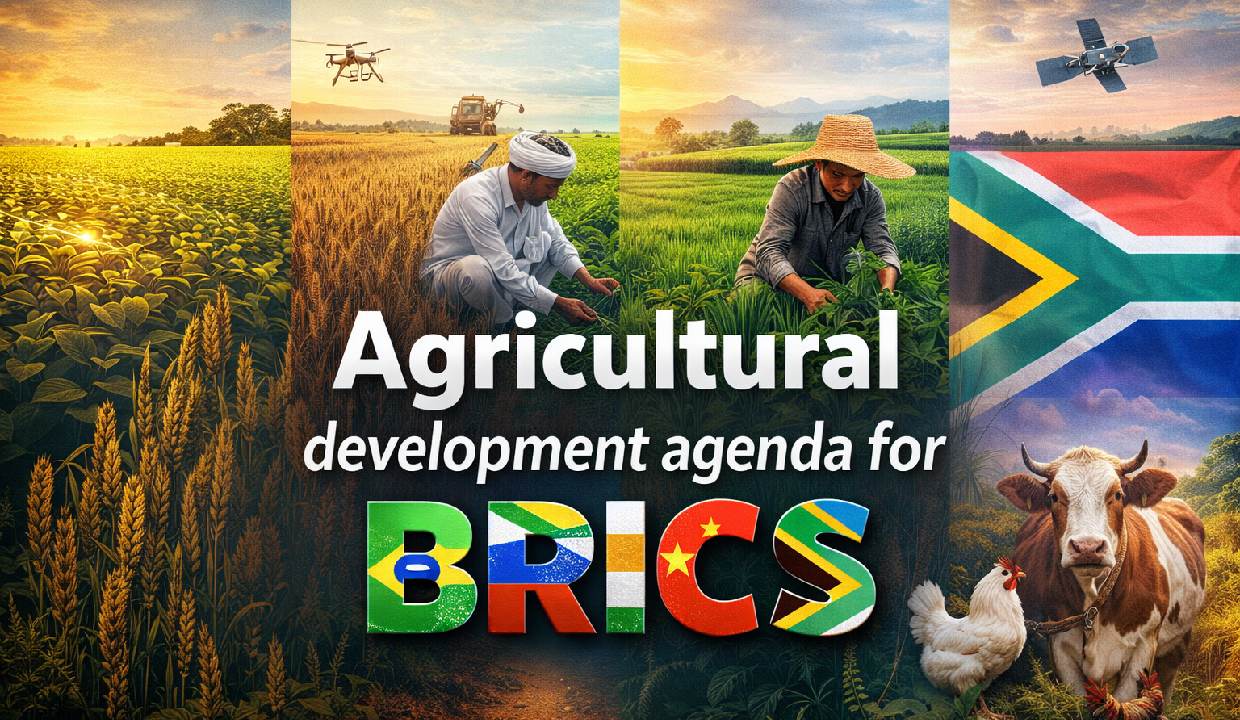
As India assumes leadership of BRICS, it has a rare opportunity to place agriculture firmly at the centre of the bloc’s agenda. For a grouping that includes 11 countries, most of them developing economies with deep agricultural roots, this focus is not optional. It is foundational.
Together, BRICS countries constitute a formidable global agricultural powerhouse.
They cultivate a significant share of the world’s arable land and span diverse production systems; extensive soybean and sugarcane cultivation in Brazil, large-scale wheat, grain and sunflower production in Russia, and intensive, smallholder-driven agriculture across China, India, Indonesia, Ethiopia, South Africa and others. This diversity is both a strength and a responsibility.
Food and nutrition security remain central challenges for the world, and BRICS nations carry a particular obligation to ensure that their policies safeguard the nutritional needs of their populations; and, increasingly, those beyond their borders. As geopolitical realignments reshape global supply chains, agriculture will become more localized, with a sharper emphasis on self-sufficiency. BRICS has a decisive role to play in navigating this transition.
Across most BRICS countries, agriculture is dominated by smallholder farmers, with women playing an ever-growing role. At the same time, robust and sustainable local food systems are gaining importance, and regenerative agriculture is emerging as a critical pathway to long-term sustainability.
These shifts are occurring against a backdrop of climate change and natural resource depletion, which threaten productivity even as population growth and rising food-quality expectations demand more output from fewer resources. Compounding the challenge is the declining profitability of farming, which risks alienating the next generation from agriculture altogether.
Despite substantial gains in global agricultural production, hunger persists. This paradox highlights the urgent need for affordable food systems and efficient supply chains that reach the poorest populations. It also highlights the gap between production and access, a gap BRICS must address collectively.
Several priorities merit attention as BRICS shapes its agricultural agenda. Technological progress in agriculture remains concentrated in a few countries, leading to an inequitable distribution of benefits. Making modern science and technology accessible to BRICS farmers is essential for improving yields and resilience.
A BRICS Agricultural Research Platform could fund locally relevant research in each country and ensure that outcomes are shared equitably, particularly with farmers in developing economies.
Regulatory alignment is another critical area. Harmonised policies governing seeds, crop protection and crop nutrition would facilitate the smooth movement of modern agricultural technologies across borders. BRICS must work towards inclusive frameworks for deregulation, licensing, intellectual property protection and commercialisation, models that enable innovation without exploitation.
Sustainable and regenerative agriculture, coupled with natural resource conservation, must be incentivised at the farm level.
This will require large-scale farmer education in local languages and a holistic approach that recognises the role of livestock, poultry and fisheries in food security.
To encourage healthy competition and accountability, India could propose a BRICS Sustainable Agriculture Index to track progress at the farm level, alongside improved access to carbon markets.
The rapid advancement of digital, satellite and related technologies has transformed many sectors; agriculture should be no exception. Data-driven, open-source digital public goods with interoperability could be developed and made freely available to farmers across BRICS countries. Such platforms could deliver advisory services, quality inputs, credit and insurance, crop monitoring, storage solutions and value-chain management. During its presidency, India is well placed to champion this initiative, drawing on its extensive talent pool.
Climate volatility, manifested in floods, droughts, rising temperatures and unseasonal rains, is already imposing severe stress on farmers. Developing climate-resilient crop varieties, agricultural technologies and food management systems must be treated as global public goods. BRICS should fund this effort through CGIAR institutes and ensure that the resulting innovations are accessible to farmers across member countries.
Equally important is the collectivisation of farmers and their integration into markets. Improved price discovery, reduced post-harvest losses and more efficient supply chains should feature prominently in the action plan. Farmer collectives across BRICS countries could also be linked to promote cross-border business opportunities.
Measuring progress will be vital. A comprehensive food and nutrition security index, applicable at national, provincial and even household levels, could help assess outcomes across BRICS countries. India could play a leading role in developing such a metric, alongside promoting responsible consumption and healthy dietary habits.
India’s BRICS presidency also presents an opportunity to advance its agricultural exports. Showcasing Indian products and building export-oriented value chains for select crops could unlock new markets. Seed exports, in particular, hold significant potential, provided they are supported by enabling policies, upgraded technology and quality standards, improved logistics, robust plant quarantine facilities and a dedicated seed export promotion council.
Multilateral platforms often adopt ambitious agendas; delivering tangible results remains the real test. Bridging the gap between intent, action and impact should define India’s approach to agriculture during its BRICS presidency.
With the right mix of policy clarity, incentives and collaboration, India can leave a lasting imprint, one that strengthens agriculture and advances farmer welfare across the BRICS world.
The Author is a Partner at AgVaya LLP Views expressed are personal; views are personal.