Agni: The Forgotten Science of Digestion
Modern society obsesses over diets, superfoods, supplements and food choices, yet digestive and metabolic disorders continue to rise. This suggests the issue may not be only what we eat, but how well we digest and assimilate it. The important question is, what if the problem is not merely what we eat, but our ability to digest and assimilate what we consume?
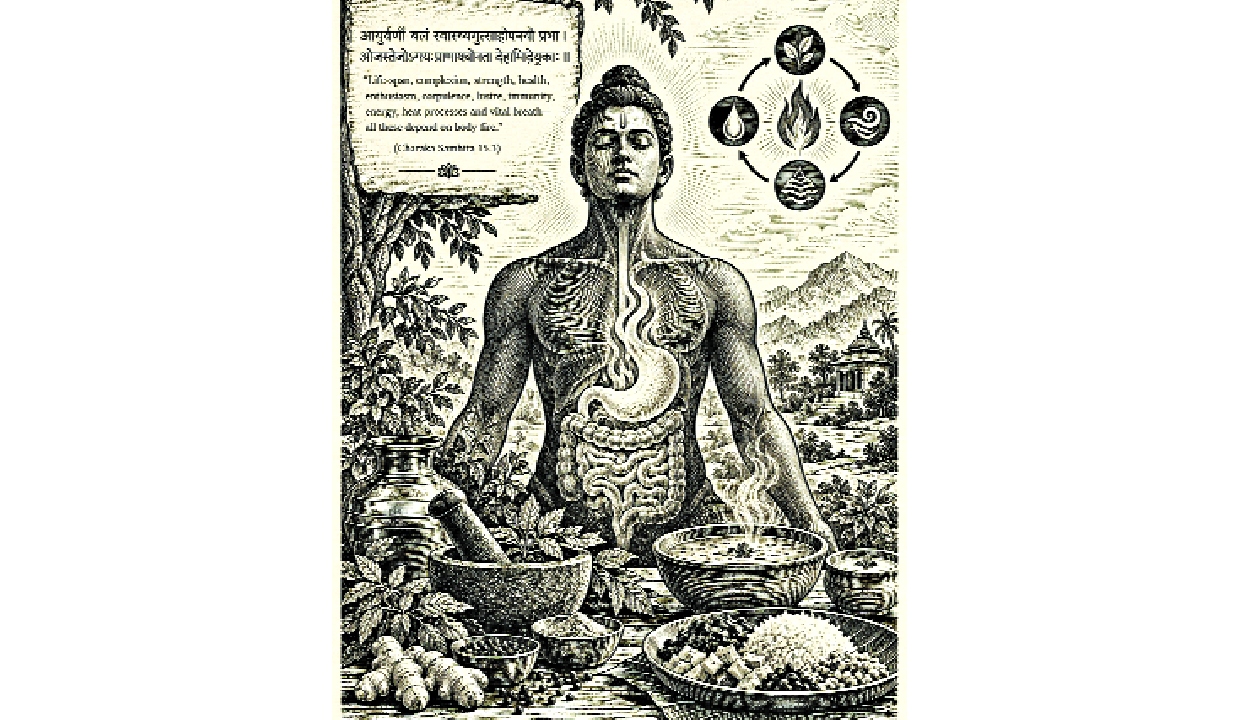
More than two thousand years ago, Ayurveda placed this question at the very centre of its understanding of health. Its answer was Agni, the digestive fire, i.e., Ahara —> Jatharagni —> Bhutagni —> Dhatvagni —> Dhatu Nourishment —> physiological function. In the classical texts, Agni is the principle of transformation that converts food into nourishment, nourishment into tissue, and life into vitality. The modern health crisis, Ayurveda would argue, is not merely a crisis of nutrition. It is a crisis of digestion.
In modern medicine of endocrinology, this has been explained as Hormone —> receptor —> cellular response —> organ function —> physiological outcome, for a healthy and balanced body to function.
The Centrality of Agni
The importance of Agni in Ayurveda can hardly be overstated. The Charaka Samhita declares:
"Life-span, complexion, strength, health, enthusiasm, corpulence, lustre, immunity, energy, heat processes and vital breath-all these depend on body-fire. One dies if this fire is extinguished, lives long free from disorders if it is functioning properly, gets ill if it is deranged, hence Agni (digestive fire) is the root of all".
This remarkable statement immediately reveals that Agni is presented as the foundation of life itself.
The Sanskrit word Agni literally means fire. Just as external fire transforms raw substances into something useful, internal Agni transforms food into energy and vitality. Without fire, food remains uncooked. Without Agni, nourishment remains unavailable to the body.
Digestion as Transformation
One of the most striking features of Ayurvedic thought is that it views health as a continuous process of transformation. Food enters the body as an external substance. Through the action of Agni, it becomes part of the individual. This transformation is so central that Ayurveda places digestion before nutrition.
The Charaka Samhita describes a hierarchy of metabolic fires. At the centre is Jatharagni, the primary digestive fire located in the gastrointestinal tract. Classical texts regard it as the master fire because all subsequent metabolic processes depend upon it. According to Ayurveda, health begins to deteriorate when Agni becomes weak or disturbed. The result is the formation of Ama, often described as improperly digested or incompletely transformed material. It represents a state of incomplete transformation. The implications are profound. One may eat nutritious food and yet fail to derive nourishment from it if Agni is impaired.
This perspective shifts attention away from food alone and toward the body's capacity to process food.
The Four Functional States of Agni
Ayurveda identifies four conditions of digestive fire.
Sama Agni, the balanced fire, represents the ideal state. Digestion is regular, appetite is healthy, elimination is proper and vitality is maintained.
Manda Agni, the sluggish fire, digests food slowly and inefficiently. Heaviness, lethargy and loss of appetite are common features.
Tikshna Agni, the excessively sharp fire, digests too rapidly. Hunger becomes excessive and the body may become depleted despite frequent eating.
Vishama Agni, the irregular fire, fluctuates unpredictably. Sometimes digestion is strong; at other times it is weak. Appetite becomes erratic and digestive disturbances frequently arise.
These categories indicate the functional state of metabolism, the current state of health, and how well the body is processing food and emotions.
Folk Wisdom and the Social Life of Agni
One of the great strengths of Indian civilization was that knowledge of Agni was not confined to physicians. Concepts that originated in Ayurvedic texts gradually entered everyday culture through proverbs, household customs, seasonal foods and festival practices.
Traditional communities instinctively adjusted their diets according to climate and season. Summer drinks such as buttermilk preparations and panakam were not merely refreshments. They reflected an understanding that digestive power changes with the seasons. The same principle underlies Dinacharya, the Ayurvedic science of daily routine. According to modern medicine, the hormone melatonin regulates the circadian rhythm, which in turn controls the sleep-wake cycle, that is, our biological clock. Modern readers often regard Dinacharya as a collection of traditional rules. In reality, its deeper purpose is the preservation of Agni. A particularly beautiful analogy compares health to a lamp. A lamp burns steadily only when supplied with proper fuel and protected from extinguishing forces such as wind and water. Agni functions in exactly the same way. Proper food, exercise and routine provide fuel. Irregular habits, excessive indulgence and neglect extinguish the flame. Dinacharya is therefore not a collection of arbitrary rules. It is the daily practice of tending the inner fire.
What Modern Life Has Forgotten
Many people now sleep late, wake tired, eat irregularly, snack constantly, and have their heaviest meals at night, often while distracted or stressed. In Ayurvedic terms, these habits disturb the natural rhythm essential for healthy digestion.
Interestingly, modern scientific research increasingly points in a similar direction. Circadian rhythms influence metabolism, hormone secretion and digestive function. Meal timing affects metabolic health. Sleep disruption affects numerous physiological systems. The Charaka Samhita repeatedly emphasises moderation:
"Neither fasting nor overeating sustains health; strength is preserved through regulated and moderate eating."
Rather than discussing circadian genes and metabolic pathways, Ayurveda spoke of the strengthening or weakening of Agni. Ayurveda reminds us that health depends not only upon what enters the body but also upon what the body is capable of transforming. The forgotten science of digestion is a reminder that life itself depends upon the delicate art of transformation. And perhaps that is the lesson most worth recovering today.
Gopal Krishna, Former Secretary, Ministry of Ports, Shipping & Waterways; Dr. Suchi Dayal, Senior Research Fellow, Bharat Ki Soch; Views presented are personal.