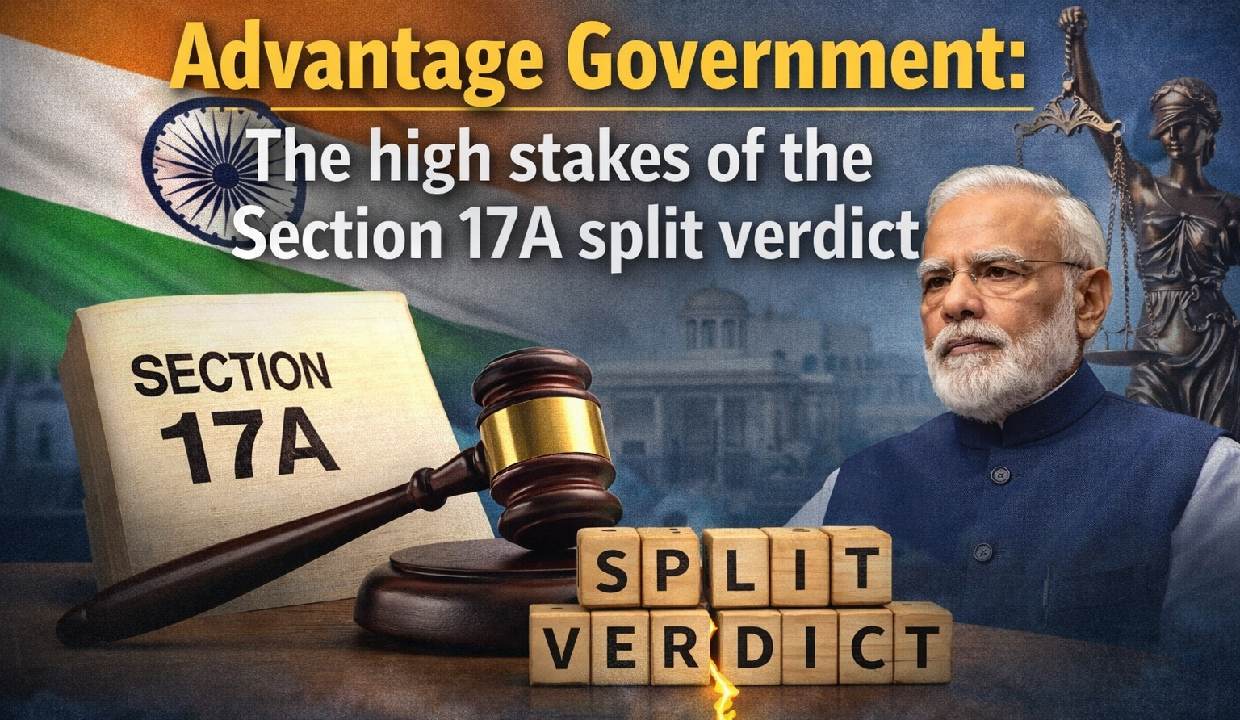
Advantage Government: The high stakes of the Section 17A split verdict
Corruption is endemic in the country. Different Laws have been enacted to deal with the menace of corruption, but it has often been found that Government efforts have been lacking in reaching the highest levels of the bureaucracy. This aspect of the law has been tested before the Supreme Court over the last three decades and has been reflected in judgments such as those in Vineet Narain, Dr Subramanian Swamy, and more recently, on January 13, 2026, in the Centre for Public Interest Litigation (CPIL) matters.
The common thread connecting the three judgments is the legal battle against “Prior Sanction” — the requirement that the Government must give permission before the police can even begin to investigate a high-ranking official. In each case, the contention was that the Government was trying to create a “wall” around senior bureaucrats.
In all three cases, the Supreme Court grappled with the same fundamental question: Does this protection shield honest officers from harassment, or does it shield corrupt officials from the law?
In the Vineet Narain (1997), also known as the Jain Hawala Case, the Supreme Court dealt with the challenge to the Government’s “Single Directive,” which required Central Bureau of Investigation (CBI) to get permission before investigating officers of Joint Secretary level and above in the Central Government and senior officers in the Reserve Bank of India (RBI), Public Sector Undertakings (PSUs), and Nationalised Banks. The Jain Hawala Case was a massive 1990s political scandal involving bribes allegedly paid by the businessman brothers to top politicians and bureaucrats, discovered through detailed entries in secret diaries.
The Supreme Court struck down the “Single Directive” because a government executive order illegally interfered with the statutory powers of the CBI to investigate crimes. It ruled that creating a “privileged class” of senior officers who are immune to investigation while junior officers are not is discriminatory and arbitrary, and goes against the mandate of Article 14 (Right to Equality) of the Constitution. Further, it was held that the Executive cannot use an “instruction” to stop a “law” from working.
Since CBI’s power to investigate comes from the statutory Delhi Special Police Establishment (DSPE) Act, after the Vineet Narain judgment, the Government introduced Section 6A into the DSPE Act in 2003 to provide a statutory “filtering mechanism” that shielded senior bureaucrats (Joint Secretary and above) from frivolous investigations by requiring prior Government approval.
Shortly, the introduction of Section 6A was challenged by Dr Swamy on the grounds that it effectively resurrected the “Single Directive” that the Supreme Court had already struck down in the Vineet Narain case. It prevented the CBI from even conducting a preliminary inquiry to verify complaints, thereby shielding potentially corrupt high-ranking officials.
A five-judge Constitution Bench of the Supreme Court agreed with Dr Swamy’s arguments and struck down Section 6A as unconstitutional because it created classification between different ranks of officers. While the judgment in the Dr Swamy case was delivered in 2014, the years prior to that witnessed several cases of corruption involving the names of senior bureaucrats.
The Section 6A judgment was a big setback for the Government, which was mulling over coming out with a law to shield senior bureaucrats to overcome the phase that was dubbed in the economic circle as that of policy paralysis, as the senior officers were hesitant to take a decisive call on policy matters, fearing the risk of a corruption inquiry.
To fill this vacuum after Section 6A of the DSPE Act was struck down, the Government introduced Section 17A through the Prevention of Corruption (Amendment) Act, 2018, arguing that without any protection, honest officers were becoming afraid to take bold decisions.
To bypass the “discrimination” argument under Article 14, the 2018 Amendment made Section 17A applicable to all public servants, regardless of their rank. It also contained the provision that no police officer can conduct an inquiry or investigation into a public servant without the prior approval of the relevant Government authority.
Immediately after the amendment was passed by Parliament, the CPIL, represented by advocate PrashantBhushan, challenged the validity of Section 17A in 2018 before the Supreme Court, arguing that the provision was unconstitutional and a direct attempt to bypass previous Supreme Court rulings. CPIL contended that the Government could not reintroduce the same “prior approval” requirement under a new name.
Approximately seven years after the petition was filed, a two-judge bench on January 13, 2026, delivered a split verdict. Justice BV Nagarathna struck down as unconstitutional the introduction of Section 17A in the PCA, while Justice KV Vishwanathan held that the law is constitutionally valid and put a rider that the Government shouldn’t decide on approval.
Instead, they must forward all requests to the Lokpal (at the Centre) or Lokayukta (in States). The independent body’s recommendation would be binding. Justice Nagarathna’s opinion is in line with the essence of judgments in Vineet Narain and Dr Swamy’s cases. The judge described the introduction of Section 17A in the PCA as “Old Wine in a New Bottle.” She held that Section 17A is essentially a third attempt to resurrect a failed regime. She argued that the reasons for striking down Section 6A (DSPE Act) apply equally here because the law still creates a “privileged class.”
While Section 17A covers all ranks on paper, she observed that in practice, it only shields those who make “recommendations/decisions” — typically higher-level officers. This creates an illegal classification between decision-makers and lower-level clerical staff.
The judge emphasised the principle of “Nemojudex in re sua” (no one should be a judge in their own cause). Since corruption often involves collective decision-making, the Government cannot impartially decide whether to investigate its own officials.
She argued that by blocking even a preliminary enquiry, the law “forestalls justice at the threshold.” Without an enquiry, the truth behind a complaint remains unknown, effectively shielding the corrupt rather than protecting the honest, and disagreed with the idea of “reading down” the law to involve the Lokpal, calling it “judicial legislation.” She maintained that once the provision is unconstitutional, the court cannot rewrite it. Justice Vishwanathan gave credence to the issue of “Policy Paralysis” in his judgment and shared the Government’s concern that, without a shield, the nation would suffer as bureaucrats would avoid bold decisions if they feared every bona fide error could lead to a criminal probe.
He argued that the entire law shouldn’t be scrapped just because it might be abused. The panacea of striking down will turn out to be worse than the disease, and thus, “throwing the baby out with the bathwater” is not the option. The judge said that since approval by a competent Government authority to investigate the complaint may lead to a conflict of interest, an independent body like the Lokpal (at the Centre) or Lokayukta (in States) recommendation would be binding.
He also took note that in the age of social media, “parading an honest person in court” causes irreversible damage to their goodwill and Section 17A acts as a necessary filter to prevent such “mala fide” prosecution, which is also rank-neutral as it applies to all public servants, thus surviving the Article 14 test.
Having regard to the divergent opinions expressed by the two judges, the Chief Justice of India will now constitute an appropriate larger Bench to consider the issues which arise in this matter afresh. Until then, the validity of Section 17A remains in a state of legal limbo.
Thus, the final answer on the constitutional validity of Section 17A will take much longer, and the law remains operational as there was no stay on it during its seven-year pendency before the Supreme Court. The law has protected officials from investigation over the last seven years.
Further, the delay in the final adjudication may lead to a rise in complaints, and resultantly Government, in all likelihood, would sit over many of them. The situation would become more worrisome as during the hearing, the Union of India, in its affidavit, provided a larger picture of how Section 17A has functioned since its inception in 2018, which was not encouraging.
Of the 2,395 cases where the CBI sought prior approval under Section 17A, the Government denied the permission in 41.3 per cent of the cases (989 requests), and there was no inquiry or investigation to begin with.
A significant percentage of cases were found to be pending indefinitely, often far exceeding the statutory timeline of three months (extendable to four). While the exact percentage of “pure inaction” varies by department, the judges noted that the average time taken often stretched into years, effectively killing the investigation through delay.
In this background, it is expected that Chief Justice of India Surya Kant will move to constitute a larger Bench at the earliest to adjudicate the constitutional validity of Section 17A of the PCA. A timely resolution is essential to maintain public confidence in the administration of justice. Any prolonged delay risks fueling criticism and frustration among civil society and public-spirited individuals, who have waged a protracted battle against corruption at the highest levels of governance.
Till then, it’s an advantage to the Government.
Leave a Comment
Comments (1)
Will Justice Nagarathna apply her reasoning to the milords? They are public servants too.