Adhikari takes West Bengal crown
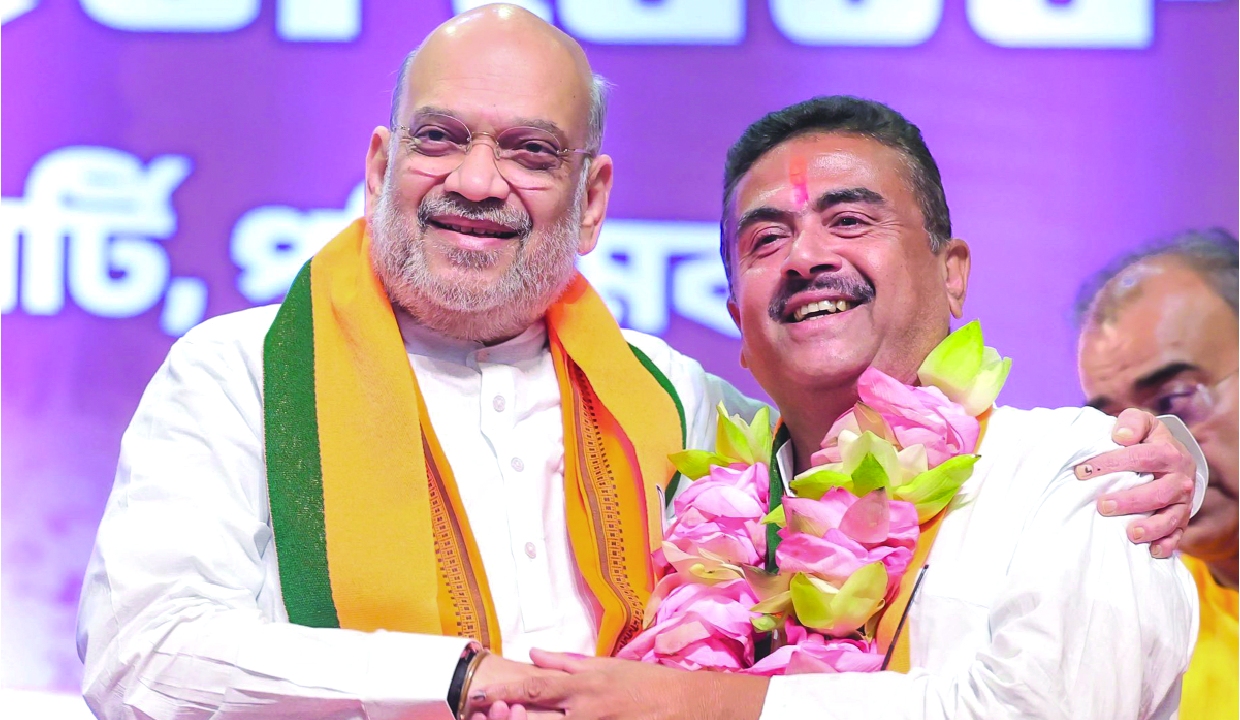
Once Mamata Banerjee’s closest aide, Adhikari now leads the State’s first BJP Government
In a historic development that signals the dawn of a new political era in West Bengal, Union Home Minister Amit Shah on Friday formally announced Suvendu Adhikari as the Chief Minister-designate of the State following the BJP’s landslide victory in the 2026 Assembly elections.
Addressing a meeting of the BJP Legislature Party in Kolkata, Shah declared that Adhikari has been unanimously elected as the ‘leader’ in the Assembly. “Suvendu Adhikari will take oath as the next Chief Minister of West Bengal tomorrow (Saturday, May 9, 2026) at the Brigade Parade Ground,” Shah said, drawing loud cheers from party leaders and MLAs. Adhikari, who was present at the meeting, was seen wiping tears as senior leaders embraced him.
The announcement came hours after the Election Commission declared the results of the fiercely contested polls, in which the BJP stormed to power with a humongous majority of 207 seats in the 294-member Assembly. The Trinamool Congress (TMC), which had ruled the State for 15 years under Mamata Banerjee, was reduced to just 80 seats. The vote share stood at 45.84 per cent for the BJP and 40.80 per cent for the TMC and voter turnout touched a record 92.93 per cent. Adhikari’s elevation caps a stunning personal and political triumph. The 55-year-old leader not only retained his traditional stronghold of Nandigram with a handsome margin but also delivered a sensational blow to Mamata Banerjee by defeating her in her own family citadel of Bhabanipur by over 15,105 votes, a ‘giant-killing’ act that has come to define his image in Bengal politics.
Party insiders said Shah’s announcement was a formality after the high command had already zeroed in on Adhikari as the natural choice to lead the first BJP Government in the State’s history. Prime Minister Narendra Modi is expected to attend the swearing-in ceremony on May 9. ‘
Suvendu Adhikari’s journey to the Chief Minister’s chair is one of the most remarkable in recent Indian politics. Born on December 15, 1970, in Karkuli village of Purba Medinipur, he comes from a well-known political family.
His father, Sisir Adhikari, is a former Union Minister and veteran legislator. Suvendu holds a Master’s degree in Arts from Rabindra Bharati University and remains unmarried.
His political journey began in 1995 as a Congress councillor in Kanthi Municipality. In 1998, he and his father joined the newly-formed Trinamool Congress under Mamata Banerjee. Adhikari rose rapidly, winning the Contai South Assembly seat in 2006 and becoming Chairman of Kanthi Municipality. He played a pivotal role in the Singur and Nandigram land agitation (2006-07) that ultimately helped the TMC defeat the Left Front in 2011. Adhikari won the Tamluk Lok Sabha seat in 2009 and 2014 before shifting to Nandigram in 2016. He served as a powerful minister in the Mamata Banerjee cabinet, handling Transport (2016-2020) and Environment (2018-2020) portfolios. Differences with the Banerjee family, particularly nephew Abhishek Banerjee, led to his dramatic exit from the TMC on December 19, 2020, when he joined the BJP in the presence of then BJP president Amit Shah.
In the 2021 Assembly elections, Adhikari defeated Mamata Banerjee in Nandigram by 1,956 votes and became Leader of the Opposition. His organisational skills, aggressive campaigning and deep roots in rural Bengal helped the BJP increase its tally from three seats in 2016 to 77 in 2021, and finally to a historic majority this year.
Widely known as the giant killer for twice humbling Mamata Banerjee electorally, Adhikari is credited with breaking the TMC’s stranglehold in the coastal districts and consolidating anti-incumbency votes across the state.
As he prepares to take the oath on Saturday, all eyes will be on how the new Chief Minister steers West Bengal towards his promised agenda of development, industrial revival and improved law and order. For millions of Bengalis who voted for change, Suvendu Adhikari’s swearing-in will mark the end of one era and the beginning of another.