A delicate balance: 12 years of Government-judiciary relations under NDA
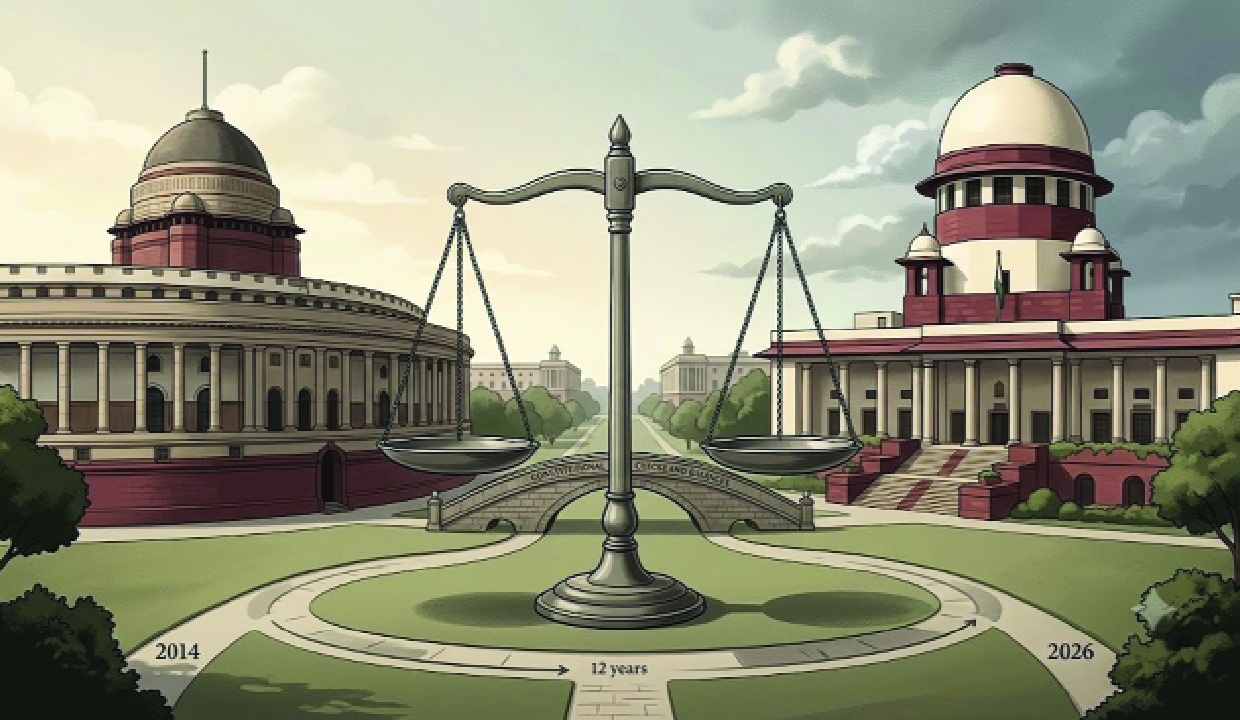
The 12-year relationship between the National Democratic Alliance (NDA) government and the judiciary has been a story of deep tension mixed with quiet cooperation.
While both sides have worked together to modernize courts, their basic disagreement over power has created an uneasy and often difficult relationship.
The relationship has been most successful in modernizing the administrative side of justice. Instead of fighting over laws, the government and the judiciary have cooperated closely on technology.
Under Phases II and III of the e-Courts Project, the government provided the necessary funds to digitize thousands of courtrooms and rural district courts.
This joint effort established virtual courts for minor offenses, connected major prisons to courtrooms via video links, and introduced live-streaming for key constitutional cases, making the legal system much more transparent. Despite their smooth cooperation on technology, the two institutions have locked horns deeply over who gets to choose higher court judges. This remains the biggest source of anger and distrust.
Early in its term, the government tried to end the judge-led “Collegium system” by introducing the National Judicial Appointments Commission (NJAC) to give elected leaders a say in appointments.
The Supreme Court struck this down in 2015, declaring that choosing judges without executive interference is vital to its independence.
Since it cannot legally dismantle the Collegium, the government has used administrative delays to show its displeasure. It frequently sits on files, delaying the appointment of recommended judges for months or years.
The executive has also regularly used “selective clearing”-approving some names from a list while ignoring others, particularly candidates who have openly criticized government policies in the past.
The tension between the executive’s majoritarian mandates and the judiciary’s role as a constitutional check has triggered several other major clashes.
The government has heavily utilized strict special laws like the PMLA (money laundering law) and UAPA (anti-terror law) against political opponents and activists.
Because these laws make getting bail nearly impossible, the judiciary has stepped in. Benches have repeatedly warned that keeping people in jail indefinitely without a trial turns the investigation into a punishment, directly pushing back against aggressive executive enforcement.
The judiciary has dealt major political blows to the government. The most prominent example was the unanimous 2024 Electoral Bonds ruling, where the Supreme Court cancelled the government’s preferred political funding system, calling anonymous corporate donations unconstitutional.
The government has repeatedly passed rules to shorten the tenures of members on quasi-judicial tribunals to give the executive more control over them. The Supreme Court has repeatedly struck these down, accusing the government of trying to bypass previous court orders. A major point of friction emerged over the executive’s increasing use of spot demolitions-popularly called “bulldozer justice”-against the properties of accused individuals.
The judiciary stepped in strongly against this practice. The Supreme Court laid down strict, nationwide guidelines, making it clear that the executive cannot act as a judge, find someone guilty, and demolish their house without following proper legal procedures. Benches warned that such arbitrary actions completely undermine the authority of the courts.
The relationship has also been tested by major mining and environmental disputes. While the government has frequently pushed for quick clearances to boost economic growth and infrastructure, the judiciary has often acted as a brake.
The courts have repeatedly penalized illegal mining operations, questioned the dilution of environmental impact assessments, and pulled up state agencies for failing to enforce ecological laws, causing a direct conflict with the executive’s developmental agenda.
The disagreement between the government and the courts has moved out of the courtrooms and into the public eye. Both sides are openly arguing about who has the final say over the country’s laws.
High-ranking leaders-including former Vice President and former Law Ministers - have publicly attacked a famous 1973 court ruling (the Kesavananda Bharati case). They argue that because the public elects the government, Parliament should have the supreme power to change any law. They feel that judges should not be allowed to block changes made by elected politicians.
The Judiciary has pushed back strongly. They explained that the Constitution has a permanent core-called the “Basic Structure”-that protects the citizens’ fundamental rights. One of the Chief Justices called this core the country’s “North Star” (a permanent guide). He stated that just because a government wins an election, it does not give it the right to destroy the core protections of the Constitution.
Despite the regular friction, the relationship has not been entirely stuck in a deadlock. On several complex social and reservation policies, the executive and judiciary have managed to find a constructive, albeit delicate, balance.
For instance, the Supreme Court upheld the government’s 10 per cent quota for the Economically Weaker Sections (EWS) and paved a legal pathway for the sub-classification of Scheduled Castes and Scheduled Tribes.
These moments demonstrate that when policies target deep social corrections without altering the framework of the Constitution, the court has willingly partnered with the executive’s legislative goals. While recent leadership on both sides has helped keep communication channels open, the underlying institutional rivalry remains entirely unresolved.
Ultimately, the 12-year legacy of the NDA government’s relationship with the judiciary shows that India’s democracy is experiencing a protracted tug-of-war: the executive seeks maximum space to implement its political mandate, while the judiciary fights to guard its role as the ultimate constitutional check.
Yet, while these grand institutional battles capture the headlines, the daily reality of the justice system remains deeply troubled. Grand digital platforms and rewritten penal codes are empty victories if the foundational pyramid is falling apart. According to real-time tracking from the National Judicial Data Grid (NJDG), India’s backlogs have crossed a staggering 55 million pending cases. This backlog, combined with a severe shortage of trial judges, means that everyday citizens are the ones who suffer the most and pay the price for this stubborn fight between the government and the courts.
True judicial reform requires both sides to step back from their battle for supremacy and work together to build a functional, well-staffed, and accessible grassroots legal system. Until that happens, the modernization of Indian justice will remain incomplete.
Writer is a journalist, covering legal affairs; Views presented are personal.