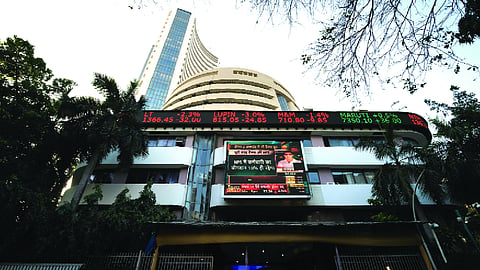

Indian equity markets are expected to enter a new phase of growth in 2026, driven by improved earnings, supportive macro conditions, and resilient domestic investor participation. This is despite global growth remaining under pressure, according to Kotak Securities’ Market Outlook 2026. Despite heightened volatility during the calendar year 2025, equities demonstrated resilience. “Despite the drawdown of 17 per cent, the Nifty 50 index erased all the losses by the end of CY25 to touch a new all-time high,” the report stated.
“Later in the year, the benchmarks hit fresh highs at points, supported by strong domestic flows and improving cyclical momentum, yet the advance was uneven across sectors and market-cap bands. Large-caps, led first by banks and heavyweight IT names outperformed, and were later joined by consumer names as the GST cut-related spending revival began to take shape,” says Prateek Nigudkar, senior fund manager, Shriram AMC. Midcaps and small-cap indices underperformed large caps during the year, while sectoral performance remained mixed, with autos, banks, and metals outperforming, and IT, FMCG, and real estate lagging.
Others are equally bullish about the markets in 2026. “India enters 2026 with stronger equity market setup, supported by robust macros, pro-growth fiscal, and monetary measures, and GDP growth expected to remain above seven per cent, setting the stage for a potential earnings recovery. We remain constructive, as earnings growth is likely to return to a double-digit trajectory post a muted fiscal year 2026, driven by improving demand, tax cuts, and monetary easing,” explains Neelesh Surana, chief investment officer, Mirae Asset Investment Managers (India).
PL Asset Management in its report, ‘PMS Strategy Updates and Insights,’ cites that equity markets scaled fresh all-time highs in November, decisively outperforming global peers as a powerful combination of record-low inflation, resilient domestic growth, and normalised valuations improved the risk-reward profile for investors. While global markets remained uneven, pressured by the weakness in technology stocks, a cooling AI-led rally, and soft macro data from China, India stood out as a relative bright spot, supported by strong domestic fundamentals and steady liquidity conditions.
Kotak Securities expects the corporate earnings to stabilise in this fiscal year, before staging a sharp recovery in the next one. The combined profits of the Nifty 50 firms are projected to grow 8.2 per cent in this fiscal, and accelerate to 17.6 per cent in the next one, supported by broad-based sectoral recovery, and a relatively stable macro backdrop. Q2-FY26 earnings exceeded expectations. Adjusted net profit of the Nifty-50 rose 2.6 per cent year-on-year, and EBITDA increased 6.7 per cent. The broader Nifty 500 universe posted modest revenue growth of six per cent, but profitability improved sharply, with profits after tax growing 15 per cent year-on-year.
Sectors such as metals and mining, oil and gas, telecom services, electronic manufacturing services, and diversified financials recorded double-digit growth in profits during the quarter. “With valuations now reasonable and market dispersion low, diversified portfolios are well-positioned to benefit, offering opportunities across sectors. Additionally, the growing presence of high-quality, sector-leading companies within the midcap and small-cap space makes a strong case for meaningful allocation,” says Surana.
According to the Axis mutual fund equity outlook, “The recently concluded season indicates that a recovery in corporate earnings may be on the horizon with most companies reporting stable performance. Festive demand provided a strong boost to discretionary categories, but the key question is whether this momentum can sustain beyond the seasonal uptick. At the macro level, GDP data reflects a notable transition from an investment-driven cycle to one led by consumption, signalling a shift in drivers of India’s growth. Looking ahead to 2026, the outlook appears cautiously optimistic. A potential resolution to the ongoing trade impasse between the US and India could boost equities and further support economic growth.”
India’s real GDP growth strengthened to 8.2 per cent year-on-year in Q2-FY26, aided by strong services and industrial output. For the full year, Kotak Securities estimates the GDP growth at 7.8 per cent, moderating to 6.5 per cent in the next fiscal year as the deflator benefits fade, but domestic demand remains supportive. Inflation eased sharply. Retail inflation fell to 0.25 per cent in October 2025, primarily due to lower food prices, and GST rate cuts. The central bank reduced the repo rate by a cumulative 125 basis points, bringing it to 5.25 per cent. Many analysts like Kotak Securities expect another 25-basis-point cut in the current cycle.
Foreign portfolio investors (FPIs) remained net sellers through the last two calendar years, 2024 and 2025. This reflects global risk aversion, and trade-related uncertainty. However, the domestic institutional investors (DIIs) continued to absorb the selling pressure, and provided stability to the equity markets. “With FPI outflows persisting, domestic investor sentiment is likely to play a crucial role in determining the market’s direction. Retail participation deepened structurally, with demat accounts that are active crossing 210 million, and investors below 30 accounting for 40 per cent of the base due to financialisation, and digital adoption.
“Capital flows told a mixed story. Foreign institutional investors were net sellers… but… retail participation via SIPs held up well, providing a steady domestic cushion to the markets with monthly SIP collections remaining sizable. Supply of fresh equity also continued to be strong with several large IPOs and elevated levels of promoter selling,” explains Nigudkar.
Globally, growth prospects remain subdued. The IMF projects global GDP growth at 3.1 per cent in calendar year 2026, while advanced economies are expected to grow at 1.6 per cent. Trade protectionism remains a key risk, with the US tariffs weighing on exports. India’s exports to the US declined 12 per cent in September 2025, although shipments to other global markets rose 11 per cent, and services exports remained resilient. Kotak Securities estimates that India’s current account deficit in 2025-26 to be 1.3 per cent of GDP.
Kotak Securities has set a base-case Nifty target of just over 29,000 by December 2026, valuing the index at 20 times FY28E earnings. The bull-case target stands at just over 32,000, while the bear-case scenario implies a level of just over 26,000. “Amid strengthened earnings outlook, we hold a favourable view for the Indian market,” the report stated. “India is benefiting from a rare combination of record-low inflation, improving earnings visibility, and strong domestic liquidity support. Looking ahead, improving market breadth, a recovery in earnings revisions and sustained SIP-led domestic participation should support a more broad-based and durable uptrend for Indian equities,” says Siddharth Vora, Head of quant investment strategies, PL Asset Management.