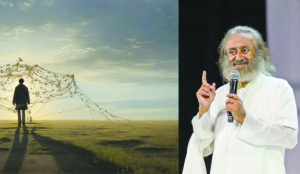
We postpone our happiness
Joy is found only in the present moment. Yet usually we find the mind swinging back and forth between the past and the future. The final-year school kids are anxious about what to do after graduation. At the start of their career, people worry about achieving career goals. Professionally settled people want to purchase a new house, find a good life partner, and get married. After getting married, people want to have children. When they become parents, they wait for their children to settle down. It is like you prepared the bed to sleep all night without sleeping at all!
We keep postponing our happiness and peace of mind. We imagine life is about securing a job, building a bank balance, and creating the perfect family. One desire gives rise to another, and the race never ends. In the process, we become miserable. And when misery takes over, we lose our health, our peace, our relationships, and even our reputation.
Life is a celebration. Life is commitment. Life is wisdom. Life is seva-selfless service. We are here on this planet for only a short while. So why suffer, and why make others suffer? Who said what, when, or why-how long can you hold on to these things?
When life revolves around commitment, care, service, celebration, attainment of wisdom, and upliftment of the human spirit, grace replaces misery. And when life becomes a celebration, then money, reputation, relationships, and health all come back to us. It is ironic because what we spent our lives chasing was always with us.
We are here for a very short period of time on this planet. Have you noticed how most of us spend our time here? Suppose we live for 80 years. In those 80 years, we spend around 26 years and 8 months sleeping. Each day, we spend 2.5 hours on food and nearly 6 years and 8 months just eating over an 80-year lifetime. Similarly, we spend 2.5 years in the toilet. If we live in a big city like New York or Mumbai, we spend nearly 3 to 5 years in traffic. We hardly get around 30 years to do something productive. This is the time when we truly live our lives.
Let us observe our mind. We spend an enormous amount of time thinking about the past. Yet the past is past. It is gone, finished. Why should we waste time thinking about something unalterable? The same holds for worrying about the future. We postpone our happiness until some future date, but it never arrives. If we live life now, tomorrow will take care of itself.
We must remember that every season in our life has had an impact on us. It has made us grow, given us strength. Rain brings mud, but it has also brought rainbows, and rainbows have brought colors into our lives. Peacocks wait for the rain. When they see dark clouds gathering in the sky, they open their colorful feathers. And when it rains, they dance so beautifully!
Similarly, when darkness comes in our lives, it doesn’t forebode the end. The phases of darkness also pass away with time. There are 2 ways to go through the dark phases: we either cry, complain, and blame, or we sing and dance through it. And when we sing and dance in the rain, we get soaked in joy.
So, let us cultivate the habit of being happy. Only we can do this for ourselves. Nobody else can do this for us.
The strength of our happiness is measured by the number of adverse situations we can smile through. It is easy to be happy when life is smooth. But if we can smile through all kinds of opposing situations that life brings, then we have grown. Let’s tell ourselves, ‘Whatever happens, I am not going to be unhappy.’ This inner strength and ‘santosha’ (contentment) are qualities we must develop. And I tell you, this can definitely be done. It is possible.
There is a famous Mullah Nasreddin story around this. Mullah Nasreddin used to grumble all the time. He was a farmer, and he would grumble about the shortfall of rain, ‘Oh, there is no rain, and no crops are growing.’ Next year, there was abundant rainfall, and Mullah had a bumper harvest. People thought, ‘This year Nasreddin wouldn’t grumble.’ So people went to greet him, ‘Oh, Mullah! How are you? You seem to be doing very well. Mother Nature has bestowed you with a bountiful harvest of crops. The lush green crops look so amazing.’ But Mullah wore the same grumpy look. He said, ‘Yes, the yield is great but now I will have to do more work in the fields!” In all these dry years, I didn’t have to do anything. But now with so much produce, I have to harvest and sell it in the market. It is a big headache.’ Whether there were crops or not, Mullah continued to grumble.
The same is true in our lives. We are unhappy about what we don’t have and we are unhappy with what is there already. Those who don’t own a car are unhappy, while those who do often worry about high maintenance costs, traffic congestion, parking scarcity, rising fuel prices, and insurance and taxes.
One needs to develop the habit of being happy. We have to take responsibility for our happiness. If our happiness depends on a person, a thing, a situation, or time, it will only be temporary. Somebody once asked me, “What was the happiest time of your life?’ I said, ‘What? The happiest time of my life? Why do you connect ‘time’ with ‘happiness’? I am happiness!’
The nature of time is that it is always changing. Life is a mix of good times and bad times. If we connect our ‘happiness’ to ‘time’, our state of being happy also changes with time. When we have this conviction that happiness has nothing to do with time, we can be happy forever. And this is the wisdom of life. All we need to do is disassociate our joy from people, places, situations, or time and realize that our innate nature is happiness. This is the highest knowledge of life. It may sound like a very difficult state of mind to attain, but it isn’t. Any fool can be unhappy when things aren’t okay. But it takes courage to be happy even when things are falling apart. And we all are courageous and strong.