Beyond HORMUZ
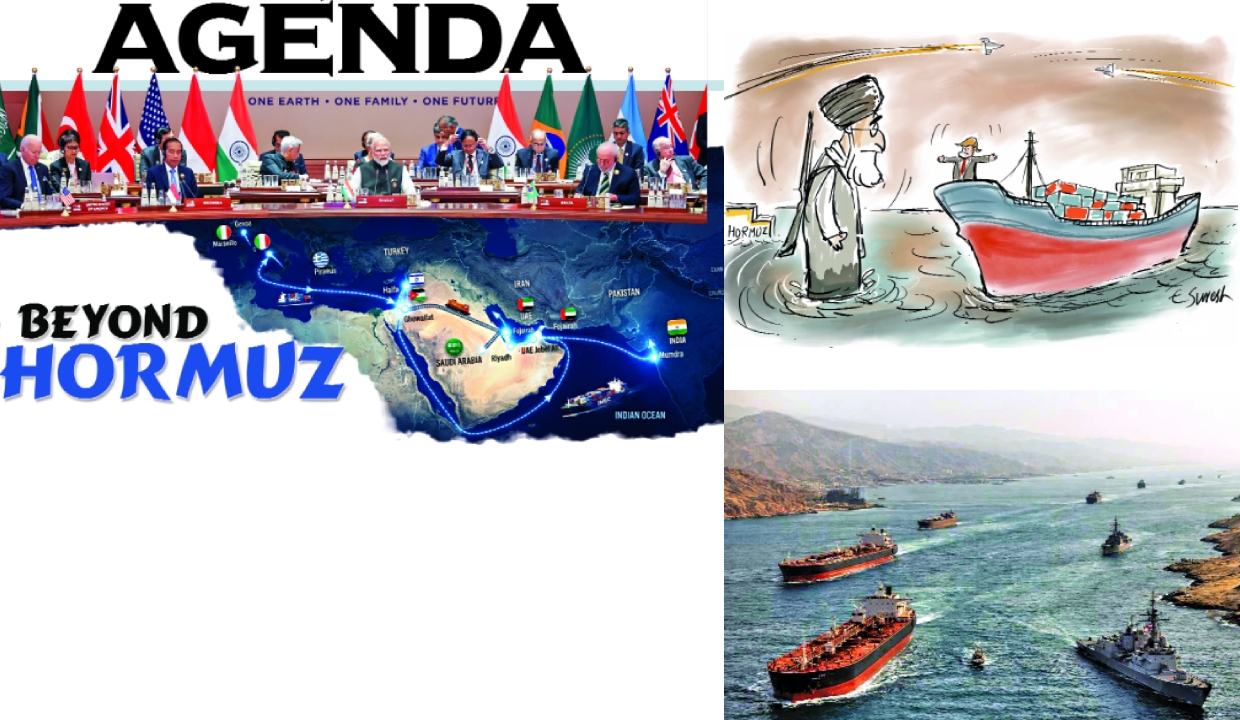
The choke points on major maritime routes can hold the global economy hostage. India must look for alternative routes and access to other ports through multimodal transportation networks, including railways, highways and pipelines
The major oil companies are looking at shipping the crude oil from the port of Yanbu on the Egyptian Sumed pipeline
There have been 64 incidents impacting trading vessels in the region since the war started, and 6000 marine crews are stranded
The current geopolitical map of West Asia at war is also the epicentre of tectonic shifts in the global energy grid. To understand why, it is important to know one key statistic: nearly 80 per cent of global trade by volume moves by sea, but just about five or six choke points on major maritime routes are critical to maintaining a free flow of vessels. These chokepoints are then also the fulcrums of the free flow of international trade, logistics costs, and most importantly, the energy security of economies dependent on imports of oil and gas from specific global supply regions. Disruptions in the Persian Gulf since last February have resulted in oil and gas price increases and global shortages. According to the IMO, there have been 64 incidents impacting trading vessels in the region since the war started, and 6000 marine crews are stranded in and around the Strait of Hormuz since July.
At the time this article goes to press, diplomatic negotiating rooms in Doha, Tehran, Muscat and Washington DC will be buzzing with activity to agree to draft language for a negotiated settlement for opening of the Strait of Hormuz and levy of a possible service charge or toll to be paid to Iran and Oman. This would be the first of its kind toll on an international maritime route, which, except for certain eventualities, is prohibited under the United Nations Conventions on the Law of the Sea. Any such toll of the Hormuz will set a precedent for other countries controlling territorial waters at narrow point (like Gibraltar and the English Channel). The service charges at Malacca and the levy of toll in the Turkish Straits do not often make headlines but will be examples for the new geopolitical world.
A note on the Strait of Hormuz: this small but critical route supplies over 20 per cent of the global oil and gas requirements, but does not actually have any international waters. At its narrowest point, the strait overlaps with the territorial waters of Iran and Oman. But the crisis has impacted global energy supply lines and sent economies into freefall around the world, especially those dependent on imports of gas and oil from the Persian Gulf. The International Maritime Organisation has written to the United Nations Secretary-General, raising the concern that permitting Iran and Oman to charge tolls or service fees violates international norms, have repercussions for global trade, and undermine the internationally recognised legal framework for international navigation.
The crisis has made it clear that choke points on major maritime routes cannot hold the global economy hostage and necessitate alternatives. The on-going crisis is not only impacting the flow of oil and gas from the Persian Gulf, but also movements towards Europe through the Strait of Bab al Mandeb, the Red Sea, and the Suez Canal that provide an exit through the Mediterranean to European markets. A similar disruption at the Suez Canal will put at risk significant energy flows from Asia to the rest of the world.
Major oil-producing nations like Saudi Arabia, UAE, Qatar, Kuwait, Iraq and Iran must look for alternative routes and access to other ports through multimodal transportation networks, including land bridging by Railways, highways, and laying pipelines. The crisis has demonstrated that business as usual is not enough. The future on the other side of this crisis may not guarantee that the free flow of ships is insured for all times to come.
A few developments indicate that many countries have already started working on options for moving oil and gas that avoid Hormuz, Bab al Mandeb, and the Suez Canal. For Saudi Arabia, exit through the Persian Gulf and the red Sea are both fraught with complications. Despite the existence of a pipeline, choke points continue to impact the flow of vessels to East Asia and Europe. The Bab al Mandeb is no longer a peripheral shipping lane. It connects the Red Sea to the Gulf of Aden and the Indian Ocean and is one of the most consequential corridors for global trade and energy shipments. Since 2023, shipping has been impacted due to attacks on the ships and the raging conflict around the strait involving Saudi Arabia, Somalia, Houthis, Israel and the USA. There are reports that the Houthis will end up in control of the state of Bab al Mandeb and impose tolls. These further strengthen the argument for alternate routes and modes of transportation for oil and global trade to be explored, worked on, and commissioned on priority.
Pipe lines are being considered in addition to roads and railways. Important crude pipe line developments in the region include an Iraq - Syria - Jordan pipe line, Saudi East West, and UAE to Oman pipeline etc. In a significant development, Iraq and Syria have decided to revive the oil pipeline between Kirkuk in Iraq to the port of Baniyas in Syria on the Mediterranean Sea. This project is likely to take about 30 months as per latest reports and would consist of two pipelines with capacity of 1.5 billion barrels per day to 2.0 billion barrels per day. The effort to rebuild the pipeline is being supported by the United States, which has already lifted sanctions from Syria. In the meantime, road transportation of oil from Iraq to the Mediterranean Port in Syria has begun in a big way. Opening a new route avoiding passage through the State of Hormuz, Saudi pipeline line from east to west connects Egyptian pipeline to the Egyptian terminal on the Mediterranean.
Saudi Arabia, the largest oil producer in the region, is bearing the brunt of the ongoing conflict impacting movement of oil and gas through its eastern coast on the Persian Gulf. Taking into account the possibility of a prolonged conflict, major Saudi oil companies have started moving larger quantities of oil on their east-west pipeline, facilitating crude oil to be delivered at their red Sea port of Yanbu for transhipment to the Egyptian pipeline. The major oil companies are looking at shipping the crude oil from the port of Yanbu on the Egyptian Sumed pipeline. The pipeline, which is an alternative to the Suez Canal, connects the Egyptian terminal of Ain Sokhna on the Gulf of Suez to Sidi Keir on the Mediterranean with a capacity of approximately 2.5 million barrels per day. Once delivered to the Mediterranean terminal, the crude is shipped to Europe, avoiding the use of even the Suez Canal, which is already congested.
An Iran - China- Central Asia - Russia - Europe multimodal route involving ships, railways, roadways, and Iran’s southern Chabahar port through INSTC is already commissioned. Iran is also looking at developing its major port at Chabahar for energy supplies of oil and gas to Southern Asia and the Far East, avoiding the port of Bandar Abbas, which is located in the Persian Gulf. Iran and Pakistan are jointly working to utilise the upcoming Gwadar port and existing Karachi port in Pakistan. Technically, the territorial waters of Iran allow it to move vessels along its entire southern length and enter territorial waters of Pakistan near Gwadar. This would also ensure the safety of the oil and gas vessels, which remain restricted for their movements within its territorial waters. The UAE and other Gulf countries are joining to commission the GCC rail line connecting UAE with Oman in addition to developing the crude pipelines to Fujairah port in Oman. Qatar and Kuwait are also looking at joining the Iraq-Syria pipeline and also utilising the UAE-Oman and Saudi East-West pipeline.
Initiative led by India and US (like IMEC) acquire greater significance now and could be a feasible alternative. However, major infrastructure projects to construct missing rail links in Saudi Arabia and Jordan are now urgently needed to operationalise the corridor. Saudi Arabia and Jordan joining the Abraham Accord will enable the corridor to make use of the Israeli port of Haifa. Other developments in this region and as alternatives to choke points elsewhere include a China-Central Asia-Europe rail corridor which also connects to Tehran and the INSTC, the Thailand canal being envisaged to provide an alternative to Malacca, and the southern Mexican rail bridging to avoid the congested Panama Canal.
Even as the world builds new routes and a bigger network that can absorb global shocks with its scale, only the silencing of guns over the Persian Gulf and the Red Sea and a regional security architecture can create conditions for stable growth. But while we wait, countries must act to achieve their own energy security and not depend on oil and gas imports from afar for economic sustainability and growth.
The crucial need for IMEC
The corridor addresses severe global vulnerabilities and reshapes transcontinental geopolitics.
Circumventing Global Trade Chokepoints: The protracted Red Sea crisis and Houthi militant attacks highlighted the fragility of relying entirely on the Suez Canal. By using an overland rail spine across the Arabian Peninsula, IMEC creates a vital alternative route.
Drastic Logistics Optimization: IMEC is projected to slash cargo transportation times by up to 40 per cent and reduce total logistics costs by nearly 30 per cent compared to traditional maritime routes.
Beyond Goods-Energy & Data Grids: The project is not just for shipping containers; it is engineered to house undersea fiber-optic data pipelines to bypass data chokepoints, alongside cross-border electricity grids and green hydrogen pipelines.
Countering China’s Belt and Road Initiative (BRI): Backed strongly by India, the US, and the EU, IMEC serves as a high-standard, transparent, and democratic infrastructure alternative to China’s debt-heavy BRI.
Strategic Alignment: It establishes a “triangular economic architecture”-positioning India as a manufacturing hub, the Gulf as a capital and logistics engine, and Europe as a high-tech consumer market.
Primary bottlenecks and challenges
Despite its immense economic logic, the corridor faces critical headwinds:
Geopolitical Conflict in West Asia: The prolonged Middle East conflict involving Israel, Gaza, and wider regional tensions has severely strained the diplomatic coordination needed for the Northern Corridor. Specifically, the planned rail link connecting Saudi Arabia through Jordan to Israel’s Haifa Port remains physically and diplomatically stalled.
Funding Gaps: While individual countries are financing domestic parts, an overarching, multi-billion-dollar joint funding pool or unified consortium for cross-border links has yet to be finalised.
Trade Fractures: Minor friction point developments, such as the imposition of sudden external tariffs or regional politics, occasionally cloud immediate construction timelines.
India-Middle East-Europe economic corridor: Progress made so far...
Since its high-profile announcement at the G20 Summit in New Delhi in September 2023, the India-Middle East-Europe Economic Corridor (IMEC) has progressed via a dual-track reality: rapid diplomatic, bilateral, and digital integration on the Eastern Corridor, contrasted against physical construction slowdowns on the Northern Corridor due to severe regional volatility.
The developmental progress achieved across different structural pillars includes the following:
Institutional and Bilateral Agreements
The India-UAE Framework: Signed in February 2024, this serves as the primary operational blueprint for the Eastern Corridor.
It focuses on standardising customs processes and establishing data sharing protocols between South Asian and Gulf logistics networks.
Dedicated Diplomatic Special Envoys: Major European participants-specifically France and Italy-appointed dedicated special envoys to drive multilateral coordination and align the corridor with the European Union’s Global Gateway initiative.
Physical Port & Railway Infrastructure
The Eastern Corridor: India has fast-tracked mega deep-sea port developments, such as the Vadhavan Port in Maharashtra, to augment cargo handling capacity. Key logistical nodes like Mundra Port, Jebel Ali Port (Dubai, UAE), and Haifa Port (Israel) are already active maritime endpoints.
The Northern Corridor: Broad overland construction of the trans-Arabian railway network started across specific domestic links in Saudi Arabia and the UAE. However, the critical rail link passing through the Jordan-Israel border has experienced major bottlenecks.
Digital and Virtual Integration
The ‘Maitri’ Digital Trade Platform: To bypass traditional transnational bureaucracy, India and the UAE began developing a virtual trade corridor. This digital clearing ecosystem uses unified documentation systems to expedite customs and container transit times.
Data & Clean Energy Corridors: Feasibility studies advanced for laying ultra-high-capacity subsea fiber-optic cables to bypass vulnerable data chokepoints like the Bab al-Mandab. Technical planning has also been initiated to connect electricity grids and green hydrogen pipelines across the Arabian Peninsula.
Recent Structural Adaptations (2026)
Due to prolonged geopolitical friction stakeholders have expanded the initial blueprint into a more resilient “network of corridors”:
Oman Integration: Oman is increasingly treated as an active maritime gateway to allow cargo ships to bypass the volatile Strait of Hormuz entirely.
Red Sea and Mediterranean Diversification: Alternative exits are being evaluated, leveraging Saudi Arabia’s Red Sea ports (Jeddah and Neom) as well as newly expanded Mediterranean port configurations to preserve the corridor’s viability.
The writer is Former Member Railway Board and Senior Adviser The World Bank; Views presented are personal.