The monk who runs state finances
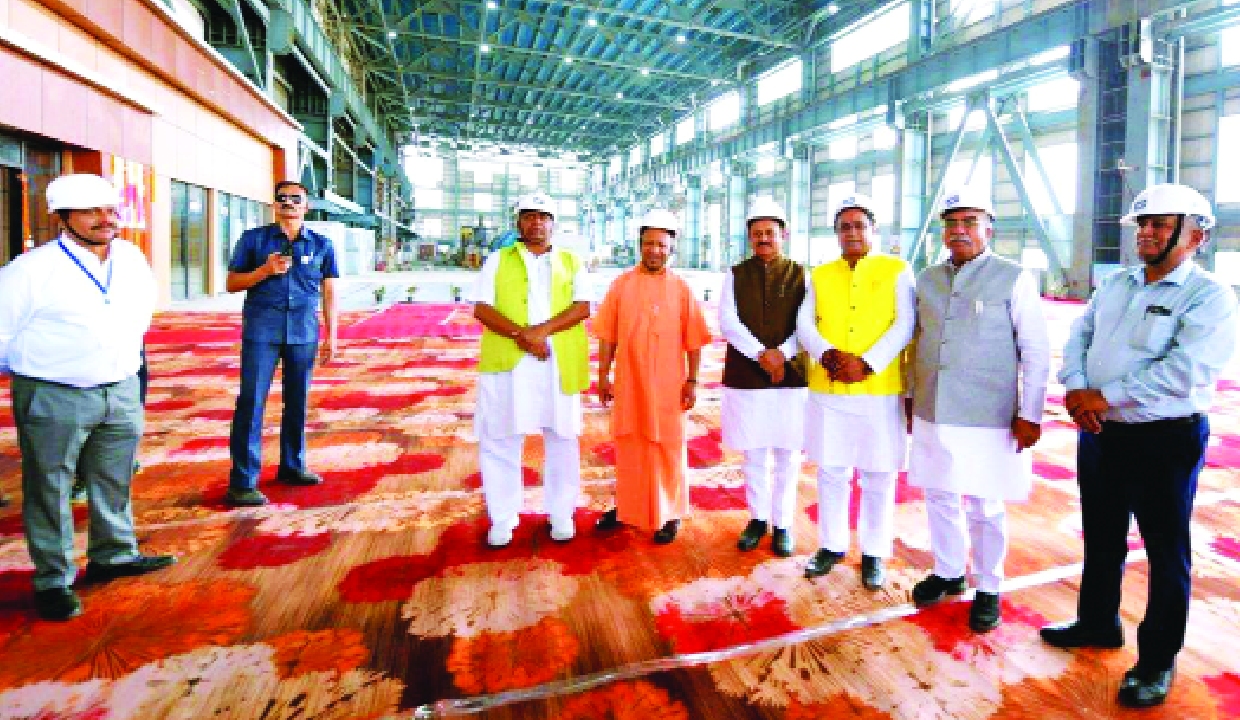
Yogi Adityanath’s Uttar Pradesh is rewriting its economic story through fiscal discipline, infrastructure investment and improved law and order, emerging as a major economic force while challenging the long-held belief that fiscal prudence belongs mainly to India’s southern and western States
In Indian politics, Yogi Adityanath is filed under a single heading: law and order. The saffron robes, the bulldozers, the pursuit of criminal syndicates that at their peak rivalled terror outfits in menace. It is a caricature that suits admirers and critics alike, and it obscures the more consequential story unfolding in Uttar Pradesh. Over nearly a decade in office, the monk has quietly become one of the country’s most disciplined managers of public money.
Start with the scale of the turnaround. In 2016-17, the last year of the Akhilesh Yadav government, Uttar Pradesh was widely written off as an economic laggard, a giant that punched far below its weight. Its output that year was about Rs 13.3 lakh crore. By 2024-25 it had reached Rs 29.78 lakh crore, more than doubling in under a decade. In absolute terms, the state has added roughly Rs 16.5 lakh crore to its economy, more than one and a half times the entire output of Bihar.
That growth has carried UP to the front rank of Indian states. At Rs 29.78 lakh crore, it is now the third-largest economy in the country, behind only Maharashtra (Rs 45.32 lakh crore) and Tamil Nadu (Rs 31.19 lakh crore), and it has moved ahead of both Karnataka (Rs 28.84 lakh crore) and Gujarat (about Rs 27 lakh crore). It now towers over the states it was long bracketed with: West Bengal (Rs 18.15 lakh crore), Rajasthan (Rs 17.04 lakh crore), Telangana (Rs 16.41 lakh crore) and Andhra Pradesh (Rs 15.93 lakh crore). UP’s economy today is three times the size of Bihar’s, roughly the combined output of West Bengal and Haryana, and within touching distance of Tamil Nadu for second place.
What makes the achievement striking is how it was managed. Growth in UP has not been purchased with the usual instruments of political economy, the freebie, the loan waiver, the off-budget borrowing that flatters one year and haunts the next. It has come instead from fiscal fundamentals: revenue that is actually collected, spending that leans towards capital rather than consumption, and a deficit kept within its guardrails. This is not an economy on steroids or subsidies, and it has managed the feat despite one of the lowest per capita incomes among the large states.
The comparison that should give the southern commentariat pause is with Tamil Nadu. UP has now drawn almost level with the coastal state in the sheer size of its economy, and on the fiscal scorecard in this data it comes out ahead on every one of the ten standard measures by which states are judged. It is one thing for a rich, long-industrialised economy to keep its books tidy; wealth is forgiving. It is quite another for a state with UP’s income levels, its population and its history to match Tamil Nadu in output and outscore it on discipline. And because UP’s per capita income is still a fraction of the southern average, the room left to grow is enormous.
Here the law-and-order reputation and the fiscal record turn out to be the same story told twice. Capital does not flow to places where contracts are settled by the strongest local strongman. By dismantling the syndicates that once ran extortion across the state, the government did more than improve the crime statistics; it rewrote the risk calculus for anyone thinking of building a factory or a warehouse in UP. Law and order, in this sense, is an enabler for the economy. Had Yogi not made so many powerful people uncomfortable, few would have trusted the state with their money. The bulldozer is not the opposite of the balance sheet. It is its precondition.
Geography will do much of the rest. A large slice of UP sits within reach of the National Capital Region, and the state has been shrewd in turning that proximity into expressways, industrial corridors and warehousing rather than leaving it as an accident of the map. Tamil Nadu has a manufacturing heritage on its side; UP has the NCR on its doorstep and a domestic market of 240 million people at home.
None of this makes UP a finished project, and honesty requires saying so. Per capita income remains low, and averages hide the distance still to be travelled in the poorer east. On current trends, the state should touch the trillion-dollar mark sometime in the early 2040s, and even that is a conservative estimate. But a model built on sustained investment is only as durable as the political stability underwriting it, and investors quietly price in the risk that a decade of discipline could be undone by a change of guard.
Still, the direction is unmistakable, and it should unsettle a few settled assumptions: that fiscal virtue is the preserve of the south and the west, that the Hindi heartland is destined to drag on the national economy, and that a leader defined by his cultural politics cannot also be a competent custodian of a treasury. UP under Adityanath is falsifying all three. The man the country files under law and order has been running his state’s finances with an eye any chief financial officer would recognise: collect what you are owed, spend on what lasts, and never mortgage tomorrow for today’s headline. It is unglamorous work. It is also the work that decides whether a state of 240 million people rises or stalls.
The author is a political analyst and the founding editor of politypolicy.com; Views presented are personal.