The Enduring Promise of ‘Un Film de Almodóvar’
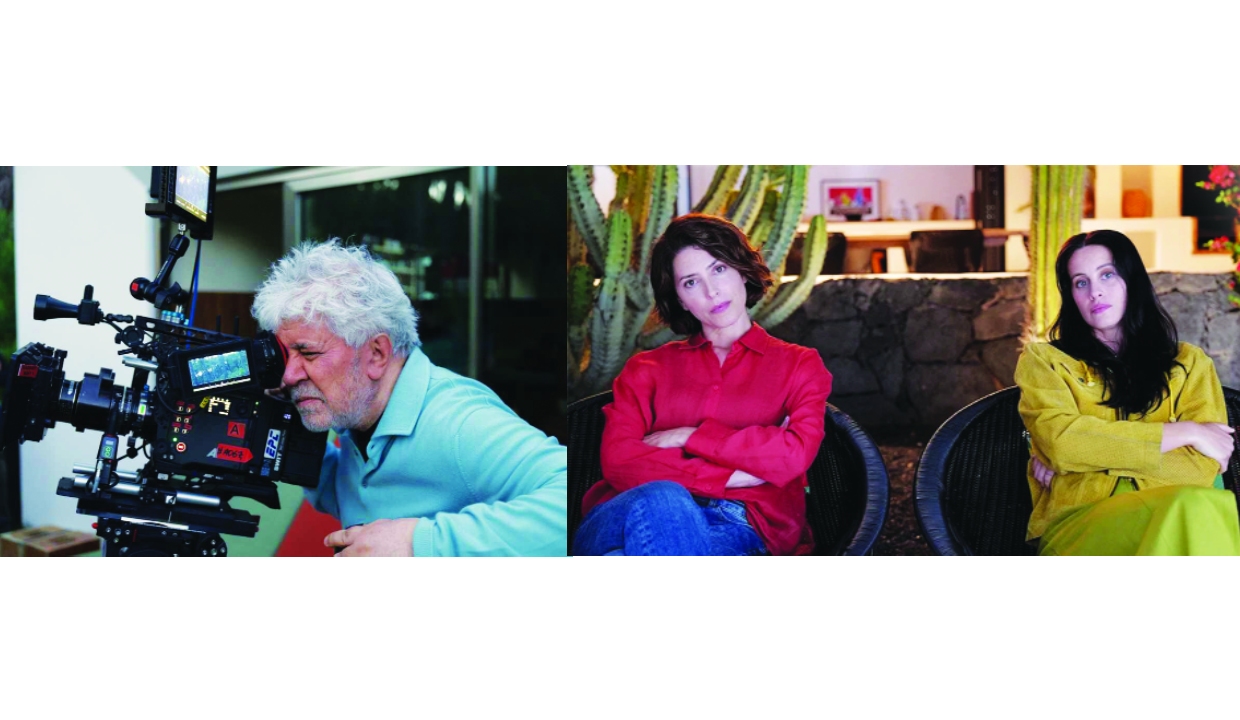
As Pedro Almodóvar returns with Amarga Navidad, a look at the filmmaker who has evolved while staying true to his cinematic instincts
There was a time when Pedro Almodóvar would not have made it to my list of three filmmakers whose next film was awaited with any great impatience. This was probably true through much of the 1990s and perhaps even into the 2000s. There were filmmakers one followed more obsessively, whose new work seemed like an event even before one had seen it. Almodóvar was different. You watched a film of his and, almost invariably, came away wondering about it. Somewhere along the way, that changed.
Today, the words Un film de Almodóvar mean considerably more to me than they did thirty years ago. Curiously, this has happened without Almodóvar dramatically changing the world he films. The women, mothers and daughters, desire and abandonment, sex and death, actors and performance, memory and secrets have always been there.
Perhaps that is because he has never seemed embarrassed by his own instincts. From Women on the Verge of a Nervous Breakdown to All About My Mother, from Talk to Her, Volver, Julieta, Pain and Glory, and his best in recent years, Parallel Mothers, the terrain remains recognisable but the people travelling through it have changed.
Desire acquires memory, sex acquires consequence, bodies age, mothers grow older and loss begins to occupy spaces once dominated by possibility. By the time Almodóvar arrived at Pain and Glory, even the act of remembering desire had become as important as desire itself. This is evolution of a particularly difficult kind: evolution without repositioning.
Filmmakers with long careers are invariably encouraged to discover new audiences. Sometimes they begin speaking the language of a generation that arrived long after them. At other times, they retreat into endlessly reproducing the film for which their original audience loved them. Almodóvar has done neither. His cinema has simply grown older alongside them; Almodóvar, instead, seems to have travelled with his viewer.
This, to me, is one of the least discussed achievements of a long filmmaking career. We talk endlessly about whether a filmmaker has remained relevant but rarely ask: relevant to whom? It also makes me think of Mani Ratnam. Watching his later films, I sometimes wonder who the imagined viewer is. Ratnam has remained contemporary partly by continually recalibrating his cinema for the audience before him; the filmmaking remains recognisably his, but the conversation seems increasingly directed towards the viewer of today rather than the viewer who first entered his world through Mouna Ragam, Nayakan, Agni Natchathiram or Bombay.
Almodóvar, like Scorsese and, in a somewhat different fashion, Quentin Tarantino, belongs to an increasingly rare category of filmmakers who have maintained a compact with their audience and allowed their audiences to age. Someone who discovered Almodóvar through Women on the Verge of a Nervous Breakdown has aged more than three decades along with his cinema. Perhaps this explains why one is looking forward to Amarga Navidad, or Bitter Christmas, differently from the way you usually anticipate a new film from a much-followed filmmaker.
I don’t particularly want to know whether, approaching five decades as a filmmaker, Pedro Almodóvar has reinvented himself yet again. I am more interested in discovering what has happened to that familiar universe since we last visited it. There are filmmakers one discovers and immediately loves. There are others whose importance reveals itself through the years, almost without announcement. Almodóvar has been the latter. Once, Un film de Almodóvar merely told you who had made the film; now, it tells you why you want to see it.
The writer is a historian whose work spans cinema, politics and contemporary Indian history. He is the author of Dark Star: The Loneliness of Being Rajesh Khanna and Rajneeti: A Biography of Rajnath Singh, among other books; Views presented are personal.