Table with Moral - The Elephant and the 6 Blind Men (A Jain fable)
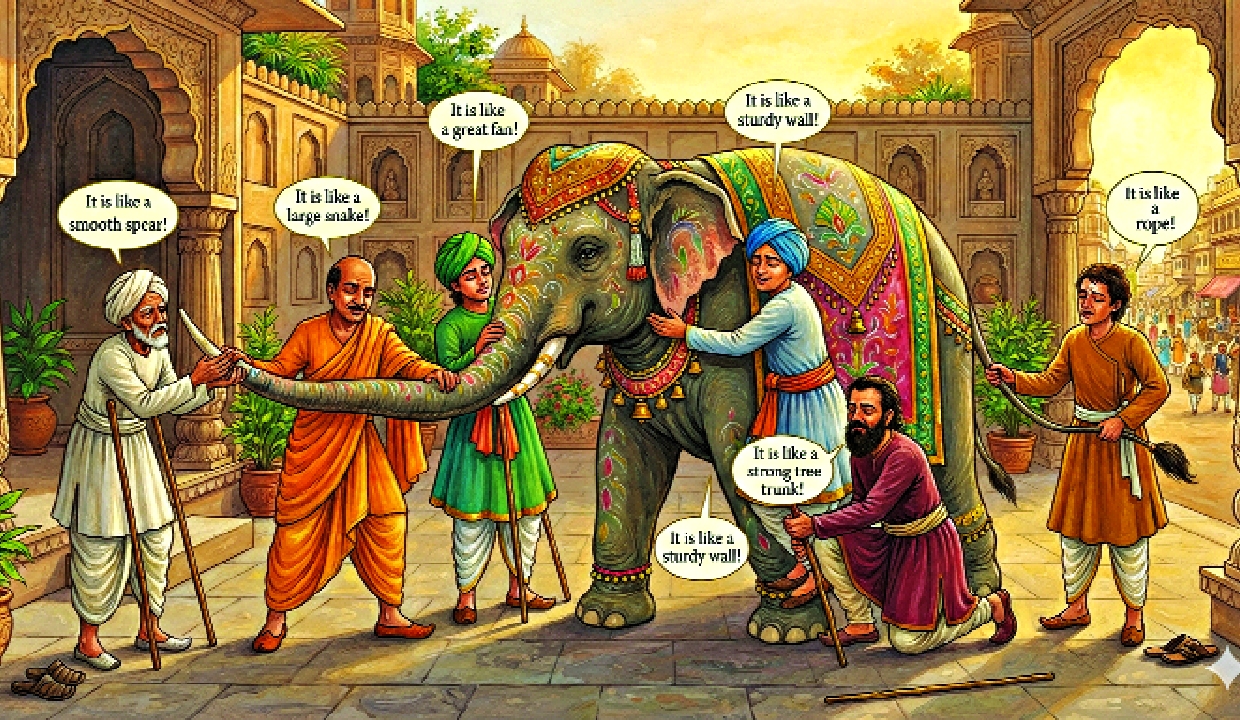
The story of the Elephant and 6 blind men is most famously used to explain Anekantvad (many-sidedness), teaching that reality is complex and no single human view can capture it entirely. In a small village, six blind men encountered an elephant for the first time. Unable to see, each man touched a different part of the animal and formed an entirely different conclusion.
The first touched its broad side and declared, "An elephant is like a wall!" The second touched the sharp tusk and said, "No, it is like a spear!" The third grasped the long trunk and argued, "It is clearly like a snake!" The fourth felt its leg and said, "It is like a thick tree!" The fifth touched the giant ear and claimed it was like a fan. The sixth grabbed the tail and stated, "It is nothing but a rope!"
This led to a heated argument as every man fiercely claimed his perspective was the only correct one. Consequently, the men began to quarrel.
A wise man passing by heard their loud words and stopped. He told them, "All of you are right. Because you each touched a different part, you all have a piece of the truth. But to know what the whole animal is like, you must put all your partial truths together."
Moral of the Fable: Never be impulsive; consider all perspectives before reaching a conclusion
The story teaches us that truth is often multifaceted, and our individual perspectives are naturally limited by our personal experiences and the information available to us. Instead of aggressively arguing with others over differing opinions, we should acknowledge that there is likely some truth in their viewpoints as well. The philosophy of Anekantvad (literally "non-one-sidedness") is a practical tool for modern life, not just an abstract concept.
Arguments often stall when both sides insist on being "right." Anekantvad teaches that two opposing emotions can be valid simultaneously. It is about seeing merit in different perspectives.