
- HOME
- INDIA
- WORLD
- BUSINESS
- STATES
- LAW & JUSTICE
- ENTERTAINMENT
- SPORTS
- VIEWPOINT
- LIFESTYLE
- TECH
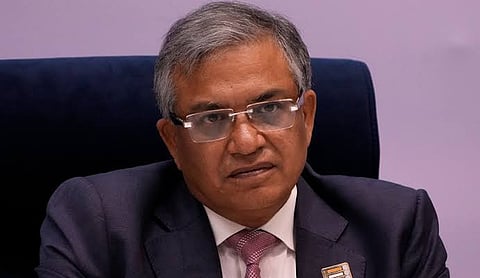
The Supreme Court on Monday declined to pass an ex-parte interim order suspending Chief Election Commissioner Gyanesh Kumar. The court said it would first seek the response of the Election Commission and other respondents on allegations that several decisions on the Special Intensive Revision were taken unilaterally.
A bench of Chief Justice of India Surya Kant, Justice Joymalya Bagchi and Justice V Mohana issued notice to the Union of India and the Election Commission of India. Notice also went to Gyanesh Kumar, Election Commissioners Sukhbir Singh Sandhu and Vivek Joshi, Deputy Election Commissioner Maneesh Garg and Director General (IT) Seema Khanna.
Senior Advocate Vikas Singh, appearing for petitioner Rakesh Kumar Singh, said interim measures were needed because every citizen now felt unsafe about their voting rights. He referred to Section 18 of the Chief Election Commissioner and Other Election Commissioners Act. It requires decisions to be unanimous as far as possible, and by majority when they are not.
Singh also referred to Section 16, which gives legal immunity to the CEC for acts in discharge of official duty. He said such protection is not available even to Supreme Court judges. He pressed for an interim order suspending the CEC immediately.
"We are dealing with a grave situation which can undermine the very basis of our democracy," Singh said. The bench said it had to first decide whether there was any violation. "The Court has to pass some interim orders, otherwise the country will burn," Singh said.
The bench observed that suspending the CEC would stall the functioning of the Election Commission. "Who will conduct the elections?" the bench asked. Singh said the other two Election Commissioners could discharge the functions.
Justice Bagchi asked whether the court could pass such an order ex parte without hearing the respondents. "If records show some decision was not unanimous etc., we will injunct those decisions and say they are ultra vires," he said. Chief Justice Kant said the court cannot pass an order solely on newspaper reports.
On the change to Form 6, the Chief Justice said no modified Form 6 has been approved by the Supreme Court. The bench then issued notice on the petition and on a connected petition filed by advocate Shailendra Mani Tripathi. Senior Advocate Menaka Guruswamy appeared in the connected matter.
Rakesh Kumar Singh's petition, filed as W.P.(C) No. 1246/2026, seeks a declaration that the Election Commission, being a multi-member body, cannot take decisions unilaterally. It seeks a forensic audit of the ECINet and ERONet databases. It also seeks a probe into the deletion of 13 crore names from electoral rolls across 30 States and Union Territories, and the suspension of Gyanesh Kumar as CEC.
Shailendra Mani Tripathi's petition, W.P.(Crl.) No. 401/2026, seeks quashing of the 14 decisions allegedly taken unilaterally. It seeks a judicial inquiry commission or Special Investigation Team headed by a retired Supreme Court judge, assisted by cybersecurity and IT experts.
The petitioner also sought prosecution under Section 32 of the Representation of the People Act, 1950. The named officials include Gyanesh Kumar, Deputy Election Commissioner Maneesh Garg and DG (IT) Seema Khanna.
The pleas followed an Indian Express investigation that Election Commissioners Sandhu and Joshi recorded at least 14 objections between October 2025 and August 2026 over Special Intensive Revision steps. The two commissioners also wrote to Cabinet Secretary T V Somanathan over the integrity of voter software.
The Election Commission said the letters to the Cabinet Secretary concerned an officer on deputation and were not related to policy or the IT division. It said the decisions on the SIR schedule were unanimous, and that queries raised at the draft stage were part of its standard process. Livemint reported that the court sought responses within a week.