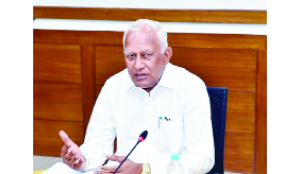
Sood reviews solar policy, power reforms in Delhi
Delhi Power Minister Ashish Sood on Thursday chaired a high-level review meeting with the Additional Chief Secretary and Special Secretary of the Power Department.
The meeting covered four key priorities: accelerating rooftop solar adoption across Government buildings and residential clusters, deploying large-scale battery energy storage systems to stabilise the grid, integrating Multi-Utility Ducts in Chandni Chowk to remove overhead wiring, and strengthening DISCOM accountability through improved performance metrics and audit mechanisms.
On DISCOM accountability, the meeting discussed streamlining performance metrics and audit mechanisms to ensure power distribution companies maintain transparent operations and strict consumer service standards.
The accountability framework for DISCOMs has been a recurring concern in Delhi’s power sector, where the three distribution companies, BSES Rajdhani, BSES Yamuna, and TPDDL, operate under regulatory oversight but have faced periodic criticism over billing accuracy, outage response times, and consumer service quality.
On the Delhi Solar Policy, the review focused on accelerating rooftop solar adoption to transition the capital toward its renewable energy goals. Rooftop solar on Government buildings represents a category where the state can directly control the pace of adoption, since it does not depend on individual homeowner decisions. The residential cluster component involves greater coordination challenges but significantly larger potential capacity.
On the Chandni Chowk Multi-Utility Duct works, the meeting reviewed integration of underground ducts that will carry power cables, telecom lines, and other utilities below street level, clearing the dense tangle of overhead wiring that has characterised the area for decades.
The MUD works are being designed to modernise electrical infrastructure without disrupting the commercial activity of one of Delhi’s busiest and most historically significant markets.
On Battery Energy Storage Systems, the meeting addressed the deployment of large-scale battery storage units designed to stabilise grid frequency, manage peak demand, and prevent localised outages.
BESS technology allows excess power generated during low-demand periods to be stored and discharged during peak load, reducing the need for expensive peaking power and improving grid resilience during periods of high consumption such as summer afternoons.