
What should an MBA offer today?
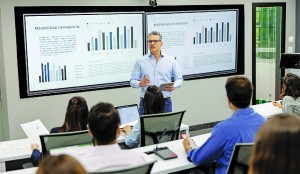
An MBA graduate today walks into a world which requires a mix of evergreen and new-age characteristics. First of all, what is the world that they are walking into? It’s a world of information explosion, AI assists, rapid technological change, choice overload, intellect outsourcing, job shortages, multiple career shifts, short-circuiting of the knowledge discovery process and a skills shortfall.
When there is unlimited information at the fingertips, the MBA class should not be just about transferring knowledge. It should evolve into an experience laboratory, a skills incubator, a curiosity fulfilment theatre. The MBA student must, in the AI world, have some inviolable human graduate outcomes. They should be questioners versus passive receivers, communicators versus talkers, collaborators versus standalone operators, eclectic versus single-idea holders, thinkers on their feet versus formulaic thought processors, character-rich versus shysters - these are the evergreen qualities needed. New-age skills require the following: problem framing and problem-solving; application of AI to functional domains; judgement capability; and technology native.
The Indian two-year MBA has the characteristic of taking in a cohort who may have nil or very little industry experience. This is a very significant disadvantage in truly imbibing the lessons of business management in a practical sense. Therefore, the MBA of the present must give maximum opportunities to students for industry immersion through observation visits, short-term high-quality projects and other platforms. The MBA programme in the AI world must more purposefully encourage an open mind as compared to blindly accepting AI-generated information, hone articulation skills in opposition to being clarity- and communication-challenged, develop the ability to answer the “why” of things and not only the “what” and the “how”, and boost curiosity levels instead of mentally dumbing down students.
The MBA has survived many shifts in industry over the past century. However, to continue this success, B-schools cannot become complacent and faculty cannot continue to adopt the same pedagogy and assessment methods as before. With the advent of AI, answers are available, the effort is low on the part of the student, and the knowledge discovery process has collapsed to an engineered prompt. Hence, the faculty must use AI to design the choreography and the need-to-know skills in the class like a movie director who designs the troughs and peaks of viewer interest as the story unfolds.
The MBA class of the present should be about storytelling - telling the story of a subject, a module, a session, a case, an experience, a project, a capstone simulation, a model and everything else in between. The MBA class of the present, in addition to the usual offerings, should be informed by geopolitics, sociology and psychology too. The MBA programme, while having focused a lot on preparing the student for their first job, must now increasingly focus on preparing students for a career in an uncertain world. Students graduating must have undergone at least two years of AI training. AI cannot be a couple of standalone courses in the curriculum. The thrust should be to make
it a “horizontal” embedded across areas, with faculty too being trained suitably.
Inculcating a Lifelong Learning (LLL) attitude should be one of the key graduate outcomes in a present-day MBA programme, akin to teaching a person to fish rather than just being served fish, because constant learning will be essential to stay continuously relevant in a rapidly evolving AI world.