
President Murmu’s I-Day event to highlight India’s diverse crafts
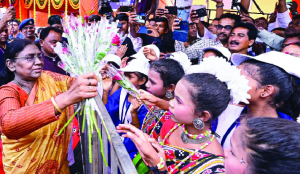
India’s rich and diverse cultural heritage will be on full display at this year’s Independence Day ‘At Home’ hosted by President Droupadi Murmu. The guests will be welcomed with traditional draping of a handwoven Maheshwari stole.
Vibrant art traditions of Chhattisgarh, Goa, Madhya Pradesh and Maharashtra have inspired the ‘invitation package’ this year, said Navika Gupta, Deputy Press Secretary to the President, while giving details of the unique reception.
The guests will be welcomed upon their arrival by the traditional draping of a specially designed stole. The stole has been handwoven in Maheshwar, MP using the traditional dual silk and cotton weave of the Maheshwari weaving tradition. It celebrates the textile traditions of Chhattisgarh, Goa, MP and Maharashtra through a combination of unique regional motifs, she said.
Drawing from the ‘Kinar’ border of the ‘Karwat Kathi’ saree of Maharashtra, the ‘Rudraksha’ border of Goa’s ‘Kunbi’ saree, the ‘Kangra’ motif of Maheshwari weaving of MP and the ‘Chinta Chowk’ motif of Chhattisgarh’s ‘Panika’ tradition, the design brings together four distinct weaving vocabularies within a single textile expression, reads its description, which is part of the invitation.
“As Rashtrapati Bhavan welcomes you on 15 August 2026 to celebrate our 80th Independence Day, we invite you to experience the cultural and artistic diversity of Bharat, and its age-old traditions of ecological stewardship,” it said.
The invitation for the occasion showcases some inspiring examples of sustainable environmental practices and conservation initiatives from the states of Chhattisgarh, Goa, MP and Maharashtra -- a region blessed with a rich landscape of rugged hills, winding river systems and abundant greenery.
Using the vibrant living art traditions of these states, the invitation offers a glimpse into the deep interdependence between communities, creativity and conservation.
The motif of the outer cover is inspired by the Kaavi art of the coastal Konkan region. The wrought iron bell attached to the address slip is handcrafted by skilled tribal ironsmiths in Bastar, Chhattisgarh, using recycled scrap iron. Each bell is individually forged, heated, and meticulously beaten into its signature conical shape.
The fabric envelope is in Bagh textile, characterised by its use of hand-carved wooden blocks and natural, vegetable-based dyes. This craft originates and gets its name from the town of Bagh in Dhar district of MP.
The invitation has a display frame featuring figurines handcrafted using ‘Lauh-Shilp’ or Pitwa art, a world-renowned tribal craft from Bastar, Chhattisgarh. Mirroring the daily life and culture of local tribes, this eco-friendly art form transforms recycled scrap iron into striking, minimalist sculptures and objects of daily use. Each piece is hand-forged from a single rod or sheet of metal without the use of casting.
The Dhokra (one of India’s oldest metal-casting traditions) sculpture on the invitation depicts community-led efforts to protect sacred forest groves, which preserve indigenous tree species such as ‘Mahua’ — which is locally regarded as the “tree of life”. The invitation also showcases Azulejo tile paintings of Goa and Warli paintings of Maharashtra.
The invitation package has been curated by the National Institute of Design, Ahmedabad, a statutory institute under the Ministry of Commerce and Industry.