
Drones emerge as unlikely lifeline in flood-ravaged Nepal
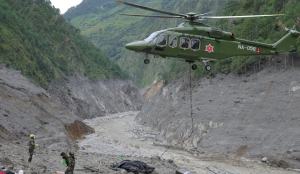
When roads vanish beneath floodwaters and swollen rivers cut off communities, reaching those in need becomes a dangerous task for rescuers in Nepal's rugged hills.
But drones are increasingly filling that gap, delivering food and medicines, searching places too hazardous for humans and, in an extraordinary new role, carrying the dead home.
Seven bodies were airlifted by drones this week from Devighat-3 in Nuwakot to Devighat-5 after rescuers found the area too difficult and dangerous to access safely, according to a report published by The Kathmandu Post on Wednesday.
It described the operation as “perhaps their most unusual role yet”.
The drone team involved personnel from the Nepal Police, Nepal Army and drone manufacturing company GarudX.
The operation is the latest demonstration of how unmanned aerial vehicles (UAVs) are becoming an additional set of eyes and hands in Nepal's disaster-response efforts.
Drones have been used to ferry food and medicines to communities cut off by floods, search for survivors in inaccessible locations and even transport bodies from areas considered too dangerous for rescue teams.
In Devighat-3, among the worst-affected areas, an AI-enabled drone recently flew over stranded villagers, using a loudspeaker to ask basic questions about their needs, including whether they had water, food or medicines.
The villagers were asked to respond by raising their hands.
“Based on the villagers' response, we make an assessment for what they require and send the delivery through drones,” Milan Pandey, director of Airlift Technology and a drone pilot, was quoted as saying by the newspaper.
The drone also asked residents to provide a phone number or address. This could be written on a placard or even in the mud, helping operators establish their location and determine what assistance was required.
Such technology is particularly useful during floods, when washed-away roads and bridges and rapidly flowing rivers can leave entire communities isolated from one another.
“We supplied at least 1.5 tonnes of emergency supplies, including food, to the affected areas in three days,” Pandey said.
Drones are also being deployed in search operations where sending people in could put their lives at risk.
In one such operation, a drone was flown inside the tunnel of the Upper Trishuli-1 hydropower project, where scores of workers are believed to have been trapped following the floods, the report said.
“We reached platform 1 of the project and saw the tunnel filled with water and rocks. It's risky and challenging to get inside,” drone operator Adarsha Bhusal said.
The drone found no signs of life inside the tunnel, he said.
According to the Independent Power Producers' Association of Nepal, around 900 workers have been reported missing at various hydropower projects along the Trishuli and Bhote Koshi rivers.
Nepal's drone ecosystem began developing after the 2015 earthquake, when international agencies introduced the technology for damage assessment and recovery operations. The capability has since increasingly shifted into the hands of Nepali companies and young drone enthusiasts.
The country's growing expertise is also being used beyond its borders. According to the World Bank, Nepal's private sector has provided drone-based services in Bhutan for multi-hazard risk assessment.
Drones, however, are not without limitations. Their payload capacity and range can restrict operations, while adverse weather conditions can also affect their use.
Yet, in places where roads have disappeared, rivers have become impassable or terrain is too dangerous for people, even relatively small drones can have an impact far greater than their size.
Operators say drones are also a significantly cheaper means of transporting supplies than helicopters.
“For a country repeatedly exposed to earthquakes, floods, landslides and mountain hazards, the rise of locally developed drone technology could mark a significant shift in how Nepal responds to disasters — putting eyes, cargo and rescue capability into places where human access is simply too dangerous,” Pandey said.
Airlift Technology, which assembles drones in Kathmandu using imported components, believes wider adoption will require supportive government policy.
“We just need an appropriate policy to promote such a life-saving machine,” Pandey said.
(With inputs from PTI)