
Modi’s green diplomacy comes of age
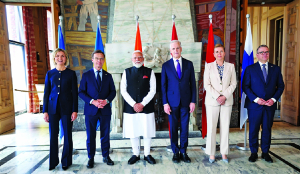
The agreements forged during Prime Minister Modi’s visit reflect a broader vision of positioning India as both a leading advocate and a key driver of a sustainable, resilient and rules-based international order
A defining feature of Prime Minister Narendra Modi’s recent five-nation tour, which covered the United Arab Emirates, the Netherlands, Sweden, Norway and Italy, was the prominence accorded to green partnerships. Clean energy, green technology, shipping, the blue economy and climate resilience figured decisively in the agenda, highlighting how environmental and economic stakes have converged at a moment of global uncertainty. India’s engagement abroad is no longer confined to conventional diplomacy; rather, it is strategically investing in partnerships and channels that secure long-term strategic interests, including energy security. In the wake of global turmoil, the resultant disruptions in supply-chain networks have exposed the vulnerabilities of fossil-fuel systems. The emphasis, therefore, is on convergence around clean energy, green technology and climate resilience, advancing self-reliance while shaping global environmental discourse and reinforcing a rules-based international order.
Bolstering green diplomacy
The Green Strategic Partnership with Norway elevates cooperation in clean energy, Arctic collaboration, defence technology, and other areas. With Sweden, the partnership focuses on green transition and resilient supply chains, while with the Netherlands, the engagement encompasses solar innovation, green hydrogen, storage and renewable investments, alongside maritime and sustainable agriculture. In the case of Italy, Prime Minister Modi and his counterpart, Prime Minister Meloni, agreed to strengthen the 2025-2027 Executive Programme for Scientific Cooperation, promoting joint research in renewable energy, quantum technologies, green hydrogen and the blue economy. Their joint tree-planting exercise underscored support for Prime Minister Modi’s domestic green drive. Further, elevating the India-Nordic relationship to a Green Technology and Innovation Strategic Partnership further consolidates this vision. The tour, which secured nearly $40 billion in investments, including from the UAE, is pivotal for its agenda, scope and timing.
Amid global supply-chain disruptions and mounting pressure on fossil-fuel systems, India’s diversification of its energy basket through diplomatic channels is both a pragmatic and an economic necessity. The oil and gas crisis during disruptions in the Strait of Hormuz exposes this vulnerability. Committed to securing its energy needs beyond fossil-fuel dependence, India is embedding clean energy into external partnerships to build resilience against future shocks.
Second, in the new geopolitical reality, economic and ecological interests are increasingly intertwined and, in many instances, inseparable, and the Indian leadership is well aware of this. By cutting carbon emissions, adopting clean-energy pathways and investing in green technology, India stands to gain significantly in building a decarbonised economy and improving developmental indicators for its underprivileged sections through access to clean and reliable energy supply, cooking fuel, sustainable transport, decent jobs, rural livelihoods and improved living standards.
Third, securing convergence with European countries on clean energy and climate action reflects a shift in mindset. Historically, differences around equity and differentiated responsibility have defined global climate negotiations, with developing countries pressing for finance and technology while developed nations urge emerging economies such as India to act at par. The change in approach stems from changing realities and increasing vulnerabilities. Though India is one of the most climate-impacted countries in the world, Europe too is increasingly facing climate-related disasters and extreme weather in the form of heatwaves, forest fires, rising temperatures and rainfall anomalies. In 2025, Europe incurred losses of nearly €45 billion due to extreme weather events.
The European Union has also significantly pushed environmental norms. Through agreements on joint projects with India in green manufacturing and technology, renewable energy and the blue economy, European countries seek to reinforce environmental standards and strengthen multilateral frameworks. India, meanwhile, maintains its long-standing Global South position on equity while unlocking finance and technical expertise. Together, these efforts bolster a rules-based order with an emphasis on inclusivity, cooperation, partnerships and sustainable development.
India’s diplomatic strength on the environmental agenda emerges largely from a wide array of domestic climate and environmental initiatives. India’s decision to ratchet up its Nationally Determined Contributions (NDCs) underscores its sincerity towards meaningful climate goals. It has pledged a 60 per cent rise in installed non-fossil-fuel capacity, a 47 per cent reduction in emission intensity, and the creation of a 3.5-4.0 billion-tonne CO2 sink by 2035, aligned with Net Zero 2070 and Viksit Bharat 2047. This is further complemented by the strengthening of grassroots institutions, the development of a carbon-market framework, infrastructure for a clean and green transition, ambitious capacity-building efforts, increased climate resilience, biodiversity protection and the conservation of natural systems. India is also driving crucial international initiatives such as the International Solar Alliance, CDRI, LEADIT and circular-economy forums, showcasing its capacity to lead the global energy and climate agenda. In other multilateral forums as well, India has pushed sustainability initiatives as key summit outcomes. This has helped generate global momentum in environmental governance, where India’s approach is active, assertive and confident.
By aligning with European countries on green partnerships, India positions itself as both a beneficiary and a driver of the global energy and climate agenda.
India is also driving crucial international initiatives such as the International Solar Alliance, CDRI, LEADIT and circular-economy forums, showcasing its capacity to lead the global energy and climate agenda
Shehzad Poonawalla is the National Spokesperson of the Bharatiya Janata Party, and Vijeta Rattani is development and sustainability expert; Views presented are personal.