
India successfully tests advanced Agni Missile capable of hitting multiple targets
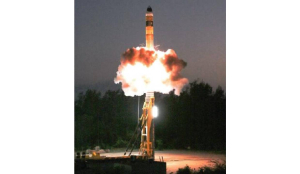
India has successfully conducted a test of an advanced Agni-5 missile equipped with Multiple Independently Targetable Re-entry Vehicle (MIRV) technology, significantly boosting the country’s strategic defence capabilities.
The missile was flight-tested jointly by the Defence Research and Development Organisation (DRDO) and the Strategic Forces Command from Dr APJ Abdul Kalam Island off the Odisha coast on May 8.
According to an official statement issued by the Press Information Bureau (PIB), the missile was tested with multiple payloads aimed at different targets spread across a large geographical area in the Indian Ocean Region.
“The missile was flight-tested with multiple payloads, targeted to different targets spatially distributed over a large geographical area in the Indian Ocean Region,” the PIB said.
The entire flight path and impact of the payloads were monitored using several ground-based and ship-based tracking systems. Officials said the data confirmed that all mission objectives were successfully achieved during the trial.
The test is being viewed as a major milestone in India’s strategic missile programme, particularly because of the missile’s MIRV capability. MIRV technology allows a single ballistic missile to carry multiple warheads that can independently strike separate targets, making interception by enemy defence systems significantly more difficult.
Defence experts say such systems strengthen deterrence capabilities by enabling one missile to hit several enemy positions simultaneously instead of relying on multiple launches.
Though DRDO did not officially identify the missile, defence sources believe the test involved an advanced variant linked to the Agni-5 programme, which forms part of India’s growing intercontinental ballistic missile (ICBM) capability. ICBMs are designed to strike targets located more than 5,500 km away.
The missile reportedly uses advanced navigation systems, precision guidance mechanisms and sophisticated re-entry technology. Re-entry is considered one of the most critical phases for ballistic missiles as warheads re-enter Earth’s atmosphere at extremely high speeds and temperatures.
According to defence analysts, the missile may reach speeds close to Mach 24 — nearly 24 times the speed of sound — during re-entry, making interception highly challenging for missile defence systems.
Experts also noted that MIRV-equipped missiles complicate enemy radar tracking because several warheads separate from a single missile and follow different trajectories. Advanced systems may also deploy decoys to confuse defence networks and reduce interception chances.
Defence Minister Rajnath Singh congratulated DRDO scientists, the armed forces and industry partners involved in the project after the successful test. He said the missile system would further strengthen India’s defence preparedness amid evolving regional and global security challenges.