
India’s Skills Revolution Must Begin in School
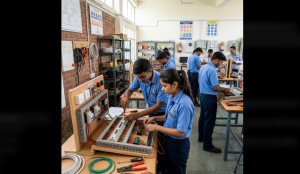
If one asks any parent in a small Indian town about the Industrial Training Institute (ITI), one would certainly notice how their voice and face changes apologetically, instantly. For years the ITI has been the place families settled for when the engineering seat or the medical rank did not come through. Children pick up on that. They grow up believing that working with your hands is a lesser ambition than working with a degree.
This thought process is gradually changing and is being challenged. In October 2025 the Prime Minister launched PM SETU, a Rs 60,000-crore scheme to upgrade 1,000 government it is of which 200 of them will act as hubs and the rest 800 as smaller spokes. The idea is simple and straightforward. If a training centre looks like a modern workplace, leads to a real job and is guided by people who actually hire, families will stop seeing it as a consolation prize.
Buildings alone will not be enough, though. By the time a child is eleven, she has already worked out what the adults around her think about skill. So the more interesting work is happening earlier, in a Class 6 classroom where a girl connects her first circuit or writes her first lines of code and realises she can make something work. It is a small moment, but careers have started with smaller ones. A small state on the western coast has been doing this for a few years now, and without much noise.
Goa announced its Coding and Robotics Education in Schools scheme, known as CARES, in its 2021 budget. It now reaches around 65,000 students in more than 440 government and aided schools, mostly in Classes 6 to 8. The equipment is free and the teachers are trained. Children use tools such as Scratch and PictoBlox to build small projects of their own. A headmaster in Gaodongrim, a village in Canacona, told reporters he was amazed at how quickly rural students took to it. At the launch of CARES learning resources and the Goa Codes 2024 prizes on January 17, 2025, Chief Minister Dr Pramod Sawant said that 10,000 students were “actively shaping their future through the CARES elective curriculum” that academic year. He added that Goa would lead the country in robotics education. In December 2025 he announced that the scheme would continue for five more years.
The state has also thought about what comes after school. Its 2025 budget made internships compulsory for graduation from June that year. It also promised higher secondary students on vocational courses, in areas like apparel, beauty and wellness, agriculture and automobiles, an accessory kit worth Rs 20,000 so they can start work with tools of their own. Then there is NIT Goa, where half the seats are reserved for Goan students. Goa did not get that easily. The Centre first wanted the seats shared with Daman and Diu, Dadra and Nagar Haveli and Lakshadweep, and the state refused to hand over land until the full 50 percent was assured to Goans. The Centre agreed from 2012, and the institute now runs from its permanent campus at Cuncolim. NIT Goa has also trained over 500 high school teachers across the state, because a quota means little if children are not ready to claim it.
What makes Goa different is who is standing in front of the class. Government school data for 2023 24 counts 11,870 women among 14,594 teachers in the state. That is a little over 81 percent, against a national share of about 55 percent. These are the women who open the classroom every morning, so a robotics scheme in Goa depends on their confidence, and more than 500 of them have been trained for it. For a village child, the first person she sees solve a problem on a screen is often her own teacher. That changes what a technical career looks like to the girls watching.
Behind all of this sits a simple idea, which is local opportunity. For too long, ambition in a small town has meant buying a bus ticket out. It does not have to. A boy from Cuncolim should be able to study engineering near his parents. A girl in Canacona should be able to learn robotics without moving to Bengaluru or Pune. A young electrician should start work with a proper toolkit and a placement, not a cousin’s phone number. When training, employers and institutions sit in the same district, families stop measuring success by how far their children travel. Staying becomes a choice rather than a compromise. None of this is finished, and honest progress reports matter more than glossy ones.
Goa still has to show that its coding classrooms lead to real jobs, that its quota seats are filled by local children who go on to thrive, and that its vocational courses carry the dignity promised in the brochures. Other states have harder problems, with bigger populations and fewer teachers. But the direction holds everywhere. Start early, train the teacher, keep opportunity close to home, and give skill the same respect we give a degree. Prestige is never announced from a stage. It is earned slowly, in classrooms and workshops, on the day a parent sees a child come home with a trade, a purpose and a salary.
This article is authored by Ajay Jasra, consultant, Rural Advocacy, New Delhi.