
Dhamra Port becomes India's first large-scale private multi-cargo port to run fully on renewable power
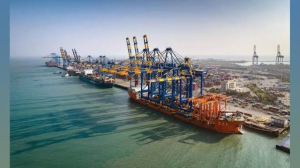
Dhamra Port in Odisha, operated by Adani Ports and Special Economic Zone (APSEZ), has shifted its entire electricity consumption to renewable power, making it India's first large-scale private multi-cargo port to operate fully on renewable electricity, the company said.
The port, which handles more than 48 million tonnes (MT) of cargo annually, now meets over 90 lakh units of monthly electricity demand from renewable sources. At its current operating level, renewable power consumption exceeds 108 gigawatt-hours (GWh) annually, APSEZ said.
The transition, effective from August 2026, is part of APSEZ's long-term Net-Zero strategy and is aimed at reducing emissions associated with purchased electricity while improving the environmental performance of its energy-intensive operations.
The shift has been achieved through a combination of captive renewable power, third-party access arrangements and green-power procurement under Odisha's regulatory framework.
Around 25-30 per cent of Dhamra's renewable electricity comes from APSEZ's captive hybrid power plant at Khavda in Gujarat, while another 10-15 per cent is sourced through third-party access.
The remaining requirement is met through a Green Consumer arrangement with Odisha's distribution utility.
Renewable electricity now powers the port's round-the-clock operations, including cargo handling, storage, rail-linked activities and other critical infrastructure.
Located on the Odisha coast between Haldia and Paradip, Dhamra is one of eastern India's key deep-draft ports. It has an installed capacity of 60 MT and handled 48.8 MT of cargo in the financial year ended March 2026.
The port has six dry-cargo berths, rapid-loading silos, wagon tipplers, track hoppers, mechanised storage yards and jetty equipment, besides rail and road connectivity to mineral-rich hinterlands across Odisha, Jharkhand and West Bengal.
The move is part of APSEZ's broader efforts to increase the use of renewable electricity across its operations and support its longer-term decarbonisation targets.