
ASI transfers Rakhigarhi skeletal remains to Anthropological Survey of India for advanced scientific study
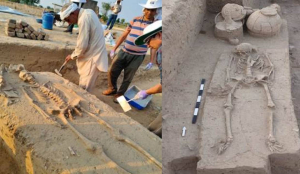
The Archaeological Survey of India (ASI) has transferred human skeletal remains excavated from Rakhigarhi in Haryana to the Anthropological Survey of India (AnSI) for advanced scientific analysis, marking a significant step in ongoing research into the Indus-Saraswati Civilisation.
The transfer has been carried out under a recently signed Memorandum of Understanding (MoU) between ASI and AnSI, aimed at promoting multidisciplinary studies of ancient human remains and archaeological findings.
During the 2025–26 excavation season, ASI archaeologists uncovered eight burials at Mound No. 7 in Rakhigarhi, an area already identified as an ancient cemetery site. Among the findings were three complete human skeletons along with several skeletal fragments recovered from other burial sites.
These remains have now been moved to the Anthropological Survey of India’s ancient skeletal repository and laboratory in Kolkata, where detailed anthropological, genetic, and forensic studies are expected to be conducted. Additional skeletal materials recovered from the site are also scheduled for transfer in the coming days.
Rakhigarhi, located in Haryana and spread across nearly 550 hectares, is regarded as the largest known settlement of the Indus-Saraswati Civilisation. The site has yielded extensive archaeological evidence, including planned urban layouts, drainage systems, craft production areas, trade networks, and burial grounds.
Experts believe that further scientific examination of the skeletal remains could provide deeper insights into the population structure, lifestyle, health patterns, and cultural practices of one of the world’s earliest urban civilisations.