
Ancient Indian Wisdom on Taxation and Fiscal Ethics: The Startup as the New Seedling
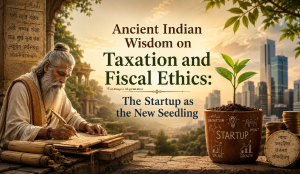
Ancient Indian thought on taxation and fiscal ethics was not confined to the mechanics of revenue extraction. It was anchored in a profound understanding of how wealth is created and how premature taxation of a nascent enterprise is not a prudent decision but a policy failure. This insight, articulated in Kautilya's Arthashastra and echoed in the Manusmriti, Shanti Parva of the Mahabharata and other ancient Indian scriptures, anticipates Bharat's taxation of startups and early-stage innovation. The 12-year trajectory of the Angel Tax, from its introduction in 2012 to its abolition in 2024, is, in essence, a modern re-enactment of ancient Indian fiscal wisdom.
The Foundational Principle: Do Not Harvest the Unripe Fruit
The Arthashastra's most important teaching on this subject is a governing doctrine embedded across its fiscal prescriptions: the state must not levy taxes on activity that has not yet matured into productive surplus. In the second Adhikarana, Kautilya instructs that the state must show Anugraha, i.e., favour or concessionary support, to those who establish new productive ground. He prescribes that farmers settling new land be supplied with seeds and working capital, and be permitted to repay only after the harvest, with tax relief structured so that it "swells the treasury eventually". The emphasis is crucial: "eventually". The revenue foregone in the germination phase is an investment, not a loss!
Kautilya understood what modern economists would later formalise in discussions over the Dupuit-Laffer curve, which describes the relationship between taxation rates and the tax revenue collected by a state. A tax rate imposed beyond an enterprise's productive capacity destroys the very base it is meant to tax. As Balbir Singh Sihag (famed author of the book titled "Kautilya: The True Founder of Economics") shows in his scholarly analysis, the Arthashastra contains "almost all the essential ingredients of a sound fiscal structure", including a theory of tax timing calibrated to the maturity of economic activity.
The Arthashastra also accorded formal recognition to the Shreni (the guild or a corporate body of merchants and artisans) as a legitimate economic actor deserving of regulatory protection. Its Adhikarana IV explicitly protects guild deposits in times of distress and Adhikarana XI addresses the governance of guilds and confederacies as distinct entities within the state's economic jurisdiction. The Shreni was, in effect, ancient Bharat's answer to the corporate enterprise (a collective of investors and skilled producers pooling capital and labour toward a common productive purpose). To tax the capital infusion at the moment of formation - before value had been created - would have been, in Kautilyan's scheme, an act of fiscal arbitration.
The Manusmriti: Capacity as the Tax's Measure
The Manusmriti's verse of proportionality (7.128) is equally significant: It means that taxes should be assessed after careful consideration, so that both he and those who do the work receive their fair share. The key phrase is "those who do the work": a recognition that the entrepreneur's surplus is not a windfall to be appropriated but a return on risk and labour that must be protected for the enterprise to continue.
The differentiated tax shares prescribed in the Manusmriti - one-sixth for mature agricultural produce, one-eighth for less productive land, one-twelfth for the least fertile - encapsulate sensitivity to the taxpayer's productive capacity that maps directly onto the question of when and how much a startup ought to bear.
Scrapping of the Angel Tax: An Error Rectified
The tension between the state's revenue instinct and the Kautilyan protection of nascent enterprise was dramatised by the debates over the so-called Angel Tax. Introduced in 2012 under Section 56(2) (viib) of the Income Tax Act, it targeted unlisted companies issuing shares at a premium above fair market value, taxing the excess as income. Intended to curb money laundering, it was criticised for stifling innovation and fundraising. It was terminated in the Union Budget 2024-25, citing the need "to bolster the Indian startup ecosystem, boost entrepreneurial spirit and support innovation".
Its structural problem was precisely what Kautilya would have identified: it taxed not income, not profit, not surplus, but capital at the moment of its commitment to an enterprise that had not yet produced anything.
The Shanti Parva (Book XII, Section 88) captures this through a beautiful analogy: The ideal state is like a bee that gathers honey without damaging the flower, so that it continues to bloom and yield. The Angel Tax violated this principle at its root. It taxed not profit, not income, not any fruit the enterprise had produced, but the very seeds being planted. In Indian civilizational ethos, those seeds deserve the state's protection, not its appetite.
Dharma, Trust and the State as Trustee
Bhishma's counsel to Yudhishthira in the Shanti Parva is clear: the state is a trustee, not a proprietor. Revenue belongs, ultimately, to the welfare of the people from whom it is drawn. When the state taxes capital that is committed to the creation of enterprises that would have employed thousands, generated property and expanded the economy's productive frontier, it is not exercising fiscal authority; rather, it is hampering its own economic base.
The paternal metaphor of the Shanti Parva - the state should be as fair between its subjects as a father between his sons - implies that the entrepreneur venturing into new productive territory deserves not predation but protection, precisely because the risks they bear serve the common good.
Conclusion
The Angel Tax's eventual elimination is not merely a chapter in Indian tax history. It is a validation of the civilisational wisdom found in the Arthashastra, Manusmriti and Mahabharata, millennia before modern startup ecosystems were imagined. The principle is simple and durable: protect the seedling. Tax the harvest. The state that confuses the two does not merely lose revenue; it destroys the future it is meant to build. As Bharat positions itself as a global hub for innovation and entrepreneurship, it is revisiting the fiscal ethics of Kautilya, Manu and Bhishma.
However, the relevance of ancient Indian texts on ethical and responsible taxation in the context of startups goes much beyond the scrapping of a tax. It is the state that controls profiteering impulses while protecting businesses, which form the bedrock of a sound startup ecosystem. Needless to say, a sound knowledge system is always a prerequisite for an idea to bloom.
Atanu Chakrabarty, Former Economic Affairs Secretary, MoF, GoI & Dr. Abhishek Anand, Senior Research Fellow, Bharat Ki Soch; Views presented are personal.