
A mirror across the Himalayas
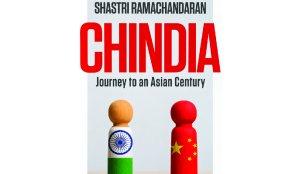
There are books that merely inform, and there are books that compel readers to question long-held assumptions. Chindia: Journey to an Asian Century by Shastri Ramachandaran belongs firmly to the latter category.
It is not just a study of India-China relations but an invitation to rethink the future of Asia itself, free from the prejudices, slogans and inherited fears that have clouded public discourse for decades.
My own fascination with China began long before I set foot in the country. One of the greatest scoops of my journalistic career was for the India Press Agency (IPA), when I reported that India was on the verge of restoring diplomatic relations with China after the rupture caused by the 1962 war.
The story created quite a stir.
The next day, with MPs and journalists demanding confirmation, External Affairs Minister YB Chavan announced in Parliament that KR Narayanan had been appointed India’s Ambassador to China.
Yet, like millions of Indians of my generation, my understanding of China remained filtered through the lens of the 1962 conflict. We grew up on the official narrative while the Henderson Brooks-Bhagat Report remained under lock and key. Defence Minister George Fernandes famously described China as “enemy number one”, reinforcing a perception that had already become deeply embedded in the Indian psyche.
When I eventually travelled to Beijing nearly two decades later, en route to Ulaanbaatar in Mongolia, I found a country that was still poor but unmistakably disciplined.
The airport was hardly superior to New Delhi’s. As the aircraft taxied, I noticed an elderly man in the familiar Mao suit carefully removing weeds from the grassy verge. The sight seemed symbolic of a nation painstakingly rebuilding itself.
Driving to the diplomatic enclave where my host, a PTI correspondent, lived, another image remained etched in my memory: endless streams of cyclists moving with clockwork precision through the streets. Even my host commuted by bicycle. Consumer goods were inexpensive. I bought batteries for my camera flash at almost half the Indian price, only to discover that they took forever to recharge. Japanese batteries proved far more reliable, a reminder that China had not yet become the manufacturing powerhouse it is today.
I also remember standing in a long queue near Qianmen Gate, close to Tiananmen Square, to buy a burger from China’s first McDonald’s outlet, which had opened only days earlier.
That scene, ordinary as it seemed then, represented a society cautiously opening itself to the world.
Years later, after the Beijing Olympics, my wife sent me photographs of the Bird’s Nest Stadium and other landmarks. Comparing those images with my memories of the city was astonishing. China had transformed itself beyond recognition. The bicycles had given way to expressways, gleaming skyscrapers and world-class infrastructure. The nation that once struggled to produce dependable batteries had become a technological giant competing with the world’s best.
It is precisely this remarkable journey that Shastri Ramachandaran explains with clarity, balance and authority.
He occupies a unique place among Indian writers on China. Having spent more than a decade as a senior journalist with Chinese publications in Beijing, he combines the curiosity of a seasoned reporter with the discipline of a serious scholar. That combination gives Chindia its distinctive flavour. It reads effortlessly without sacrificing intellectual depth.
His earlier work, Beyond Binaries: The World and China, established him as one of India’s perceptive observers of contemporary China. That book appealed largely to diplomats, academics and policy specialists. Chindia, however, speaks to a much wider audience. It translates complex geopolitical developments into lucid prose that ordinary readers can readily grasp.
Writing objectively about China is no easy task for an Indian. Public opinion has long been shaped by suspicion, selective information and political rhetoric. Unlike Indians who proudly claim distant relatives in Britain or America, very few can say they have Chinese friends.
Familiarity breeds understanding, distance breeds caricature.
Ramachandaran approaches China without ideological baggage. His central argument is straightforward yet profound: the twenty-first century belongs to Asia, and India and China will largely determine its course.
The two countries have every reason to cooperate rather than confront each other. Their destinies are intertwined economically, strategically and civilisationally.
That is easier said than done. Powerful geopolitical interests would prefer India and China to remain adversaries, constantly distracted by border disputes and strategic rivalries. Such confrontation benefits outside powers far more than it benefits either Asian giant.
The book is particularly refreshing because it refuses to indulge in comforting illusions. Ramachandaran frankly acknowledges where China has surged ahead of India. Whether in infrastructure, manufacturing or increasingly in advanced technologies, China has established a commanding lead.
Even in areas where India once claimed comparative advantage, such as information technology, China has emerged as a formidable competitor. The rapid rise of AI platforms like DeepSeek illustrates how intensely China now competes with the United States rather than with India.
He also places China’s diplomacy in a broader regional context. Beijing today enjoys stronger relations with many of India’s neighbours than New Delhi does. Nepal, Bangladesh and much of Southeast Asia feature prominently in his analysis. His discussion of China’s regional engagement is comprehensive, authoritative and remarkably accessible despite the complexity of the issues involved.
The book also ventures beyond bilateral relations into global geopolitics. Ramachandaran analyses America’s declining influence, including its chaotic withdrawal from Afghanistan under President Joe Biden.
Future editions may well examine the consequences of subsequent developments in West Asia, including America’s confrontation with Iran, further enriching an already comprehensive study.
Throughout the book, Ramachandaran writes with quiet confidence. His prose has a magisterial quality, yet it never becomes ponderous. Complex strategic calculations, diplomatic manoeuvres and historical developments are explained with admirable clarity, making them easily digestible even for readers with little prior knowledge of international affairs.
Ultimately, Chindia is far more than a book on India-China relations. It is a thoughtful meditation on Asia’s future and on the immense possibilities that emerge when neighbours choose cooperation over confrontation.
It serves as a mirror reflecting both countries, their strengths, their weaknesses, their misunderstandings and their shared potential.
The image it offers is clear: India and China need not fear each other to prosper. They must learn to trust one another if they are to triumph together. In that sense, Shastri Ramachandaran has written not merely a book, but an indispensable guide to understanding the century that Asia is destined to shape.