Singeetham Srinivasa Rao, the maverick who pushed South cinema beyond its boundaries, passes away at 94
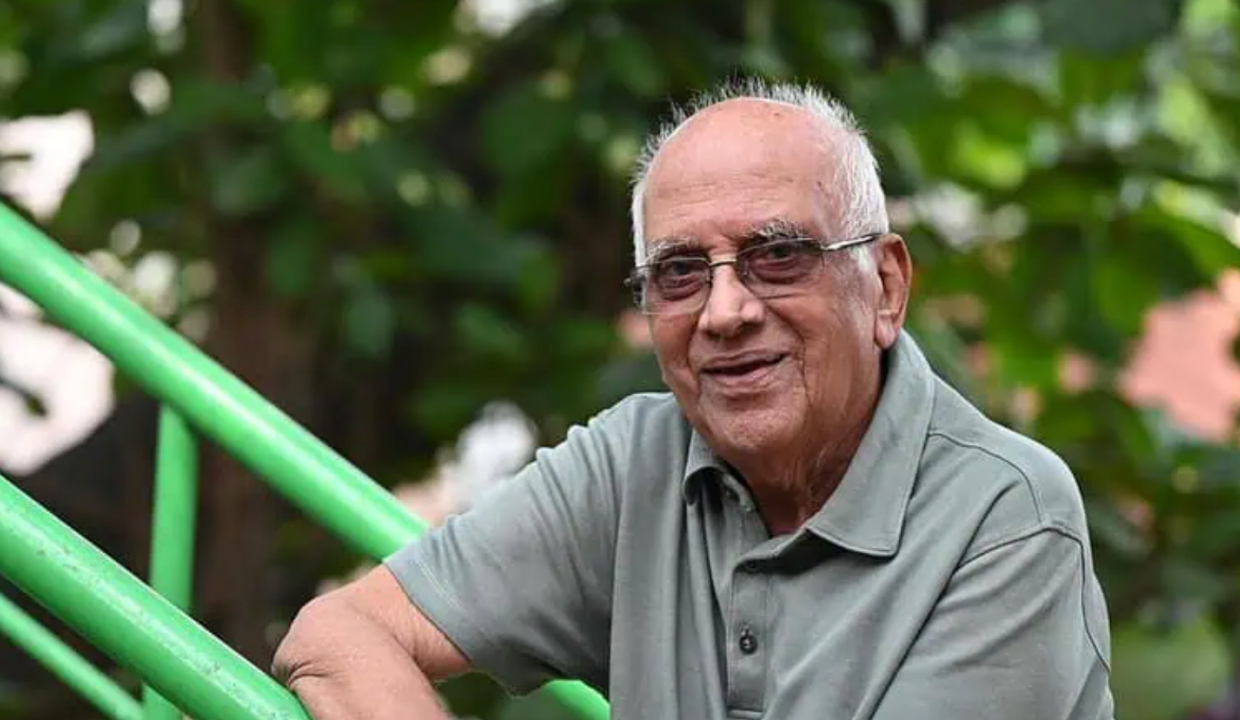
Veteran filmmaker Singeetham Srinivasa Rao, one of Indian cinema’s most inventive directors whose work bridged linguistic and genre frontiers for over five decades, passed away in Chennai. He was 94. Rao had been undergoing treatment for age-related health complications at Kauvery Hospital.
His passing marks the end of an era defined by bold creative audacity. Across a career directing roughly 60 films in Telugu, Tamil, Kannada, Hindi, and Malayalam, Singeetham refused to stick to a comfortable formula. Whether introducing time travel to mainstream Telugu audiences, staging dialogue-free black comedy, or pioneering practical visual effects before the dawn of digital CGI, he treated commercial cinema as an open playground.
'He passed away in his youth': Industry mourns a master
Tributes poured in from across the Indian film industry, with actors, technicians, and directors highlighting his boundless curiosity and refusal to let age diminish his enthusiasm.
Actor-filmmaker Kamal Haasan, who shared one of Indian cinema’s most fruitful director-actor partnerships with Singeetham, penned a deeply moving tribute.
"Singeetham sir, by his own choice, passed away in his youth, along with his youth. His youthful spirit did not spread to many. Among the friends and disciples who walked alongside him, holding his hand, I am one of them," Kamal wrote. "Dying young need not be a tragedy. It can be glorious. Singeetham Srinivasa Rao is a great example. I have admired him since I knew him. Now I aspire to live like he did."
Filmmaker SS Rajamouli called him a fearless pioneer whose imagination shaped how an entire generation looked at cinema. Actor Jr NTR mourned his demise, writing: "A visionary who thought ahead of his time, delivering films like Aditya 369, Pushpaka Vimanam, and Mayuri that feel fresh even across generations."
Actor Nani shared a voice note from Singeetham on social media, recalling the veteran director’s unending appetite for storytelling: "Whenever he called or messaged, he spoke straight about his new ideas and the film he wanted to make next. That infectious energy and curiosity, even in his nineties."
From a physics degree to the sets of Mayabazar
Born on September 21, 1931, in Gudur (in present-day Andhra Pradesh), Singeetham was raised in an intellectually vibrant household—his father was a school headmaster and his mother an accomplished violinist. He graduated with a degree in physics from Madras Presidency College, an academic training that frequently resurfaced in his sharp, analytical understanding of screen geometry, optical illusions, and camera craft.
Before turning to cinema, he immersed himself in theater and literature, citing Telugu poet Vemana and satirists Mark Twain and P.G. Wodehouse as foundational influences.
His entry into cinema came in the mid-1950s under the mentorship of legendary director K.V. Reddy. Reddy, known for his fastidious production planning and grand scale, inducted Singeetham as an apprentice on classic productions including Donga Ramudu (1955) and the 1957 magnum opus Mayabazar. Singeetham spent nearly two decades working as an assistant and associate director, internalizing the delicate art of world-building and character blocking.
Early realism and the Kannada golden run
Singeetham made his independent directorial debut in 1972 with the Telugu film Neethi Nijayithi. His early career leaned into rooted social realism. He directed Dikkatra Parvathi(1974), a Tamil drama based on C. Rajagopalachari’s story about poverty and rural indebtedness, which bagged the National Film Award for Best Feature Film in Tamil. In Telugu, his film Tharam Marindi (1977) tackled agrarian exploitation and social caste structures, winning the Nandi Award for Best Feature Film.
By the early 1980s, Singeetham expanded into Kannada cinema, beginning an era-defining collaboration with Dr. Rajkumar and producer Parvathamma Rajkumar.
Between 1982 and 1988, he directed Rajkumar in seven films. Hits such as Haalu Jenu(1982), Chalisuva Modagalu (1982), Bhagyada Lakshmi Baramma (1986), and Rajkumar’s milestone 200th film Devatha Manushya (1988) were revered for their clean family humor, sensitive relationship dynamics, and chart-topping soundtracks. Singeetham also introduced Dr. Rajkumar’s sons to cinema, directing Shiva Rajkumar’s debut Anand (1986) and Raghavendra Rajkumar’s debut Chiranjeevi Sudhakar (1988).
Redefining the rules: Kamal Haasan and genre innovation
If his Kannada films proved his mastery of commercial sentiment, his creative synergy with Kamal Haasan established him as one of South cinema’s most radical experimenters.
Having first directed Kamal in the actor’s 100th film, the sensitive romance Raja Paarvai(released in Telugu as Amavasya Chandrudu, 1981), the duo went on to rewrite the conventions of mainstream cinema:
● Pushpaka Vimana (1987): At a time when Indian commercial films relied heavily on punchy dialogues, Singeetham crafted a silent black comedy about an unemployed youth who stumbles into a five-star hotel room. It was a box-office triumph, won the National Film Award for Best Popular Film Providing Wholesome Entertainment, and proved that physical comedy and social satire transcended linguistic barriers.
● Apoorva Sagodharargal (1989): Long before digital visual effects existed in Indian cinema, Singeetham brought to life the character of Appu, a dwarf circus clown seeking revenge. Through forced perspective, specially dug floor trenches, custom shoes, and meticulously matched angles, he pulled off a visual illusion that baffled viewers and remains a technical touchstone.
● Michael Madana Kama Rajan (1990): Written alongside Crazy Mohan and Kamal Haasan, the quadruple-role farce turned rapid-fire wordplay, split screens, and situational chaos into an enduring cult classic.
In Telugu, Singeetham made equally bold leaps. With Aditya 369 (1991), starring Nandamuri Balakrishna, he gave Indian cinema one of its most coherent time-travel films, seamlessly transporting modern characters between a dystopian 25th-century apocalypse and Sri Krishnadevaraya's 16th-century Vijayanagara Empire. Three years later, he mounted Bhairava Dweepam (1994), reviving high folklore and fantasy through imaginative miniature models and practical camera effects.
Even when handling biographical drama, he found unique narrative approaches: in Mayuri(1985), he persuaded classical dancer Sudha Chandran to enact her own life story after losing a leg in an accident, producing an inspiring drama that swept 14 state Nandi Awards.
A mentoring force to the end
Unlike many veterans whose styles hardened with age, Singeetham remained deeply attuned to modern cinematic developments. Young filmmakers frequently sought his counsel: Kalki 2898 AD director Nag Ashwin consulted him during the writing and pre-production stages of the sci-fi spectacle to refine its world-building.
Even well into his nineties, Singeetham walked onto film sets, recently directing Sing Geetham, an eco-musical.
Singeetham Srinivasa Rao leaves behind a filmography that defies easy categorization. In an industry frequently bound by box-office formulas, he remained an artisan who proved that the best way to honor an audience was to never give them the same thing twice.