Relearning Agroecology from India’s Living Traditions
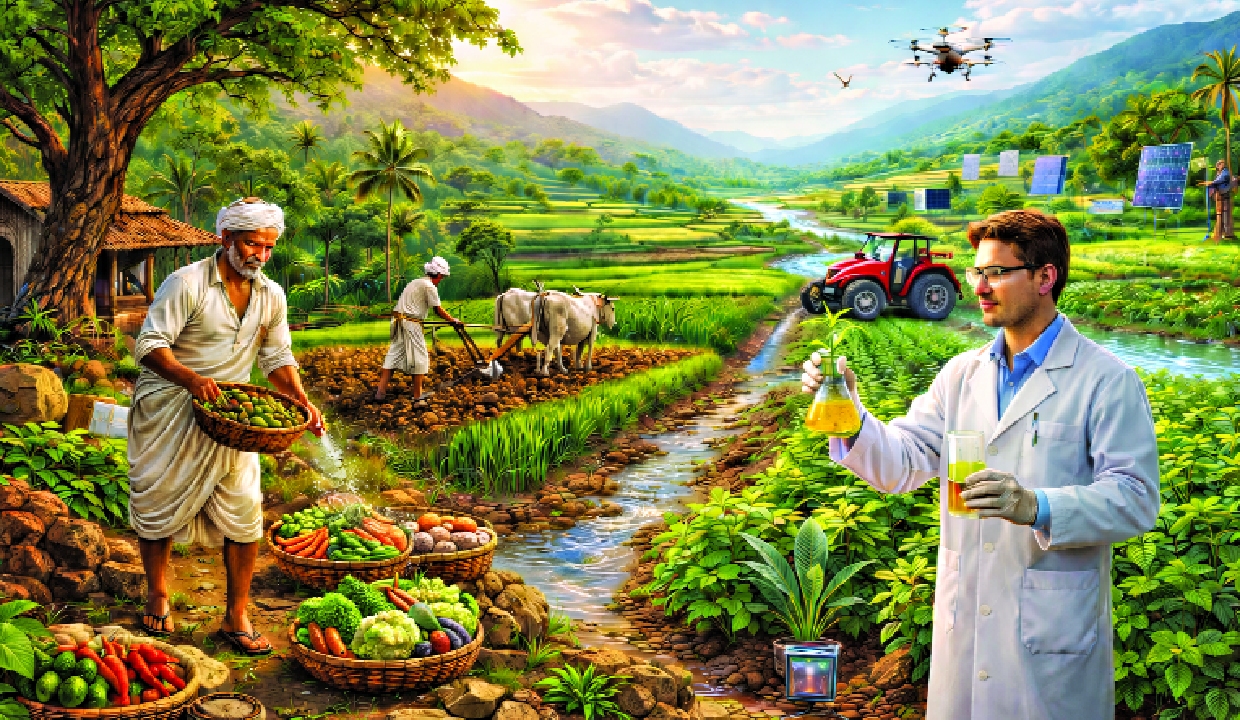
Ancient Indian agrarian knowledge recognised that soil fertility, crop resilience and food security arise from diversity, not monoculture. Agricultural land was treated as a living ecological system sustained through crop rotation, mixed cultivation, and attentive stewardship. This ecological orientation was not abstract philosophy; it was codified in classical texts and embedded in archaeological and lived agrarian practices across regions.
Textual and Archaeological Roots
The Krishi Parashara (c. 400 BCE) presents agriculture as seasonally calibrated and soil-conscious, advocating crop rotation and mixed cultivation based on rainfall and lunar cycles. This ecological orientation is elaborated in Vrikshayurveda (c. 1000 CE), Surapala, classified soils and described organic nutrient formulations such as Kunapajala, a fermented mixture of plant and animal matter, indicating an early understanding of circular fertilisation and soil management. The Arthashastra (c. 300 BCE) formalised agriculture; the Sita Adhyaksha (superintendent of agriculture) was tasked with seed preservation, irrigation oversight, manure regulation and seasonal planning. Sangam literature (c. 300 BCE) reflects region-specific agroecology in ancient Tamilakam through its classification of five ecological landscapes: Kurinji (mountain), Mullai (forest), Marutham (wet plains), Neithal (coastal), and Palai (arid). Each zone was associated with distinct crops, water systems, and livelihoods adapted to terrain and rainfall.
Similarly, epic literature reinforces these concerns. In the Sabha Parva of the Mahabharata, the sage Narada asks King Yudhishthira whether farmers remain dependent solely on rainfall, a condition termed Adevamatruka. This query implies the ruler's duty to construct tanks and canals, framing water as a shared trust. The Aranya Kanda of the Ramayana depicts forest hermitages where fruit-bearing trees, cultivated fields, and groves coexist, reflecting early agroforestry principles.
Moreover, archaeological evidence further grounds the agrarian knowledge. The Indus Valley regions of Harappa and Mohenjodaro demonstrate grain storage, irrigation management and diversified cropping patterns, including barley, pulses, sesame and millets. Early rice cultivation in the middle Ganga plains at Lahuradewa suggests experimentation with regionally suited crops, while Neolithic sites in peninsular India, such as Brahmagiri and the ash-mound complexes of Karnataka, point to millet-based agro-pastoral systems adapted to semi-arid ecologies. All these indicate regionally adapted agricultural experimentation across ecological zones since antiquity.
Landscapes as Laboratories
India's geography spans diverse climates, from Himalayan glaciers to tropical coasts and arid deserts. Each ecological zone generated distinct agricultural knowledge systems shaped by centuries of observation and experimentation.
In the Himalayan belt, terrace farming stabilised fragile slopes and reduced erosion. Ladakh's Zing irrigation system stored and gradually released glacial meltwater, conserving topsoil and supporting nutrient cycling during short growing seasons. Crop selection prioritised frost resistance and early maturity. In coastal Kerala, the saline-tolerant Pokkali rice system combined rice with prawn and fish cultivation, restoring soil fertility through tidal nutrient exchange and aquatic biomass. Agricultural calendars tracked rainfall rhythms and seasonal winds with notable precision rooted in lived experience. In the north-eastern hills, Jhum cultivation functioned as rotational agroecology. Land was briefly cultivated, then left fallow for forest regeneration and nutrient renewal. Mixed cropping and community labour suited fragile terrains. In western India, Rajasthan's Khadin system captured monsoon runoff through earthen embankments, depositing nutrient-rich sediments onto fields even under minimal rainfall. Sacred pastures such as Oran and Gochar sustained livestock-based nutrient cycles while preventing desertification. Together, these practices reflected a cultivation ethos aligned with ecological limits.
Why Traditional Agroecological Wisdom Matters Today
India has not been institutionally passive. The Soil Health Card Scheme, nutrient-based fertiliser subsidy reforms, the Paramparagat Krishi Vikas Yojana, the National Mission on Natural Farming, and the Indian Council of Agricultural Research's (ICAR) 'National Innovations in Climate Resilient Agriculture' reflect policy awareness of ecological risk. Yet, ecological pressures persist. ICAR estimates that nearly 30% of India's land is degraded. Soil Health Card data indicate widespread soil organic carbon deficiencies. NITI Aayog's Composite Water Management Index (2018) highlights severe groundwater depletion across agrarian regions. The policy architecture exists; it is now time to place ecological resilience at the centre of agricultural performance.
Way Forward
A systematic pan-Indian repository of Indigenous agroecological knowledge is now essential. Much of this knowledge survives in fragments preserved in community memory, manuscripts and local practices, yet remains unsystematically documented. A national repository could document farming methods alongside ecological parameters such as soil type, rainfall and irrigation systems, linking historical insight with contemporary needs. To move beyond mere documentation, it must be structured around clear institutional and intellectual priorities.
First, traditional agroecological practices must be documented in context, grounded in diverse geography, seasonal cycles and environmental conditions. Second, interdisciplinary collaboration among agronomists, ecologists, historians and farmers to evaluate how traditional practices perform under climatic stress. Third, agricultural and environmental curricula should recognise indigenous knowledge as part of India's scientific tradition. Fourth, digital platforms can connect this repository with advisories, enabling tradition and technology to reinforce one another.
Finally, the repository must inform practical ecological interventions. Indian soils are experiencing declining soil organic carbon and humus levels, while substantial volumes of organic waste remain underutilised. Treating biomass and organic waste as resources can restore fertility while reducing dependence on synthetic inputs. Integrating composting, biomass recycling and traditional organic formulations into soil management policy would strengthen long-term ecological resilience.
The aim is not to return to pre-modern agriculture but to broaden what counts as knowledge. In an era of ecological uncertainty, sustainability depends on reinterpreting inherited wisdom that understood land as a living system to be sustained with care and continuity.
Meenakshi Lekhi, Former Minister of State for External Affairs, Govt. of India, and Dr Sophia Lisam, Senior Research Fellow, Bharat Ki Soch; Views presented are personal.