Realpolitik over idealism
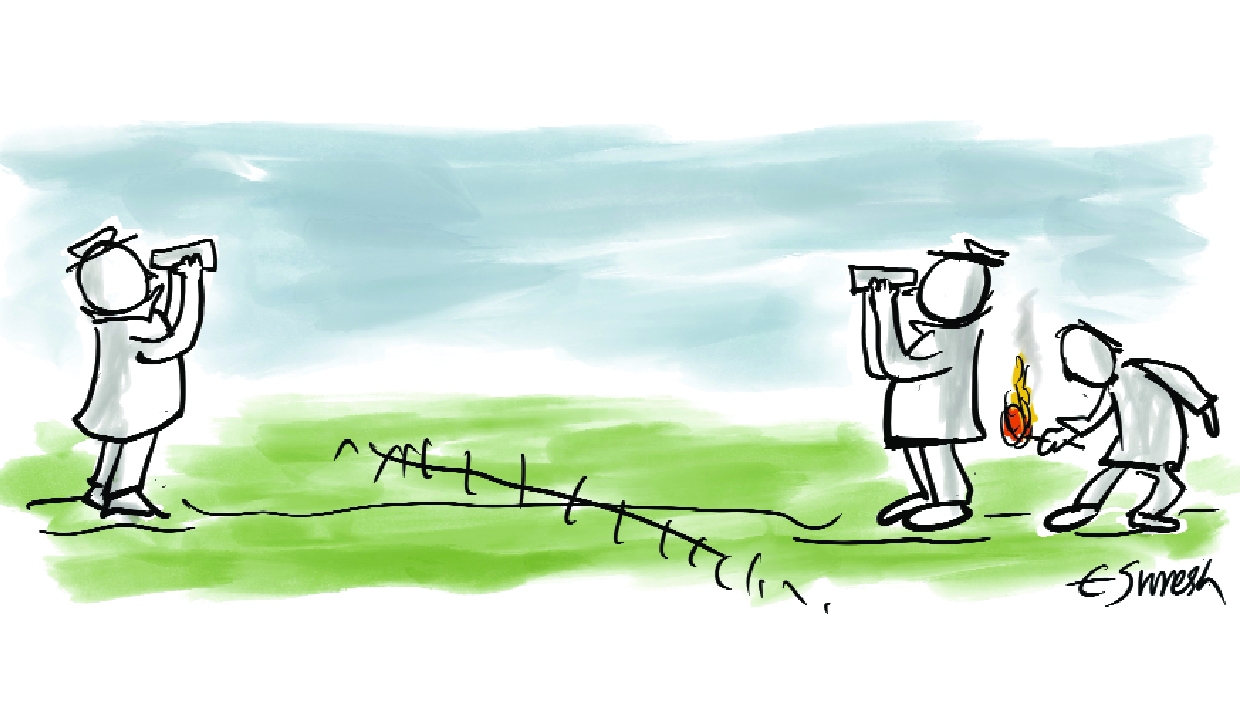
Sharing a long and porous border with Myanmar, confronting cross-border insurgency, managing refugee flows, advancing critical infrastructure projects, and countering China’s growing influence leave India with little room for diplomatic idealism
Driven by strategic pragmatism, India has had to embrace the military government of Myanmar despite the severe democratic backsliding there. New Delhi recently rolled out the red carpet for Myanmar President U Min Aung Hlaing, who seized power in 2021 through a military coup that toppled the democratically elected government of National League for Democracy (NLD) leader and State Counsellor Aung San Suu Kyi.
India, which prides itself on being the world’s largest democracy, notably refrained from hosting U Min Aung Hlaing during the first four years after the coup. However, the veneer of legitimacy the former military chief has now achieved by engineering his appointment as President through a dubious parliamentary vote helped India shrug off its hesitation.
Myanmar, after all, is of immense geostrategic importance to India, with the two countries sharing an extremely porous 1,643-km land border. A restive and unstable neighbourhood directly threatens India’s national security interests, reinforcing the pressing need for New Delhi to engage with Nay Pyi Taw at the highest level.
India was the military leader’s first port of call since becoming President in April. Myanmar’s close ally, China - which has no qualms about the military junta’s trampling of democratic norms — had already engaged with U Min Aung Hlaing on the sidelines of regional summits before he assumed the role of President. This intensifying geopolitical jostling with Beijing for influence remains a primary driver behind New Delhi’s diplomatic outreach.
Following the high-level meeting between U Min Aung Hlaing and Prime Minister Narendra Modi, New Delhi sought to frame this renewed engagement not as an endorsement of a repressive regime, but as part of its belief in “sustained dialogue” with a neighbour. As Foreign Secretary Vikram Misri noted, “History has shown that disengagement doesn’t give us any results that are better than engagement, and it certainly doesn’t produce democratic change.”
The visiting Myanmar President’s assurance, in turn, that “its territory would not be permitted to be used against India’s security interests” was certainly welcomed here. This pledge is critical for two reasons. One, armed insurgents from India’s Northeast have long used Myanmar’s soil as a safe haven from which to launch operations in Mizoram, Manipur, Nagaland and Arunachal Pradesh.
Two, the ongoing civil war in Myanmar and the consequent regional instability directly threaten Indian interests. There has already been a huge exodus of refugees into Manipur and Mizoram, forcing India to scrap the long-standing Free Movement Regime (FMR) with Myanmar and step up border fencing. Additionally, the spillover of Rohingya refugees from Myanmar’s restive Rakhine State into neighbouring Bangladesh, as well as India, is also a major concern.
Like India, Myanmar faces its own domestic security challenges from various armed rebel factions. Reflecting these shared anxieties, the India-Myanmar joint statement extended Indian support for Myanmar’s “sovereignty and territorial integrity”, while both sides also condemned the “misuse of sovereign territory for activities inimical to their security interests”.
India’s strategic imperatives in Myanmar also include a vital connectivity dimension. New Delhi has undertaken two ambitious infrastructure projects in the country: the Kaladan Multi-Modal Transit Transport Project and the India-Myanmar-Thailand Trilateral Highway. Both initiatives have suffered massive delays and remain in limbo due to Myanmar’s precarious security situation.
The Indian delegation raised the issue during the presidential visit, stressing that these projects remain a “major priority” for India. While U Min Aung Hlaing assured New Delhi that his administration would do everything possible to ensure their completion, achieving this is easier said than done against the backdrop of an active civil war. For now, India can only exercise patience and hope that local conditions improve enough for construction to resume.
In its quest for alternative routes to bypass the narrow and vulnerable Siliguri Corridor - which could become a chokepoint in a conflict with China - India has heavily invested in the Kaladan project to connect with its landlocked Northeast. Crucially, India has already developed the strategically located Sittwe Port in Myanmar, which will allow goods to be shipped from mainland India by sea and then moved to the Northeast via river and road corridors up to Mizoram. Overlooking the Bay of Bengal, the port is an integral piece of India’s strategic calculus - especially since China has developed its own gateway to the bay, the Kyaukphyu deep-sea port.
Equally critical is the trilateral highway project, which can be a game-changer in terms of trade and connectivity. This highway will provide India with direct road connectivity to ASEAN nations, reducing its historical reliance on maritime links and boosting regional trade. In effect, it anchors India’s efforts to forge deeper ties with Southeast Asia in line with its “Act East” policy. Myanmar, incidentally, is the only ASEAN member that shares a land border with India, making it an indispensable bridge to the regional bloc.
With Myanmar “sitting at the confluence of India’s Neighbourhood First, Act East, and MAHASAGAR policies”, as Foreign Secretary Misri described it, New Delhi remains hopeful that its latest overtures to Nay Pyi Taw will successfully protect its long-term strategic interests.
India’s calculated embrace of Myanmar’s military regime is governed by hard-nosed realpolitik. Bound by a volatile border, escalating security threats, and a high-stakes geopolitical rivalry with China, New Delhi simply cannot afford the luxury of isolation.
A restive and unstable neighbourhood directly threatens India’s national security interests, reinforcing the pressing need for New Delhi to engage with Nay Pyi Taw at the highest level
The writer is senior journalist and writes on strategic affairs; Views presented are personal.