Ram temple: India’s civilisational awakening
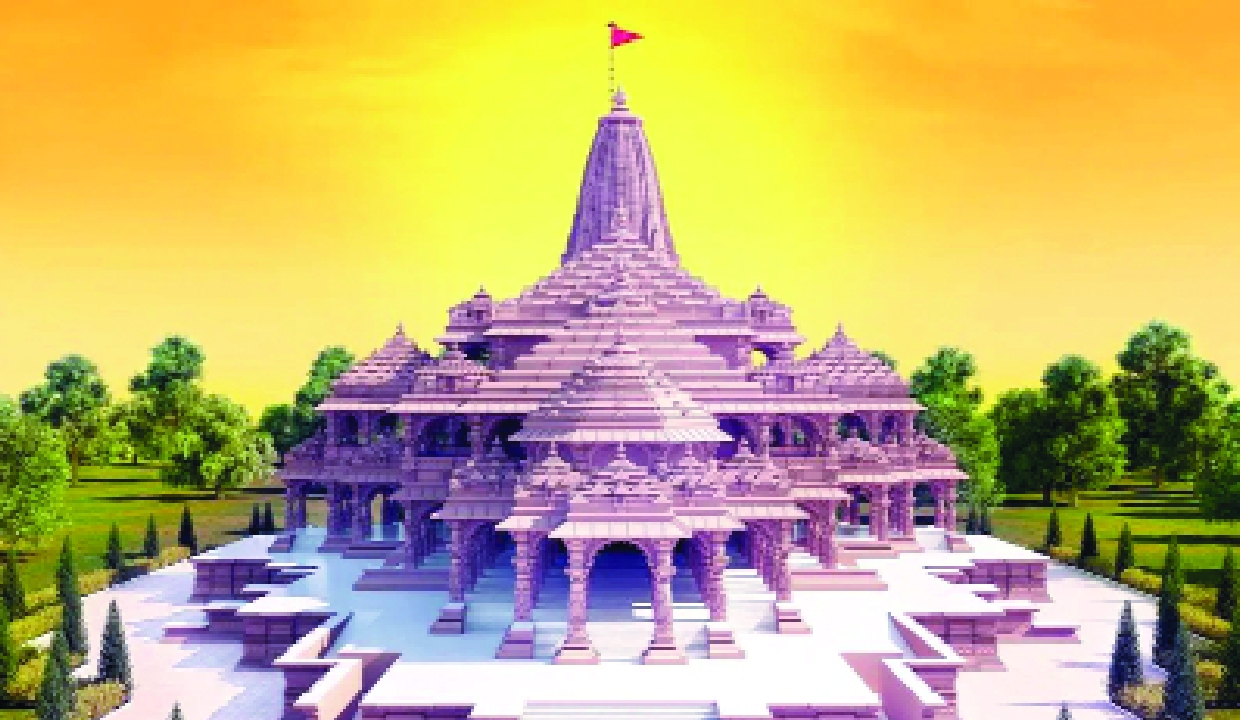
Indian civilisation, particularly Hinduism — better known culturally as Sanatan Dharma — thrived for thousands of years under the rule of Muslim invaders and the British. In spite of subjugation and tyranny, Indians did not convert en masse as happened in other civilizations of Asia, Africa and Latin America. The Indian psyche was deeply hurt when Babur, in 1528, demolished the temple at the birthplace of Lord Ram in Ayodhya, but the seething anger lingered for centuries as devotees continued to offer prayers at a raised mud platform known as the ‘Ram Chabutara’ within the precinct.
In November 1858, a group of 25 Nihang Sikhs, led by Baba Fakir Singh Khalsa, entered the complex and built a clay platform (Chabutara) inside the premises, placed a picture or symbol of Lord Ram and wrote “Ram Ram” in charcoal on the walls. They performed a Vedic havan and left. An FIR was later registered against them on November 30, 1858, by the mosque muezzin. This action by the Nihangs is a crucial document proving that Hindus had been worshipping here for a long time. Then again, in the night of December 22-23, 1949, a group led by Mahant Abhiram Das entered the locked Babri mosque and placed a nine-inch metal idol of Ram Lala beneath the central dome.
A large gathering of thousands thronged the site, and to prevent communal escalation, the administration locked the outer gates but allowed a Hindu priest inside to perform limited daily puja and bhoj offerings to the idol. The then Prime Minister Nehru directed that the idol be removed, but the District Magistrate KK Nayar took a pragmatic decision to avoid communal tension by sealing the main building and allowing a lone priest to perform basic puja only; this continued until February 1986, when the locks were opened under a court order officially granting Hindus access to the inner section for worship. The rest is history until January 22, 2024, when Prime Minister Narendra Modi inaugurated the majestic temple constructed after the November 9, 2019, Supreme Court verdict.
Why write this article now, when the Ram Temple is in the news for the wrong reasons? The immediate cause is the public uproar regarding theft of donations and an alleged financial scam in which staff responsible for its safekeeping were siphoning off crores. Some quick action has been taken and things are on the right path, but baying for the blood of the people at the helm who trusted these thieves — due to lack of administrative acumen — and smearing the entire temple management is undesirable and suggests ulterior motives. Such things can happen in any religious institution.
For example, a massive Vatican financial scandal involving Cardinal Becciu began in 2019; he was stripped of his rights as a cardinal and, after trial, was convicted in December 2020. Similarly, the Caritas Luxembourg 61.2 million bank and donation fraud case began in 2014 and continued until 2026. In October 2024, former congregants filed a major financial fraud lawsuit against Gateway Church of Texas. These accusations were often directed at top management, whereas the Ram temple case appears to involve petty thieves and not the trustees. It is therefore highly undesirable to accuse senior management without evidence.
Likewise, in Islam, the misuse and diversion of zakat — which is analogous to donations - has been a persistent issue. Investigations into the Bashir regime in Sudan revealed that funds intended for the poor were routinely diverted to entities linked to the regime. Similar inquiries have been reported against various charities in the Middle East. These incidents, including Ayodhya, underscore the global challenge of maintaining transparency and the need for continuous oversight over massive flows of donations and gifts, and they call for strict internal audit and modern accounting and management procedures.
It seems many people want to take advantage of this event politically, particularly those who opposed the Ram temple’s construction and who pander to vote-bank appeasement politics. In reality, portraying the issue as an attack on the Hindu religion — ostensibly at the behest of “woke” Western elites with double standards — misreads the situation. The global progressive movement vocally supports land-back movements, the return of sacred sites to Native Americans, and the decolonisation of African and Australian spaces. Yet when the same logic of decolonisation and the restoration of sacred indigenous geography was applied to Ayodhya — backed by an exhaustive, multi-decade legal process and conclusive archaeological evidence from the Archaeological Survey of India (ASI) - it was branded regressive by some of their Indian cohorts.
Thus, in global media, academic circles and certain domestic intellectual hubs, the event leading to the Ram temple’s construction was frequently framed not as a moment of cultural healing but through the modern lens of hyper-nationalism and as an instance of majoritarianism. This globalised “woke” framework inherently struggles to accommodate non-Western civilisational icons. The Anglo-American woke club views the world from an exclusive Western template. Christianity and whiteness are historically associated with institutional power and colonial expansion. But when it comes to India, any attempt to promote cultural renaissance is instantly mapped to Western imperialism, dismissively ignoring Hinduism’s history as a victim of brutal, multi-century colonial and imperial onslaughts, and viewing the assertiveness of Hinduism with suspicion.
Therefore, when Hindus pointed to archaeological and historical evidence of a temple being demolished to build a mosque, the narrative was systematically suppressed or downplayed by Marxist and progressive historians for decades. Lord Ram is not only a deity but an icon of righteousness and the soul of the foundations of Indian civilisation’s core elements of governance. Unlike many ancient pagan or indigenous civilisations that were entirely erased by global colonial movements, India’s indigenous civilisation survived. The reclamation of Ayodhya is a manifestation of that survival.
For global critical theorists, an indigenous majority asserting its historic rights and building a monument to its survival disrupts the standard post-colonial narrative, which often prefers indigenous cultures to remain permanently oppressed. Thus, the controversy surrounding the Ram Mandir is a clash between a globalised intellectual elite and an assertive India. The “woke” view sees the Ram Mandir as a fracture in secularism, whereas the vast majority of India views it as the healing of a historical wound. India is asserting its right to define its own modernity, its own secularism, and its own path towards justice.
The writer is a former IFS officer and Chairman of the Centre for Resource Management and Environment; Views presented are personal.