PM Modi inaugurates two metro corridors in national Capital
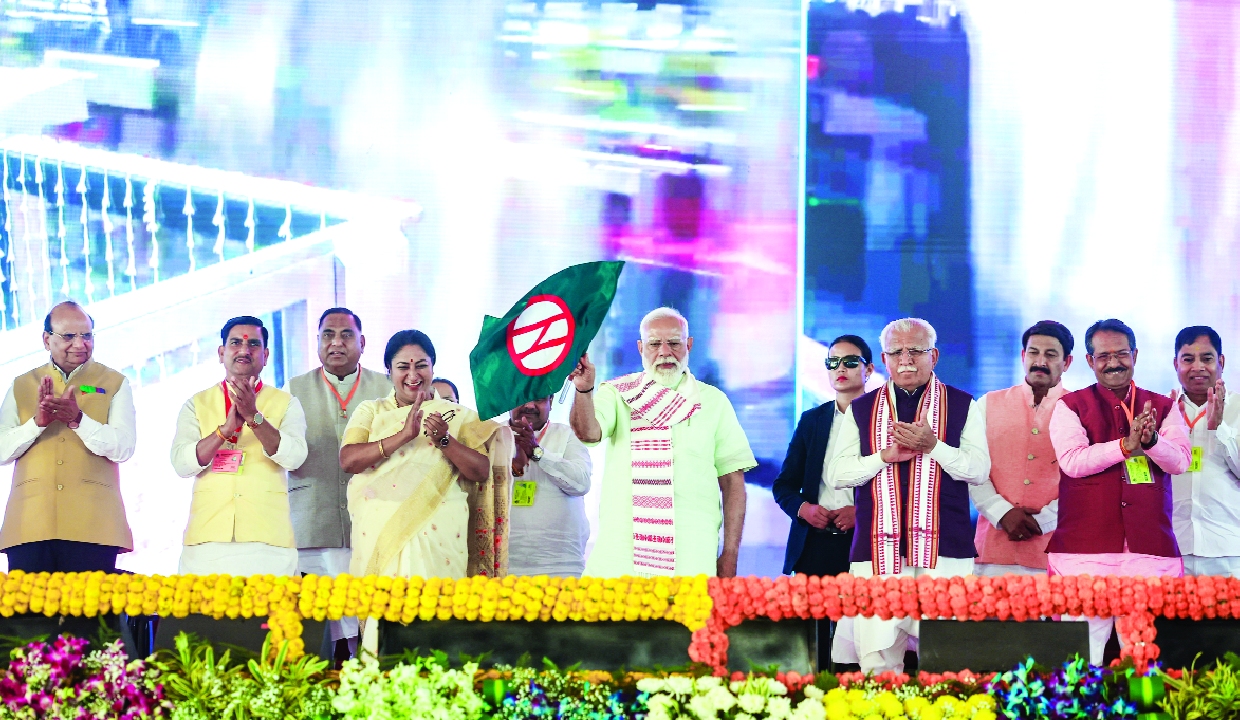
Prime Minister Narendra Modi on Sunday inaugurated two new Delhi Metro corridors, including the country’s first “Ring Metro” and laid the foundation stone for three more metro lines, providing direct connectivity to several important locations in the national Capital.
The two new Delhi Metro corridors inaugurated by the prime minister were the Majlis Park-Maujpur Babarpur (Pink Line) corridor of around 12.3 km and the Deepali Chowk-Majlis Park (Magenta Line) corridor of around 9.9 km. He also inaugurated and laid the foundation stone of projects worth Rs 15,200 crore under the central Government’s General Pool Residential Accommodation (GPRA) redevelopment plan. The total cost of all projects is around Rs 33,500 crore.
Addressing a gathering at Burari ground after inaugurating and launching projects worth Rs 33,500 crore, including two new Metro corridors, Modi said the pace of all-round development in Delhi has accelerated since the BJP Government was formed a year ago and alleged that under AAP’s rule, works were stalled due to excuses and projects “died in files”. He said Delhi is not only the Capital of the country, but is also the identity of India and a symbol of its energy. He said that there was a time when Delhi was often criticised for its inefficient transportation system.
“Today, we have all gathered here to give a new momentum to the development of Delhi,” Modi highlighted. Modi said that there was a time when Delhi was often criticised for its inefficient transportation system. “Commuting from one part of the city to another would take hours, and women frequently had to wait at bus stops for long periods, hoping to catch a bus or auto-rickshaw. However, the situation in Delhi is rapidly changing,” he said.
These corridors will benefit several areas of Delhi, including Burari, Jagatpur-Wazirabad, Khajuri Khas, Bhajanpura, Yamuna Vihar, Madhuban Chowk, Haiderpur Badli Mor, Bhalaswa and Majlis Park.
Modi laid the foundation stone for three new corridors under Phase V-A of the Delhi Metro, covering a route length of around 16.1 km.
The three new corridors are RK Ashram Marg to Indraprastha, Aerocity to Indira Gandhi Airport Terminal-1 and Tughlakabad to Kalindi Kunj. These corridors will provide direct connectivity to several important locations in the Capital and improve connectivity for those travelling between Noida, South Delhi and the airport.
Emphasising that Delhi is the global identity and energy symbol of Indian democracy, the Prime Minister noted that modernising the Capital’s infrastructure and connectivity, such as the Namo Bharat train and the historic expansion of the Metro network to 375 kilometers, is essential for showcasing India’s confidence to the world.
“The more modern, convenient, and better-connected Delhi becomes, the more strongly India’s self-confidence will be visible to the world,” Modi remarked.
The Prime Minister emphasised that under the double-engine governance model, every transport facility in the national Capital is being systematically upgraded to ensure clean, comfortable, and modern travel for the lakhs of citizens who rely on bus services daily.
“While over four thousand electric buses provided by the Centre are already operational, an additional 1,800 new buses have been deployed in the last year alone, including hundreds of ‘Devi Buses’ designed to enhance last-mile connectivity across Delhi’s colonies and neighborhoods”, Modi remarked.
The Prime Minister stated that the Government is currently working in mission mode to address the diverse challenges facing the national Capital, specifically highlighting how the Peripheral Expressway has successfully diverted lakhs of vehicles that previously had to enter the city. “A massive initiative for the rejuvenation of the Yamuna River has been launched, with work already underway on projects worth crores of rupees to ensure its cleanliness,” highlighted Modi.
Modi slammed the previous AAP dispensation, saying the “AAPda (disaster) Government” halted all development work in Delhi for 10 years. “Their way was to do less work and make more excuses. Today, Delhi has a model of development — excuses have stopped and work has begun.
“Earlier, projects used to die in files and today, projects are being implemented on the ground.” Now, our government is operating in mission mode to address the challenges facing Delhi,” he said.
The prime minister inaugurated and laid the foundation stone of projects worth Rs 15,200 crore under the General Pool Residential Accommodation (GPRA) redevelopment plan.
PM Modi, accompanied by Union Housing and Urban Affairs Minister Manohar Lal Khattar, visited GPRA Type-5 quarters in Sarojini Nagar and handed over the keys to female allottees. He also interacted with some women labourers.
He inaugurated the 12.3-km Majlis Park-Maujpur-Babarpur corridor of the Pink Line and the 9.9-km Deepali Chowk-Majlis Park corridor of the Magenta Line.
The Majlis Park-Maujpur-Babarpur stretch will benefit areas such as Burari, Jagatpur-Wazirabad, Khajuri Khas, Bhajanpura and Yamuna Vihar, strengthening connectivity in north and east Delhi.
The Deepali Chowk-Majlis Park section is an elevated extension of the Magenta Line and will connect areas including Madhuban Chowk, Uttar Pitampura-Prashant Vihar, Haid Badli Mor and Bhalaswa.
With the addition of these stretches, the Pink Line and Magenta Line networks will expand further, improving last-mile connectivity and easing travel for daily commuters across the Capital, according to the statement.
PM Modi also laid the foundation stone for three new Delhi Metro corridors under Phase V-A of the expansion plan, covering a total route length of around 16.1 km.
These include the Ramakrishna Ashram Marg-Indraprastha corridor, the Aerocity-Indira Gandhi International Airport Terminal-1 corridor and the Tughlakabad-Kalindi Kunj corridor, which are expected to improve connectivity between central Delhi, south Delhi, Noida and the airport.
Reflecting on his visit to Sarojini Nagar prior to the event, the Prime Minister highlighted the inauguration of modern residential complexes specifically designed for Government employees.
PM Modi emphasised, “Those who work tirelessly to fulfill the nation’s resolutions deserve safe, clean, and convenient living conditions, which is the driving force behind these new infrastructure projects.” With thousands of flats handed over to beneficiaries today, Modi expressed his firm belief that these modern homes would usher in a new era of happiness and aspiration for the nation’s “Karmayogis.”
Concluding his address, the Prime Minister described Delhi as a historic city that is currently witnessing a transformative era defined by the self-confidence of a “New India,” which will serve as the foundation for a developed future.