No new knees, just bhangra: Punjab’s I-Day health showcase goes awry
Punjab’s health revolution came with all the right ingredients on Independence Day — a Chief Minister, a parade, Government banners, elderly men breaking into bhangra (traditional folk dance of Punjab), and a song celebrating dancing old men. There was only one problem with the script — the men performing the supposed post-knee-replacement dance were not actual knee-replacement patients. At least, one openly said he had never undergone the surgery, while the State health department later clarified that no actual knee-implant beneficiary was part of the performance.
What was meant to be a triumphant showcase of the Mukhya Mantri Sehat Bima Yojna has turned into a political spectacle where the choreography seems to have been more convincing than the achievement being advertised. The scheme provides eligible beneficiaries treatment of up to `10 lakh.
The setting was the State-level Independence Day function in Ferozepur, where CM Bhagwant Mann unfurled the Tricolour on Saturday and watched the various departments take part in the march-past. Among the displays was the State Health Department’s section, carrying banners and messages about the Government’s healthcare initiatives.
Then came the bhangra.
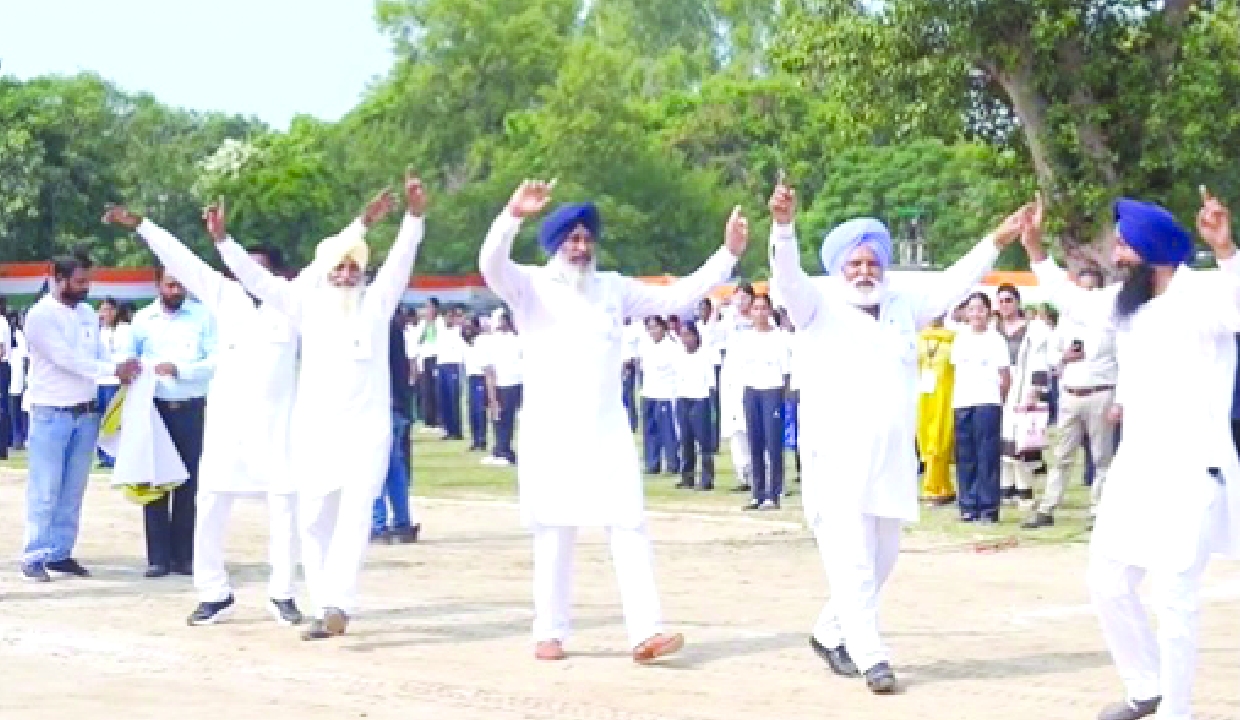
A group of five elderly men was made to dance as part of a presentation meant to convey that senior citizens, after successful knee-replacement treatment under the Government’s health insurance scheme, had got back on their feet — and were now fit enough to dance.
The visual was cheerful, colourful, and tailor-made for the cameras. The elderly dancers performed to the Gurdas Maan’s iconic number Beh ke dekh jawana, babe bhangra paunde ne (loosely translated as ‘sit back and watch, young man; the old men are doing bhangra.
As the group of elderly men danced past the main stage, the announcer told the gathering that they were beneficiaries of the sehat bima yojna whose successful knee-replacement surgeries had restored them to such good health that they could now dance.
The performance may have been intended to say that Punjab’s elderly could now dance because the Government had given them new knees. Instead, the story took a turn when one of the dancers and a retired State health department driver (name not disclosed) said that he had never undergone knee-replacement surgery.
He said he had been called by the health department mass media officer and asked to participate in the August 15 programme and perform bhangra. He said all five participants were connected to the department and that another elderly participant from Zira was also a retired driver. Importantly, he said he could speak only for himself and did not know about the medical history of the others.
The health department’s subsequent explanation was even more revealing. A senior health official, who did not wish to be named, told The Pioneer that the knee-replacement segment was a symbolic presentation, and no actual knee-replacement patient had participated.
And that is where the Government’s carefully choreographed health revolution ran into the Opposition’s very different choreography.
Punjab Congress president Amarinder Singh Raja Warring accused the Mann Government of turning Independence Day into a publicity stunt. Calling elderly people the State’s pride rather than props for political publicity, he demanded an apology from Mann, resignation of Punjab health minister, Dr Balbir Singh and action against officials responsible for the presentation.
Warring said the Government had staged a spectacle in the name of its “health revolution”, while Punjab’s hospitals needed doctors, medicines and genuine treatment rather than publicity and photo-ops. He also attacked what he described as the Government’s penchant for “lies, drama and theatrics”.
Congress MLA Pargat Singh alleged that the elderly men shown dancing were health department employees, not beneficiaries of knee-replacement treatment, and accused the Government of using senior citizens for political publicity.
SAD leader Bikram Singh Majithia too condemned the performance, calling it a drama. He questioned the wisdom of showcasing symbolic beneficiaries when, according to him, Punjab’s Government hospitals continue to need basic facilities, doctors and medicines.
The Government can argue that it was merely a symbolic representation. But politically, symbolism has its limits — particularly when the image being sold is that of elderly beneficiaries celebrating the success of a medical procedure that, by the department’s own account, none of the performers had actually undergone.
Thus, Punjab’s health revolution entered the Independence Day parade carrying banners of healthcare, marched before the Chief Minister and ended in a spirited bhangra. The only thing that did not quite make it into the parade was an actual knee-replacement patient.
But the bhangra That was very real.