New disease found: Judiciary must be shielded from political attacks
The judiciary should be protected from personal attacks and from colouring judges with wrong intentions. In a constitutional democracy, the courts stand as the final sentinel on the qui vive, always alert to protect rights. Judiciary should be free from unwanted colourings, because the faith of the judges should never be allowed to faint. Once that faith weakens, the entire edifice of constitutional governance starts to crumble.
If such colouring is allowed, if every judicial order is casually attributed to political or ideological bias, the trust over the judiciary will fall. Recent public discourse has shown how quickly narratives spread, especially when amplified by party machinery or social media ecosystems.
What then remains for a citizen? A citizen obeys court orders because he believes the judge is neutral. When neutrality is doubted, the rule of law becomes a rule of convenience.
In the Thirupparangunram issue, for protecting the religious rights of Hindus conferred by the Indian Constitution, Justice GR Swaminathan passed an order. Around the same time, across India, debates on temple rights, minority rights, and Article 25 freedoms have become flashpoints, showing how sensitive such matters are. Whether one agrees or disagrees with the reasoning, the constitutional remedy is appeal, not slander.
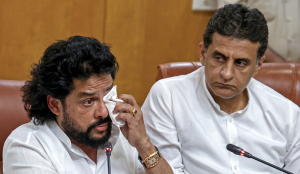
Yet a DMK MP, TR Baalu, stood in Parliament and declared that they “got an order from an RSS judge”. A senior parliamentarian forgetting that the conduct of judges in their official duties generally cannot be discussed in Parliament or State Legislatures, as per Article 121 of the Constitution, undermines the very safeguard created to ensure judicial independence.
The act of TR Baalu demands action for breach of parliamentary privilege or contempt of the House. In legal tradition, this is scandalising the court, an established category of contempt recognised since the Privy Council’s 1899 decision in McLeod v St Aubyn, reiterated in Indian jurisprudence from Brahma Prakash Sharma (1953) to Arundhati Roy (2002).
Even more disturbing is that the High Court Registrar has not taken cognisance of this grave breach. Is this allowed? By remaining passive, the institution risks letting a dangerous precedent take root.
If this passes without action, every judge becomes vulnerable. Anyone unhappy with a judicial order will simply pour colour, attach a political label, and escape accountability. A state Government may claim political rhetoric as free speech, but freedom of speech ends where intimidation of the judiciary begins.
When a citizen sees a Member of Parliament openly attacking a judge in this manner, and the institution not responding, what confidence will he have to follow a court order? This silence sends the wrong signal, that judicial orders can be selectively obeyed. The message becomes dangerous: “Obey if it suits you; defy if it doesn’t.” That is the death of constitutional morality.
This attitude resurfaces when a Commissioner of Police is shown declaring publicly, “We are not following the order; we will face the consequences”, and this defiance is projected as heroism of the Chief Minister.
In legal language, this is nothing but executive overreach dressed as bravery. Across India, debates on police non-compliance, from Delhi to Tamil Nadu, have raised the same concern: politicians celebrating disobedience erodes public discipline. In the concept of the rule of law, heroism lies in obedience to the Constitution, not rebellion against it. The police commissioner says he has no fear of consequences, it is the duty of the court to ensure that disobedience of a court order will ensue in consequences not only for a layman, but also for a police commissioner. That “ensure” is a real equality.
Due to the disease that an “accepted vengeance towards Hinduism” in the common mind of India, the Thirupparangunram incident has been allowed to pass as if it were normal. That silence has given birth to a new disease, attacking the judiciary as the new normal. Attacking Hindus is old normal; attacking the courts is becoming the new normal. If the judiciary is targeted, constitutional morality is weakened at its root. If this continues, the greatest casualty will not be a judge or a political party but the very idea of justice.
A democracy must protect its judges from personal attacks, ideological branding, and institutional silence. The courts have always been described as temples of justice; their sanctity cannot be compromised by political mudslinging. Otherwise, the people will lose their last refuge, an impartial courtroom. And when that refuge collapses, nothing remains to protect the citizen.
The author is Tamil Nadu BJP State secretary; Founder, Project Tamil AI and Integral Humanism Foundation.