NEET Bill: Tougher law, bigger stakes
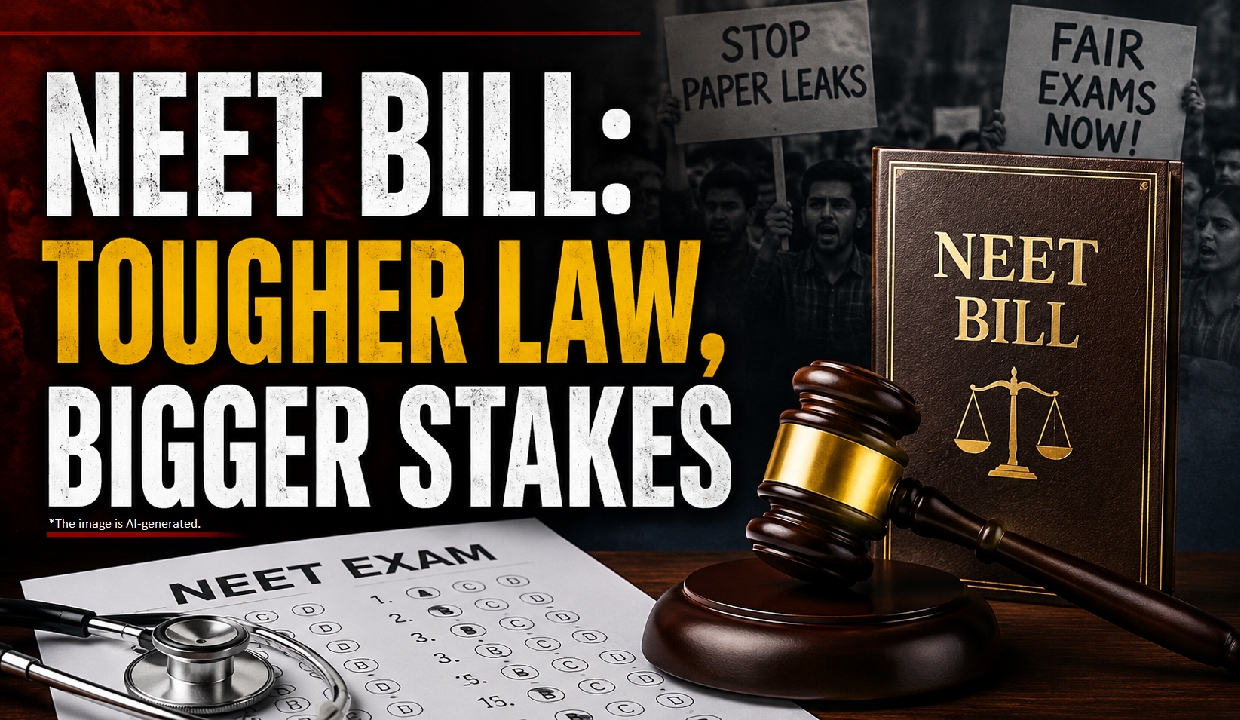
The LS has passed a Bill to curb exam paper leaks. The real test will be whether the new law plugs the loopholes that allow leaks to occur in the first place
The Lok Sabha’s passage of the Public Examinations (Prevention of Unfair Means) Amendment Bill, 2026, marks a necessary tightening of India’s response to the menace of examination paper leaks. Introduced by Union Minister Jitendra Singh on July 27 and passed by voice vote on July 29 amid Opposition protests, the legislation raises the stakes considerably for those who compromise the integrity of public examinations.
Under the amendments, individuals involved in unfair means can face five to ten years in prison and a fine of up to Rs 50 lakh. For organised examination fraud, the minimum imprisonment rises to seven years and the minimum fine to Rs 10 crore. Service providers can face higher penalties and an eight-year debarment. The Bill also provides for special fast-track courts, the completion of investigations within two months, and trials within three months of the filing of a chargesheet.
There is little doubt that such provisions are welcome. Paper leaks are not minor administrative lapses. They destroy the credibility of examinations, waste years of students’ lives and reward dishonesty at the expense of merit. A strong deterrent is therefore essential. Speedy prosecution is equally important because a law that takes years to secure convictions can hardly deter an organised racket.
Yet, the Opposition has a point that deserves serious consideration: a tougher law does not automatically create a leak-proof examination system. Congress Deputy Leader Gaurav Gogoi pointed out that leaks continued despite the 2024 law and questioned the effectiveness of the existing institutional framework. Other Opposition members argued that the Bill concentrates on punishment while failing to address wider systemic weaknesses and accountability.
The Opposition’s objections, therefore, should not be reduced to opposition for opposition’s sake. Nor should the government dismiss every criticism as political obstruction. The real question is whether prevention has received as much attention as punishment. The government itself has acknowledged the need for broader reform by setting up a high-powered panel on examination reforms. An earlier expert committee made 101 recommendations, including greater use of computer-based testing and multiple shifts, but several important measures have yet to be fully implemented.
The way forward must therefore be comprehensive. Every stage of the examination chain-from paper setting and printing to encryption, transportation, storage, distribution and digital access-must be independently audited. Service providers need stringent background checks, financial scrutiny and real-time security monitoring. Technology must be used not merely after a leak but to make leaks substantially harder in the first place. The NTA and other examination bodies must also have clearly defined accountability, with responsibility fixed at the appropriate level when serious failures occur. The new law can be a strong deterrent, but it cannot, by itself, restore public faith. India needs a tougher, smarter and more accountable examination system.