Ladakh deadlock ends as Centre agrees to elected body
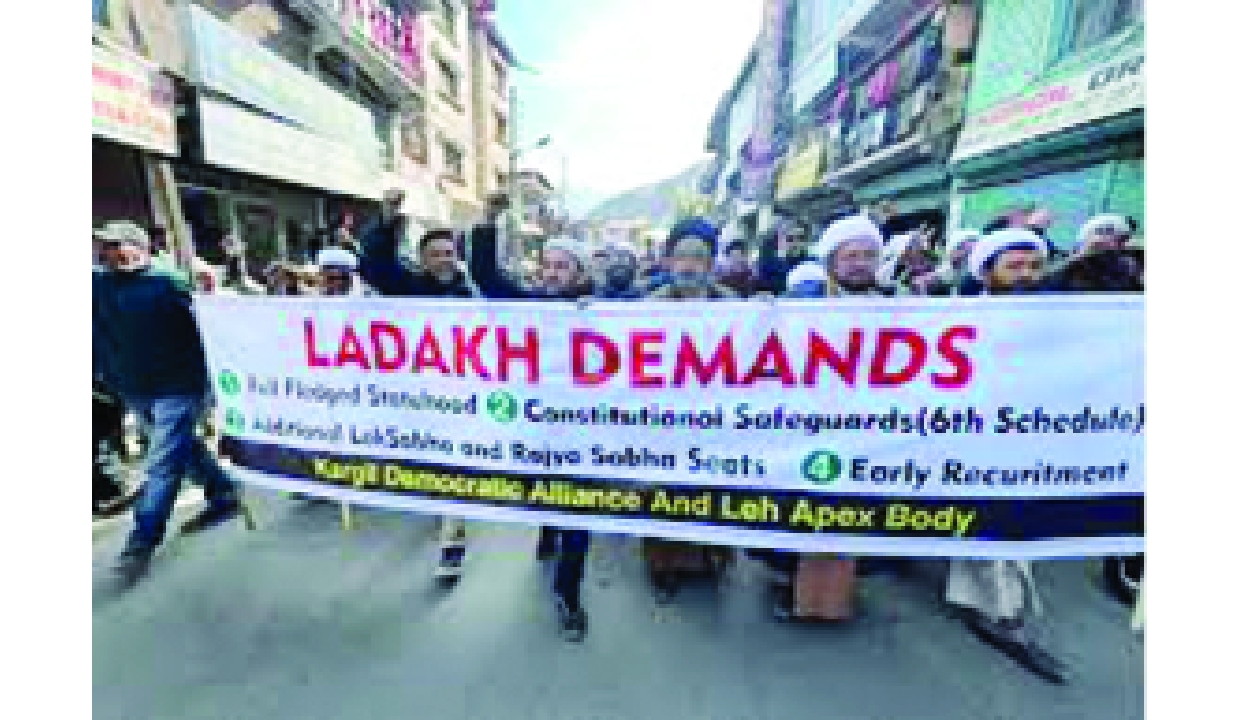
Ending the political deadlock in the cold desert region of Ladakh, the Ministry of Home Affairs (MHA) has finally arrived at an in-principle understanding with representatives of the Leh Apex Body (LAB) and Kargil Democratic Alliance (KDA) to establish a Union Territory-level legislative body with substantial legislative, executive, and financial powers.
With this, the joint leadership, spearheading a campaign to achieve statehood status for the Union Territory of Ladakh, has come one step closer to realising their dream, leaving behind squabbling leadership in Jammu and Kashmir.
The ice was broken late Friday evening when both sides resumed talks in a cordial atmosphere after a gap of three long months in the Union Capital.
The Sub-Committee meeting convened by the Ministry of Home Affairs was attended by senior officers of MHA and UT administration of Ladakh; Thupstan Chhewang, Haji Hanifa Jan, MP, Dr Mohd Jaffer Akhoon, chairman-cum-CEC of Ladakh Hill Council, Tashi Gyalson, BJP leader and former CEC Leh Council; Chering Dorjay Lakrook, climate activist Sonam Wangchuk and Dorjey Stanzin; all from LAB; Asgar Ali Karbalai, Sajjad Kargili and Ghulam Rasool Nagvi from KDA.
During the meeting, deliberations focused on the future administrative and political framework of Ladakh.
The representatives of Leh Apex Body (LAB) and Kargil Democratic Alliance (KDA) reiterated the longstanding aspirations of the people of Ladakh regarding the restoration of democracy, constitutional safeguards and the demand for statehood and sixth schedule protections, reflecting the shared commitment of all stakeholders towards an inclusive and sustainable governance framework for the region.
A statement issued after the meeting by Chering Dorjay Lakrook and Asgar Ali Karbalai, co-chairpersons of LAB and KDA, respectively, said that following detailed and constructive deliberations, both sides have arrived at an in-principle understanding on several critical points.
“In this model, the legislative, executive and financial powers will rest with elected representatives through a Union Territory-level legislative body. All bureaucrats of the UT, including the Chief Secretary, will come under the executive head of the UT-level elected body (proposed to be the Chief Minister)”, the joint statement said.
“The LAB and KDA have reached an in-principle understanding with the Government of India on restoring democracy in Ladakh and providing Constitutional safeguards on the lines of Article 371 A, F, and G (as applied to Nagaland, Sikkim and Mizoram)”, the joint statement said adding the KDA and LAB look forward to closely working out the finer operational details with the MHA in consultations with legal and Constitutional experts.
The LAB and KDA joint statement said the MHA authorities explained that the only reason why Ladakh cannot be made a state at the moment is that it currently lacks adequate revenue generation to meet the revenue expenditures, like salaries of employees.
However, it added, this setup will lead Ladakh towards full Statehood as and when it meets the revenue criteria.
In the coming weeks, the MHA is expected to prepare a draft for the UT level legislative body with suggestions from LAB and KDA before its implementation. So far, the MHA hasn’t given any timeline for implementation of the proposals. However, the Ministry officials assured that it will be done as early as possible.
After the meeting ended, former Ladakh MP Thupstan Chhewang said, “The meeting was highly anticipated, and discussions covered Ladakh’s long-standing issues. For five to six years, dialogue with the Home Ministry had brought partial consensus and implementation at the ground level, but the key demands — statehood and UT with legislature, along with constitutional safeguards — had remained unresolved. Today, however, a historic consensus was reached.”
It was agreed that due to financial non-viability, Ladakh cannot at present be granted statehood or UT with a legislature. Yet, a customised political system will be implemented, giving elected bodies powers similar to those of a Chief Minister and ministers, including law-making authority...”
BJP leader and former Chairman-cum-CEC of Leh Autonomous Hill Council, Tashi Gyalson, who also attended the meeting, said that in addition to the UT-level legislative body, there will also be seven district councils in Ladakh.
Strongly hailing the decision, Tashi said that what type of UT-level legislative body will be, including its name, mode of elections, and other issues, will be decided through meetings between all stakeholders.