Japan, South Korea discuss economy and regional challenges at summit
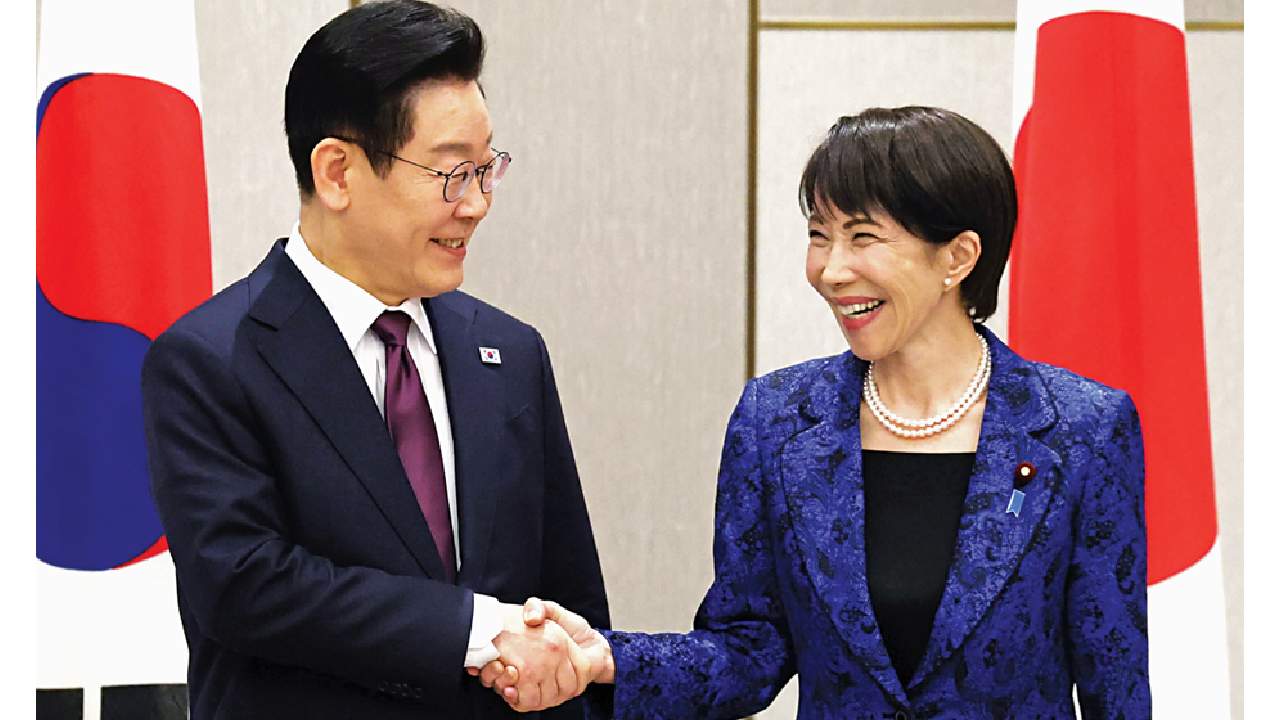
South Korean President Lee Jae Myung and Japanese Prime Minister Sanae Takaichi agreed to step up cooperation between the neighbours, whose relations are occasionally strained, as they both face growing uncertainty and regional challenges.
“I believe cooperation between Korea and Japan is now more important than ever and anything else, as we have to continue moving forward to a new, better future amid this complex, unstable international order,” Lee said at the outset of the summit on Tuesday.
Takaichi said she renewed her determination to further improve Japan’s relations with South Korea “as I believe the two countries should cooperate and contribute to the stability in the region.” “This year I will elevate Japan-South Korea relations even higher,” said Takaichi, who aims to secure stable ties with Seoul while Tokyo struggles with a worsening dispute with China.
The meeting could deliver a political win as Takaichi seeks to shore up her power. A few months after taking office, she enjoys strong approval ratings, but her party has a majority in only one of two houses of Parliament. There is growing speculation that she may be planning a snap election in hopes of gaining more seats. Takaichi is hosting Lee in her hometown, Nara, an ancient capital known for its treasured deer and centuries-old Buddhist temples, following a request by Lee during the October APEC meeting in Gyeongju, South Korea.
Nara, the centre of cultural exchanges between the Korean Peninsula and Japan in ancient times, “carries a special meaning at a time Korea-Japan exchanges are more important than ever,” Lee said. Takaichi will take Lee on a tour of Horyu Temple, which includes buildings from the late 7th or early 8th century. They are among the world’s oldest surviving wooden structures and illustrate Japan’s adoption of Buddhism via the Korean Peninsula. Lee will meet with South Korean residents in Japan before returning home in the afternoon.
Japan’s cultural, religious and political ties to the Korean Peninsula are ancient, but in modern times, its relationship has been repeatedly disrupted by disputes stemming from Japan’s brutal colonial rule of Korea from 1910 to 1945. Takaichi was in Nara on Monday to prepare and posted on X: “I hope to further push forward Japan’s relations with South Korea in a forward-looking way as we meet in the ancient capital of Nara with more than 1,300 years of history and longstanding cultural exchanges between Japan and the Korean Peninsula.”
The Japanese prime minister faces intensifying trade and political tension with China over a remark about Taiwan that angered Beijing days after she took office. Takaichi said that potential Chinese military action against Taiwan, the island democracy Beijing claims as its own, could justify Japanese intervention. Tuesday’s meeting was intended to focus on trade and the challenges of China and North Korea, as well as efforts to deepen trust between the two countries.
Japan and South Korea, both key US allies, must also figure out how to deal with President Donald Trump’s unpredictable diplomacy, and both countries are under US pressure to increase defence spending. Lee was in Beijing last week for talks with Chinese leader Xi Jinping as China steps up economic and political pressure against Japan and seeks to cosy up to Seoul.
During the visit, the South Korean leader told reporters that relations with Japan are as important as those with China but that South Korea’s ability to broker reconciliation between its neighbours is limited. Japan’s PM Sanae Takaichi, right, shakes hands with South Kore’s President Lee Jae Myung in Nara ap.